CA Inter Costing Classes with Chapter Tests & Evaluation
CA Himanshu Singla teaches CA Intermediate Cost & Management Accounting and is a practicing chartered accountant. His teaching focuses on conceptual clarity and ICAI-oriented answer writing.

Important Points:
Clear explanations supported by real-world examples
Concentrate on solving numerical problems.
Revision materials, question banks, and notes
Tests, homework, and assistance with revision
Resolving doubts and mentoring students
It is not enough to simply attend lectures to prepare for CA Intermediate Paper 4: Cost & Management Accounting. An effective strategy is
(a) Learn the basic concepts
(b) Solve practical problems
(c) Take chapter-wise tests
(d) Practice written answers
(e) Identify and correct mistakes
(f) Review performance and improve
CA Inter Costing Class Structure
The goal is to take students from basic concepts to exam-level preparation.
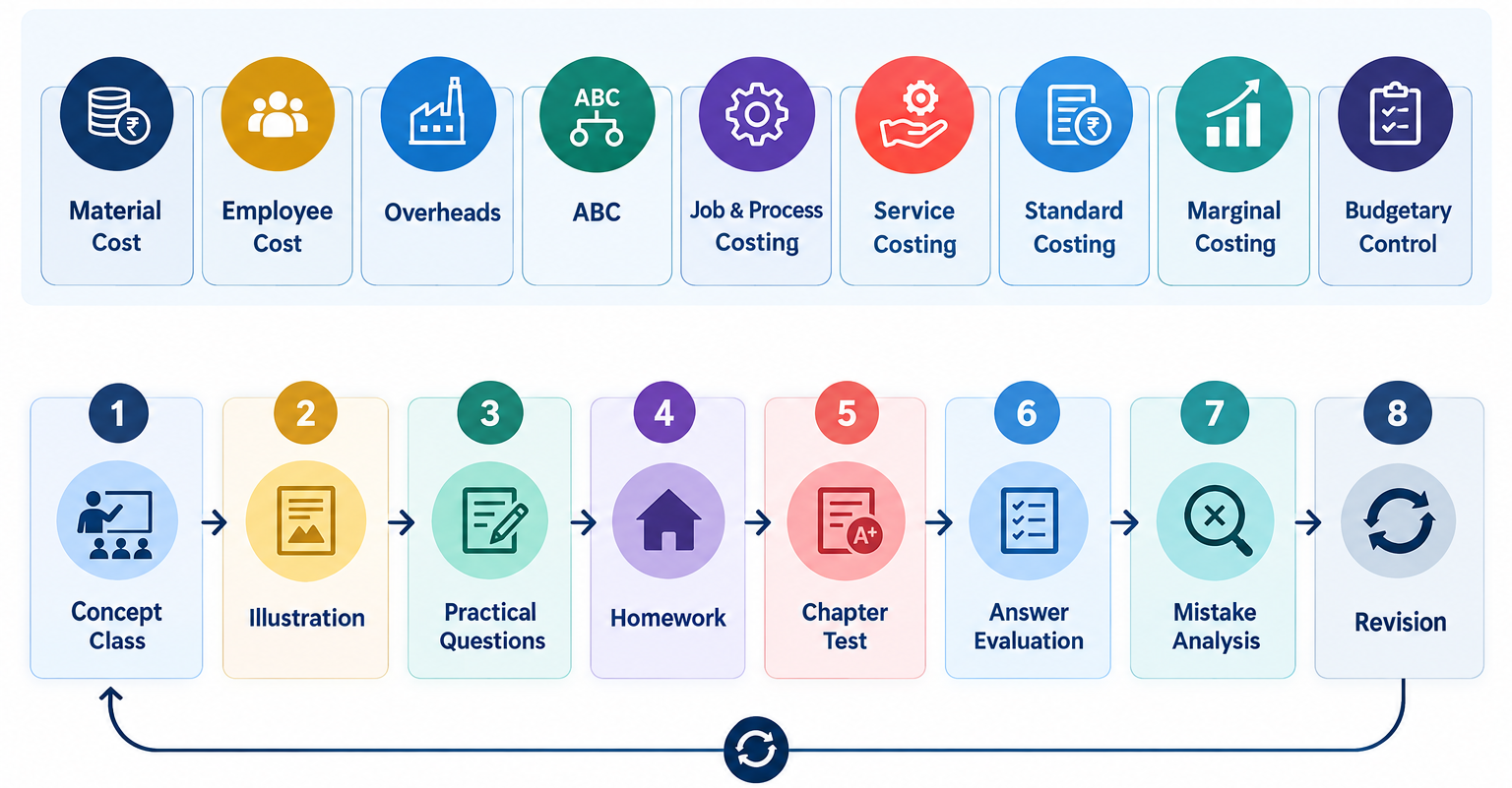
Phase: Development of Concepts
Each chapter should start with teacher-led lessons on the following subjects:
Terminology and Key Concepts
Important methods and formulas
Practical examples
ICAI-pattern style questions
Common exam adjustments
Chapter-specific exam tips
Students should keep a separate Formula & Concept Register with the following information for numerical chapters:
· Formula
· Meaning of variables
· Conditions of applicability
· One solved illustration
· Common mistake
· Examination tip
Chapter-Wise Class and Test System
The course should be divided into individual chapters, with a test immediately after completion of each chapter.
Stage | Activity | Student Outcome |
1 | Concept Lecture | Understand the chapter. |
2 | Faculty Illustrations | Learn application. |
3 | Homework | Independent practice |
4 | Chapter Test | Test retention |
5 | Answer Evaluation | Identify mistakes. |
6 | Discussion | Correct conceptual errors |
7 | Re-attempt | Improve presentation. |
8 | Revision | Long-term retention |
Test Structure for Chapters
Easy questions shouldn't be the sole ones on chapter tests. They ought to progressively cover:
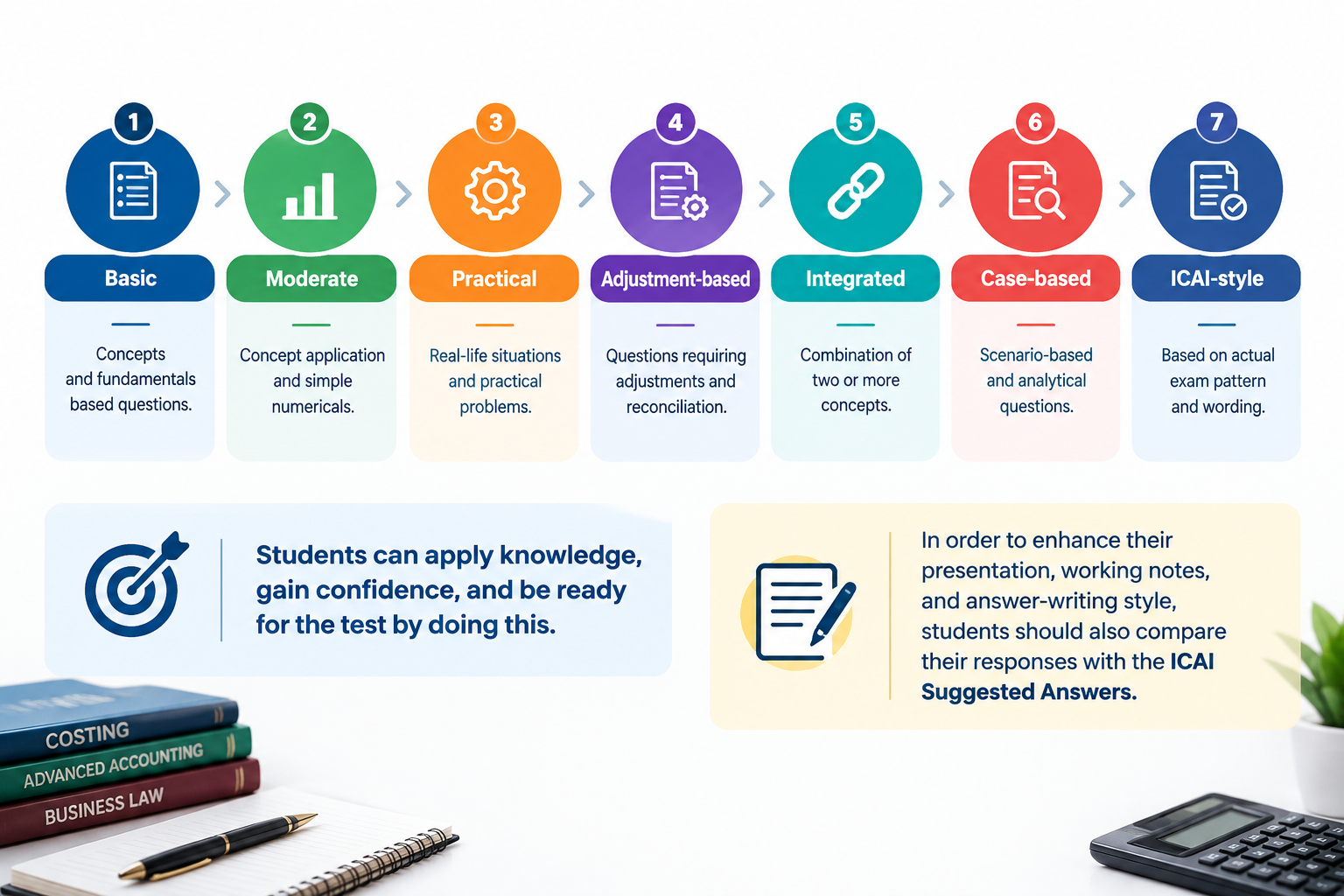
Chapter Test Pattern
A suitable chapter-test structure can be:
Chapter Type | Time Period | Marks | Focus |
Short Chapter | 35–45 minutes | 30–35 | Basic concepts and practical questions |
Medium Chapter | 60 minutes | 40 | Conceptual and practical questions |
Major Chapter | 90 minutes | 70 | Comprehensive and exam-level questions |
Full-Semester Tests
After completion of all chapters:
Test 1 – 25% Portion
Test 2 – 50% Portion
Test 3 – 75% Portion
Test 4 – 100% Portion
Full Semester Mock Test 1
Full Semester Mock Test 2
Final Examination Simulation
This ensures that the student does not become dependent on chapter-wise preparation.
Answer Evaluation System
The most important part of the course should be checking and evaluating students’ written answers.
Just conducting tests is not enough. Students should also understand:
Is my answer presented properly?
What did I write correctly?
Where did I lose marks?
Did I explain my answer clearly?
Did I use the correct formula?
Did I make any calculation or conceptual mistake?
Therefore, every submitted answer should be checked properly and systematically.
This will help students understand their mistakes, improve their answer-writing skills, and score better in the examination.
Evaluation Parameters
A. Accuracy of Concepts
For example, the student should be able to:
Assign costs to the appropriate department or area.
Calculate material cost correctly.
Classify overheads correctly.
Calculate variance correctly.
Apply the correct marginal costing method.
Prepare the budget correctly.
Essential: Correcting the final response is insufficient. A student shouldn't get full credit if they employ the incorrect approach or notion but manage to arrive at the right end amount.
Both the final solution and the approach taken to arrive at it should be the main focus of the evaluation.
B. Working Notes
When it comes to costing, working notes are crucial. The assessor should verify that the student has presented the computations in an understandable and accurate manner.
Whether assumptions are clearly mentioned.
Whether the calculations are done step by step.
Whether the correct formulas are shown.
If all required workings are available.
Whether the figures are accurately transferred from one stage to the next.
C. Presentation
The student should be trained to present answers professionally.
A good answer should contain:
Question Number
Required Working / Formula
Calculation
Working Notes
Final Answer
Important figures should be clearly identifiable.
Essay-Type Answer Evaluation
Costing is mainly numerical, but students also need to answer theory questions clearly and properly.
For theory answers, follow this simple format:
Heading – Write the topic clearly.
Introduction – Give a short meaning of the topic.
Main Explanation – Explain the points one by one.
Classification / Formula / Treatment – Add these if needed.
Example – Give a simple example if useful.
Conclusion – End with a short concluding line.
Example of presentation:
Meaning
Objectives
Features
Procedure
Advantages
Limitations
Conclusion
Suggested Evaluation Report
After every chapter test, students should receive a structured report.
Evaluation Area | Observation |
Concept Understanding | Clarity of concepts |
Practical Application | Ability to apply concepts |
Calculation Accuracy | Numerical mistakes |
Working Notes | Quality of workings |
Presentation | Neatness and readability |
Time Management | Completed on time |
Formula Application | Correct formula used |
Final Answer | Accuracy of answer |
Overall Performance | Faculty comments |
The report should also mention:
Performance Parameter | Details |
Marks Obtained | 32/40 |
Percentage | 80% |
Exam Level Estimated | Good |
Strength | Overhead Calculations |
Weakness | Working-Note Presentation |
Priority for Revision | Reconciliation & Adjustment Questions |
Mistake Book System
Every student should maintain a dedicated Costing Mistake Book.
After each test, the student should record:
Question | Mistake | Reason | Correct Approach |
Q3 | Wrong formula | Formula confusion | Revise formula sheet. |
Q5 | Calculation error | Rushed working | Recheck calculations. |
Q7 | Wrong classification | Concept unclear | Revise chapter concept. |
Q9 | Incomplete working | Poor presentation | Follow standard format |
The mistake book becomes extremely valuable during the final revision.
Instead of revising every question again, the student can revise the questions in which marks were previously lost.
Performance Tracking
The course should maintain a Chapter Performance Dashboard.
Chapter | Test Marks | % | Accuracy | Status |
Material Cost | 34/40 | 85% | Good | Completed |
Employee Cost | 31/40 | 77.5% | Good | Revise |
Overheads | 27/40 | 67.5% | Average | Priority |
ABC | 35/40 | 87.5% | Excellent | Strong |
Cost Sheet | 32/40 | 80% | Good | Completed |
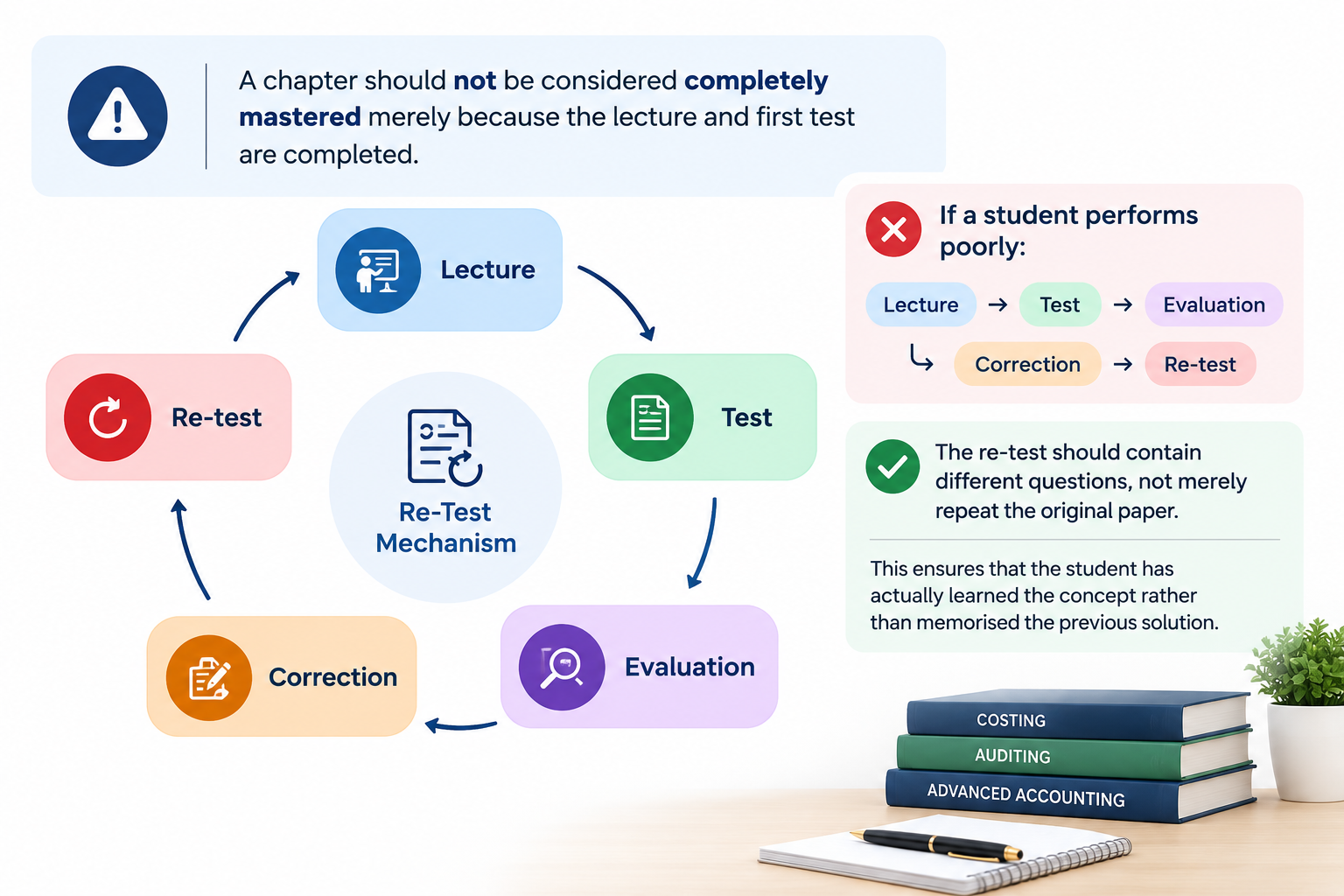
Students scoring below a defined benchmark should receive a targeted retest rather than simply moving forward.
For example:
85%+ – Strong
70–84% – Good
55–69% – Needs revision
Below 55% – Re-study + re-test
Re-Test Mechanism
Integrated Costing Tests
After individual chapters, students should be exposed to integrated questions.
Examples of Integrated Questions:
Material Cost, Labor Cost, Overheads, and Cost Sheet
Standard Costing and Variance Analysis
Marginal Costing and Decision Making
Process Costing and Losses and Abnormal Loss
This is important because examination questions may require students to apply multiple concepts rather than operate within a single isolated formula.
Final Objective
The main aim of CA Inter Costing preparation is not just to finish the syllabus. Students should be able to:
Understand the question quickly.
Choose the correct concept and formula.
Show proper working steps.
Avoid calculation mistakes.
Write answers in a clear format.
Review and improve your mistakes.
Stay confident and manage time in the exam.
Therefore, costing classes should follow a complete system:
Learn → Practice → Test → Evaluate → Correct → Re-Test → Revise → Perform
This process should continue from the first chapter to the final mock test.