
CA Full Form: Meaning, Course Details & Career Scope Explained
Thinking of further career options in commerce? Have you heard the term CA? If you are a student looking for career options, CA is one of the most rewarding and prestigious career options. If you want to explore the world of financing, taxation, and accounting, chartered accountancy is the best option. With proper guidance, preparation, and dedication, students can start preparing early.
You may have a question such as: What exactly is CA? How to start preparing? Through this blog, we will explain to you everything about the CA professional journey in 2026.
CA Full Form: CA stands for Chartered Accountant.
What is a CA?
A Chartered Accountant is a certified expert in taxation, financial accounting, and auditing. A CA also maintains financial businesses for government institutions, companies, and individuals. Further than just performing financial analysis, a CA operates as a Strategic Planning Consultant, ensuring that an organisation remains financially healthy, compliant with complex laws, and ethically sound.
Who Conducts the CA Exam in India?
The CA examinations are conducted by the ICAI (Institute of Chartered Accountants of India). The ICAI was established in 1949 under the Chartered Accountants Act. After the AICPA (American Institute of Certified Public Accountants, the ICAI is the second-largest professional body of CAs in the world and the only regulating body in India.
CA Course Structure
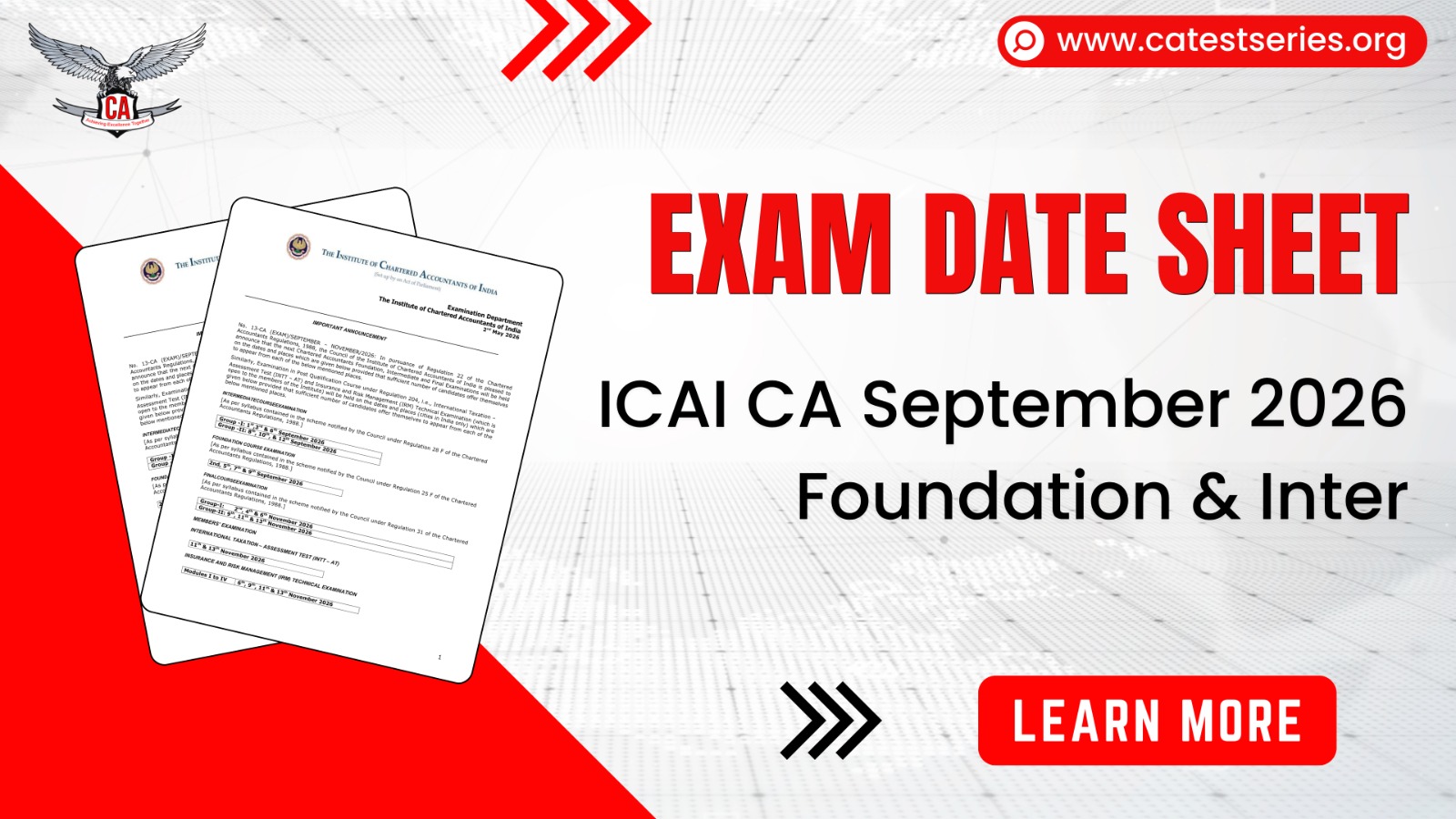
Under the revised scheme, NSET (New Scheme of Education and Training), the CA is organised into three sequential levels– CA Foundation, CA Intermediate, and CA Finals, and a mandatory practical training period called Articleship Period.
1. CA Foundation: The CA Foundation is the first level in the journey to becoming a Chartered Accountant. It evaluates the basic knowledge of core subjects such as Accounting, Business Laws, Quantitative Aptitude, and Business Economics. CA Foundation ensures that a student develops a solid foundation of subjects before the intermediate level.
Parameter | Details |
Duration | 4 months of study period after registration |
Exam Pattern | 4 papers (2 descriptive and 2 objective) |
Subjects | Paper 1: Principles and Practice of Accounting (Descriptive) |
Paper 2: Business Laws (Descriptive) | |
Paper 3: Quantitative Aptitude (Objective) | |
Paper 4: Business Economics (Objective) | |
Frequency | Conducted annually in January, May/June, and September |
CA Foundation is a 400-mark examination of 400 marks, and negative marking is for objective-type papers only. To qualify for the intermediate, you must pass the foundation with 40% in each paper and 50% aggregate.
2. CA Intermediate: After clearing the CA Foundation, the Intermediate is the second stage of the CA Examination. level, which helps in understanding the core subjects at the advanced level. The main objective is to build analytical skills for further professional responsibility and practical training.
Parameter | Details |
Structure | 6 papers divided into 2 groups (each group contains 3 papers) |
Subjects | |
Group I | Paper 1: Advanced Accounting |
Paper 2: Corporate Laws | |
Paper 3: Taxation | |
Group II | Paper 4: Costing |
Paper 5: Auditing | |
Paper 6: Financial Management | |
Direct Entry (After Graduation) | Commerce with 55% Other streams with 60% |
Direct Entry: If you are a graduate student with the required passing percentage (either in commerce or other streams), you can skip the foundation level and directly apply for the CA Intermediate level.
3. Articleship (Practical Training): This articleship period is mandatory to pursue the CA Finals. The duration of articleship must be 2 years under a certified Chartered Accountant.
Parameter | Details |
Duration | 2 years(as per the new scheme) |
Eligibility | After clearing CA Intermediate (either one or both groups) |
Training Area | Must be conducted by a registered member of the ICAI |
This training period helps in understanding how to apply theoretical knowledge in practical scenarios.
4. CA Final: The CA Final is the last and most important stage of the CA Examinations. Before appearing for the finals, a candidate must have completed the articleship period.
Parameter | Details |
Structure | 6 papers (Paper 6 is an Open-Book Case-Study Paper) |
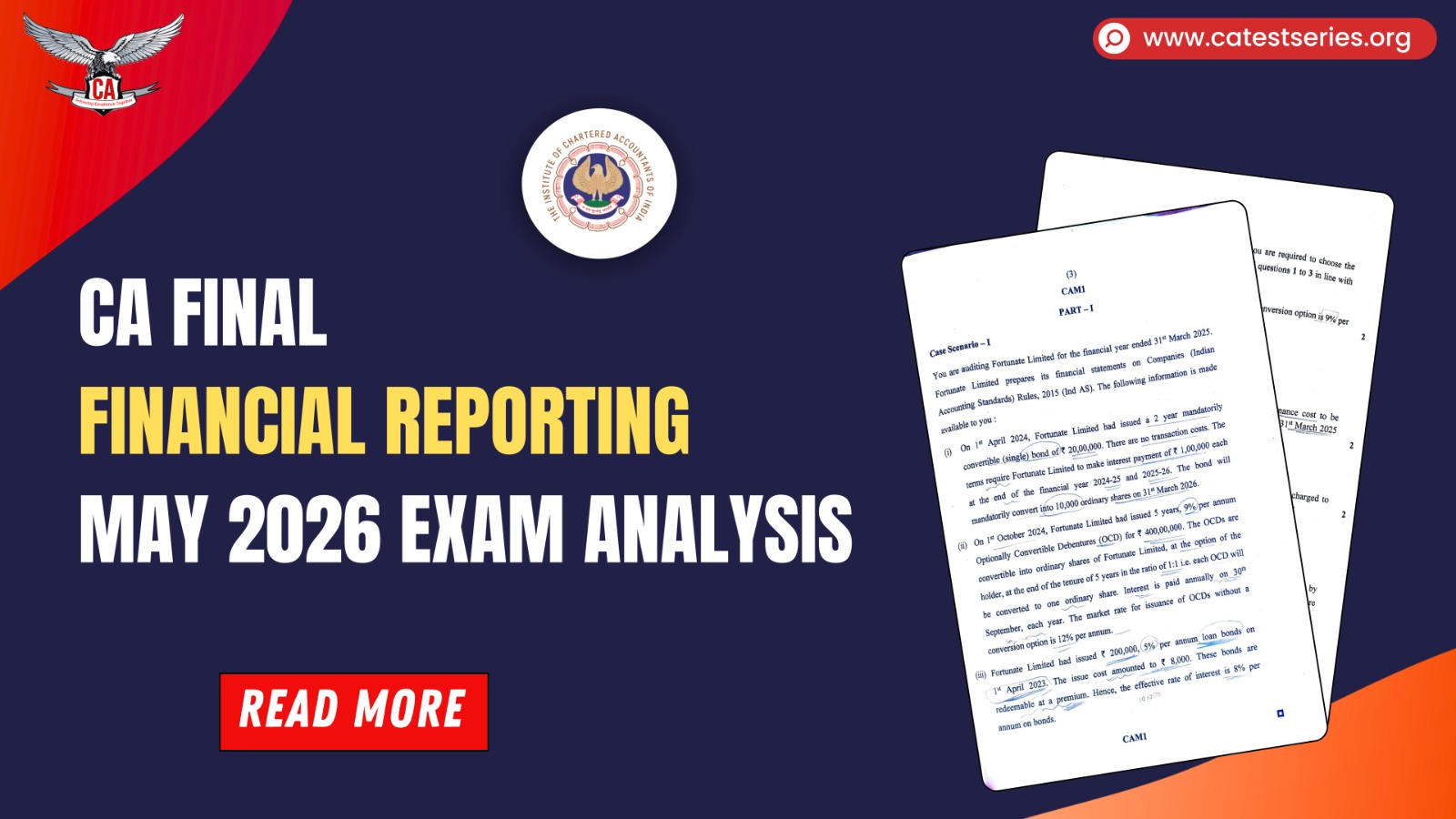
Subjects | Paper 1: Financial Reporting |
Paper 2: Advanced Financial Management | |
Paper 3: Advanced Auditing, Assurance, and Professional Ethics | |
| Paper 4: Direct Tax Laws & International Taxation | |
Paper 5: Indirect Tax Laws | |
| Paper 6: Integrated Business Solutions (Open-Book Case-Study Paper) | |
Status | Designated as a Chartered Accountant after clearing this level of examination. |
The CA Final is the last stage to become a Chartered Accountant.
Eligibility Criteria for CA
To chase the CA profession, a candidate must meet eligibility requirements designated by the ICAI. There are two major criteria for eligibility: the Foundation Route and the Direct Entry Route.
Entry Route | Eligibility Criteria |
Foundation Route | 1. Registration is allowed after passing Class 10. 2. Candidates can appear for the exam only after appearing for their Class 12 board examinations |
Direct Entry Route | 1. Commerce Graduates/Postgraduates with a minimum of 55% marks. 2. Non-commerce Graduates/Postgraduates with a minimum of 60% marks. 3. Candidates who have cleared the Intermediate level of the ICSI or the ICMAI. |
Beyond these, the candidate must clear all three levels of the CA Examination: Foundation (applicable if students appearing after 12th), Intermediate, and Finals. The Articleship period of 2 years is also mandatory.
Skills Required to Become a CA
Attaining a CA qualification is not merely about being able to handle numbers. A CA also needs to have analytical thinking skills to be able to interpret financial data, a high level of concentration for detail to ensure accuracy, a strong moral character to gain and maintain the trust of others, good communication skills to be able to explain complicated laws in simple terms, and a commitment to continuous learning to keep up with changing regulations.
Skill | Core Focus |
Analytical Thinking | Financial analysis |
Attention to Detail | Accuracy control |
Ethics & Integrity | Moral standards |
Communication | Client clarity |
Continuous Learning | Ongoing updates |
Skills are necessary in every field. A skilled CA also has salary benefits.
Career Opportunities After the CA Course
The CA qualification opens a door to a wide range of career paths across several sectors. A professional can choose to do a public practice, take up a leadership role in a corporation, work in banking and financial services, serve in a government department such as the Income Tax Department or the CAG of India, or pursue a global career in countries like the UK and Canada.
Sector | Key Roles |
Public Practice | Audit & Tax Services |
Corporate Sector | CFO, Finance Controller |
Banking & Finance | Investment & Risk Roles |
Government Sector | Tax & Audit Departments |
Global Opportunities | Overseas Finance Roles |
A Chartered Accountant qualification can be your key to so many career sectors like finance, taxation, auditing, consulting, and corporate leadership. If you have the right experience and specialization, you will be able to create a very rewarding career as a CA not only in India but also abroad.
Salary Package of a CA (2026 Trends)
The salary package for a qualified CA depends on several factors, such as the length of experience, the industry, the place or location, and the specific skills or specialisation. Most of the time, newly qualified Chartered Accountants get quite attractive salaries as their first packages. These packages then get augmented significantly with experience or by getting leadership roles or international exposure. Those who are involved in investment banking, MNCs, or overseas markets, on the whole, are paid considerably more than those in the traditional roles.
| Experience Level | Average Salary Range (Per Annum) |
| Freshers | ₹9 Lakhs – ₹13 Lakhs |
| Mid-level (5–10 years) | ₹18 Lakhs – ₹30 Lakhs |
| Senior (15+ years) | ₹40 Lakhs – ₹1 Crore+ |
Note: Candidates holding ranks and those who clear CA exams in the first attempt get salary packages starting from over 15-20 Lakhs in Big 4 firms or other top-tier MNCs.
Why Choose CA as a Career?
Chartered Accountancy as a career is a great choice that can give you both strong professional and financial benefits. A CA qualification is recognised worldwide, and it can open up doors for you in different countries. It is seen as a job role that people will still need even in a recession because every business has to be financially overseen, no matter the state of the economy. The CA route is quite affordable when compared to costly professional degrees, yet it is capable of generating serious long-term gains.
Moreover, being a CA comes with the privilege of having the right to sign audit reports, which is a matter of law and also represents the recognition, dignity, and trust given to the profession.
Becoming a Chartered Accountant is not a short distance but a long one. It is about self-discipline, spending many hours studying, and having a “never give up” spirit. But the prize waiting for you at the finish line, the two-letter prefix “CA,” is a mark of trust and excellence that will be with you forever.