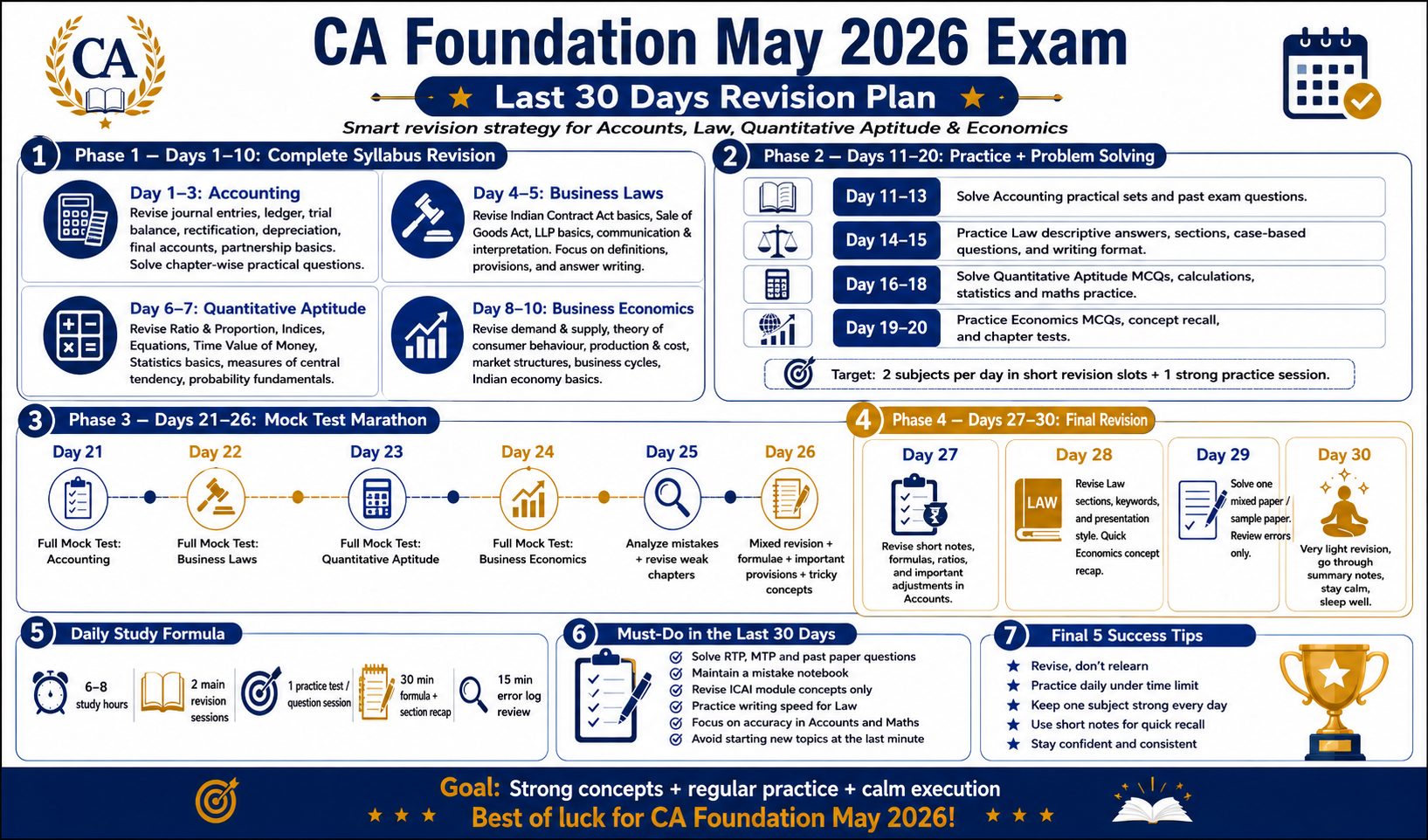
CA Foundation May 2026 Exam — Last 30 Days Revision Plan
The final 30 days before the CA Foundation May 2026 Exam can completely change your result. This is the phase where toppers improve accuracy, strengthen weak concepts, and master revision techniques. Many students spend months studying but fail to revise properly in the last month. On the other hand, students with a smart revision strategy often score higher even with limited preparation.
The CA Foundation exam is not just about hard work. It is about retention, consistency, practice, and time management. The final month should not be used for learning everything from scratch. Instead, it should focus on revising concepts, solving mock tests, improving speed, and reducing mistakes.
A structured 30-day revision plan helps students stay disciplined and confident. It removes confusion about what to study daily and ensures that all four subjects are revised multiple times before the examination. Whether you are a first-time candidate or a repeater, following a realistic revision strategy can help you maximize your score.
This guide provides a complete last 30 days revision plan for CA Foundation May 2026, including subject-wise strategies, mock test planning, time management tips, and smart revision methods that can improve your overall performance.
Understand the Goal of the Final 30 Days
The biggest mistake students make in the last month is trying to complete untouched topics instead of revising what they already know. The purpose of these 30 days is not to become perfect in every chapter. The goal is to improve retention, confidence, and exam temperament.
During this phase, students should focus on:
- Revising all important concepts multiple times
- Practicing MCQs and descriptive questions
- Improving writing speed
- Solving mock test papers
- Analyzing mistakes regularly
- Strengthening weak chapters
- Managing stress and maintaining consistency
The final month is all about smart execution. Even average students can score well if they revise efficiently and avoid panic.
Students should divide these 30 days into three phases:
- First 10 days for complete syllabus revision
- Next 10 days for intensive practice and mock tests
- Final 10 days for quick revision and confidence building
This structure ensures balanced preparation without burnout.
Create a Realistic Daily Study Schedule
A proper timetable is the backbone of an effective revision plan. Instead of studying randomly, students should follow a fixed daily routine that covers all subjects consistently.
An ideal study day during the last month should include:
- Theory revision sessions
- Practical problem-solving practice
- MCQ solving
- Mock paper analysis
- Quick formula revision
Students preparing full-time can study for 10–12 productive hours daily, while college-going students can aim for 6–8 focused hours.
A balanced timetable may look like this:
Morning hours should be used for practical subjects like Accounts and Mathematics because concentration levels are higher. Afternoon sessions can be dedicated to Law and Economics theory revision. Evening hours are best for MCQs, mock tests, and formula revision.
Avoid studying one subject for the entire day. Rotating subjects keeps the mind active and improves retention.
Also, include small breaks between sessions. Long continuous study sessions reduce productivity and increase fatigue.
The key is consistency. Following a timetable every day is more effective than studying excessively for one or two days and then losing momentum.
Subject-Wise Revision Strategy for Accounts
Accounts is one of the most scoring papers in CA Foundation if revised properly. The last 30 days should focus mainly on practice rather than reading theory repeatedly.
Students should revise:
- Final Accounts
- Partnership Accounts
- Bills of Exchange
- Bank Reconciliation
- Depreciation
- Rectification of Errors
- Inventory Valuation
Start by revising concepts and formats, then immediately solve practical questions. Writing practice is essential because Accounts requires presentation accuracy and working notes.
Students should maintain a separate notebook for:
- Important adjustments
- Journal entries
- Common mistakes
- Formula shortcuts
Time management is critical in Accounts. Practice solving full-length questions within time limits. Avoid spending too much time on a single difficult adjustment.
Mock tests are extremely important for Accounts preparation. Solving previous year questions helps students understand the pattern and frequently asked concepts.
The last week should focus mainly on revision of formats, adjustments, and high-weightage chapters.
Smart Preparation Strategy for Law
Law is often considered difficult because of its theoretical nature, but proper revision techniques can make it manageable and scoring.
The biggest challenge in Law is retention. Students may understand concepts but struggle to remember provisions during the exam. Therefore, revision should focus on repeated recall practice.
Students should prioritize:
- Indian Contract Act
- Sale of Goods Act
- LLP Act
- Companies Act basics
Instead of reading entire chapters repeatedly, students should prepare concise revision notes with:
- Important provisions
- Keywords
- Definitions
- Section references
- Short summaries
Presentation matters a lot in Law papers. Answers should be written in a structured format including:
- Provision
- Explanation
- Conclusion
Students should practice writing answers in simple professional language. There is no need to memorize textbook language completely. Concept clarity is more important.
Daily revision is necessary for Law. Even one hour of regular revision can significantly improve retention.
During the final 10 days, students should revise only notes and important provisions instead of full study material.
How to Revise Mathematics, Statistics, and Logical Reasoning
Many students fear Mathematics because of speed and accuracy issues. However, this paper becomes highly scoring with regular practice.
The final 30 days should focus on:
- Formula revision
- Speed improvement
- MCQ practice
- Calculator efficiency
- Mock paper solving
Students should prepare a formula notebook containing all important formulas from Mathematics and Statistics. Daily revision of formulas improves recall speed during the exam.
High-weightage areas usually include:
- Ratio and Proportion
- Equations
- Time Value of Money
- Probability
- Correlation and Regression
- Permutations and Combinations
Instead of solving extremely difficult questions, focus on ICAI-level practical problems. Accuracy matters more than attempting overly complex sums.
Logical Reasoning should not be ignored because it can improve overall scores significantly. Practice puzzles, coding-decoding, direction tests, and analytical reasoning regularly.
Mock tests are crucial because this paper is time-sensitive. Students should practice solving MCQs under strict time limits to improve speed.
The final week should mainly focus on formulas, shortcuts, and previously solved questions.
Economics and Business Revision Plan
Economics and Business Commercial Knowledge require smart revision rather than excessive memorization.
For Economics, students should focus on:
- Demand and Supply
- Theory of Consumer Behavior
- National Income
- Money and Banking
- Indian Economic Environment
Understanding concepts is more important than rote learning. Students should revise graphs, definitions, and important economic terms regularly.
Business Commercial Knowledge can be scoring if revised strategically. Students should focus on:
- Business organizations
- Government policies
- Business environment
- Important institutions
- Recent commercial awareness
Short notes are extremely effective for this subject. Reading concise notes daily improves retention and saves time.
MCQ practice is essential because the paper is objective-based. Students should solve chapter-wise MCQs and analyze incorrect answers carefully.
The last week should focus mainly on:
- Quick notes
- Definitions
- Important concepts
- MCQ practice
Avoid learning completely new concepts during the final days.
Importance of Mock Tests and Previous Year Papers
Mock tests are the most important part of the final 30-day strategy. Many students study extensively but fail to perform because they lack exam practice.
Mock tests help students:
- Improve speed
- Manage time effectively
- Reduce exam fear
- Identify weak areas
- Improve answer presentation
Students should ideally solve:
- At least 6–8 full mock tests
- Previous year question papers
- ICAI sample papers
Always attempt mock papers in real exam conditions. Sit for the full duration without distractions. This builds stamina and concentration.
After every mock test, spend time analyzing mistakes. Focus on:
- Silly calculation errors
- Time wastage
- Weak chapters
- Presentation issues
Do not get discouraged by low mock scores initially. The purpose of mock tests is improvement, not perfection.
The final 10 days should include at least one mock paper every alternate day.
Common Mistakes Students Must Avoid in the Final Month
The last month has been extremely sensitive. Small mistakes during this phase can negatively impact performance.
One major mistake is studying new chapters continuously. This creates confusion and weakens already prepared concepts. Revision should always take priority over new learning.
Another common mistake is ignoring health and sleep. Many students sacrifice sleep during the final days, which reduces concentration and memory retention.
Students should also avoid:
- Comparing preparation with others
- Following multiple study sources
- Changing strategy repeatedly
- Excessive social media usage
- Overloading the timetable unrealistically
Panic revision is another serious issue. Some students try to revise the entire syllabus in one or two days before the exam. This increases stress and lowers confidence.
Instead, students should trust their preparation and focus on calm, structured revision.
Maintaining a positive mindset is equally important. Confidence plays a huge role in exam performance.
Final 7 Days Strategy Before the CA Foundation May 2026 Exam
The last seven days should be used for light but effective revision. This is not the time for intensive studying or experimenting with new strategies.
Students should focus on:
- Formula revision
- Important provisions
- Quick notes
- High-weightage topics
- Mock paper analysis
Avoid solving extremely difficult questions during this period. Focus only on strengthening confidence.
A smart final-week routine includes:
- Revising concise notes daily
- Solving selected MCQs
- Reading summary charts
- Revisiting common mistakes
Students should also organize exam-related essentials such as admit cards, stationery, and exam center details to avoid last-minute stress.
Sleep becomes extremely important during the final week. A fresh mind performs better than an exhausted one.
One day before the exam, avoid studying late at night. Revise lightly and stay relaxed.
Remember that consistency over the last 30 days matters more than studying aggressively for a few hours. A calm and disciplined approach can significantly improve scores in the CA Foundation May 2026 Exam.
With proper planning, regular revision, and consistent mock test practice, students can enter the examination hall with confidence and clarity. The final month is your opportunity to convert preparation into results. Stay focused, trust your strategy, and keep revising smartly.