Standard Costing Variance Formulas: A Concept-First Guide
Standard Costing is one of the hardest topics for CA Inter students, and it forms the main part of Cost and Management Accounting. The problem is not the mathematics; rather, it leads many students to memorise variance formulas of standard costing without understanding their meaning.
It is always better to learn the meaning of each variance first. If you know the reason for a variance being either price variance, quantity variance, rate variance, efficiency variance, mix variance, or volume variance.
Why Rote Learning Fails Here?
Variances in standard costing (material, labour, overheads, etc.) are not a list of figures to remember, but a comparison of how things should happen (standard) and how things actually happened. It looks like the formulas are different in nearly all the questions because the context is different every time – in one case actual output may differ from the budgeted output, in another the proportion of raw materials may be different, etc.
Memorising a formula without understanding why it exists is risky, because a small change in wording can throw off a student who learned the words but never learned the logic behind them.
Rote Learning vs Understanding
Point | Rote Learning | Understanding |
How you study | You learn words by heart | You learn the reason behind the idea |
New questions | You get confused | You can still answer |
Memory | You forget it fast | You remember it for longer |
Marks | Good only in easy, direct questions | Good at both easy and hard questions |
Revision time | More, since you must repeat often | Less, since logic is easy to recall |
Confidence | Drops if a question is phrased differently | Stays steady, even for new cases |
Himanshu Singla: Best Faculty for Standard Costing Variance
From the way his style of teaching is characterised, it is quite clear that the focus is put on creating the “why” first, before anything else:
With a concept-first approach, he makes sure students understand the reasoning behind the concepts and can apply them to solving problems and not just memorise formulas. He uses Animation and storytelling to make the concept visual and understandable. He covers concept visualisation, practice, homework, mentoring and revision. Now, below is the example given by Himanshu Singla in his class and its complete explanation.
What Is Standard Costing?
Standard Costing is a costing method where predesigned costs are assigned for materials, labour, and other activities. These predesigned costs are called standard costs.
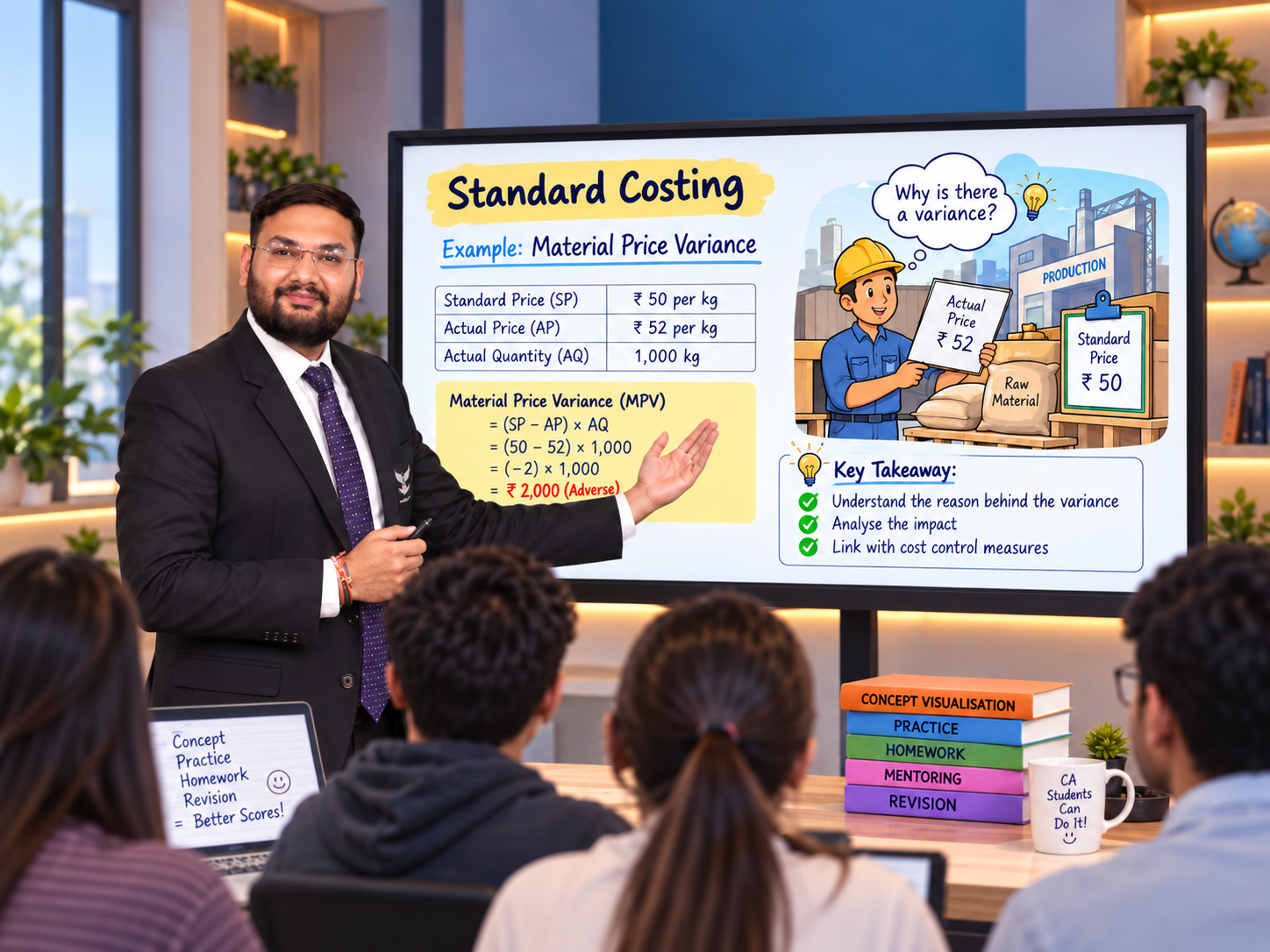
After comparing the actual cost that occurs in the process of production to the standard cost, any variance between the two is determined. The variance is the difference between the two costs.
For instance, let's say a firm sets a standard cost for material at ₹50 per unit, but the actual cost turns out to be ₹55 per unit — that's a variance of ₹5 per unit. Scale that up across a full purchase, and the same logic applies at the total-cost level. If the firm's standard cost for a batch works out to ₹10,000 but the actual cost comes to ₹11,000, the variance is calculated the same way:
Variance = Standard Cost − Actual Cost = ₹10,000 − ₹11,000 = ₹1,000 Adverse
Characteristics of Standard Costing
Costs are established beforehand.
Performance is measured against the standard.
The difference is called variance.
Variance analysis can be done.
It helps management in controlling costs and enhancing efficiency.
What Is Variance Analysis?
Variance Analysis is the identification, calculation, and analysis of the difference between actual performance and standard performance. The primary reason for variance analysis is to answer the following question:
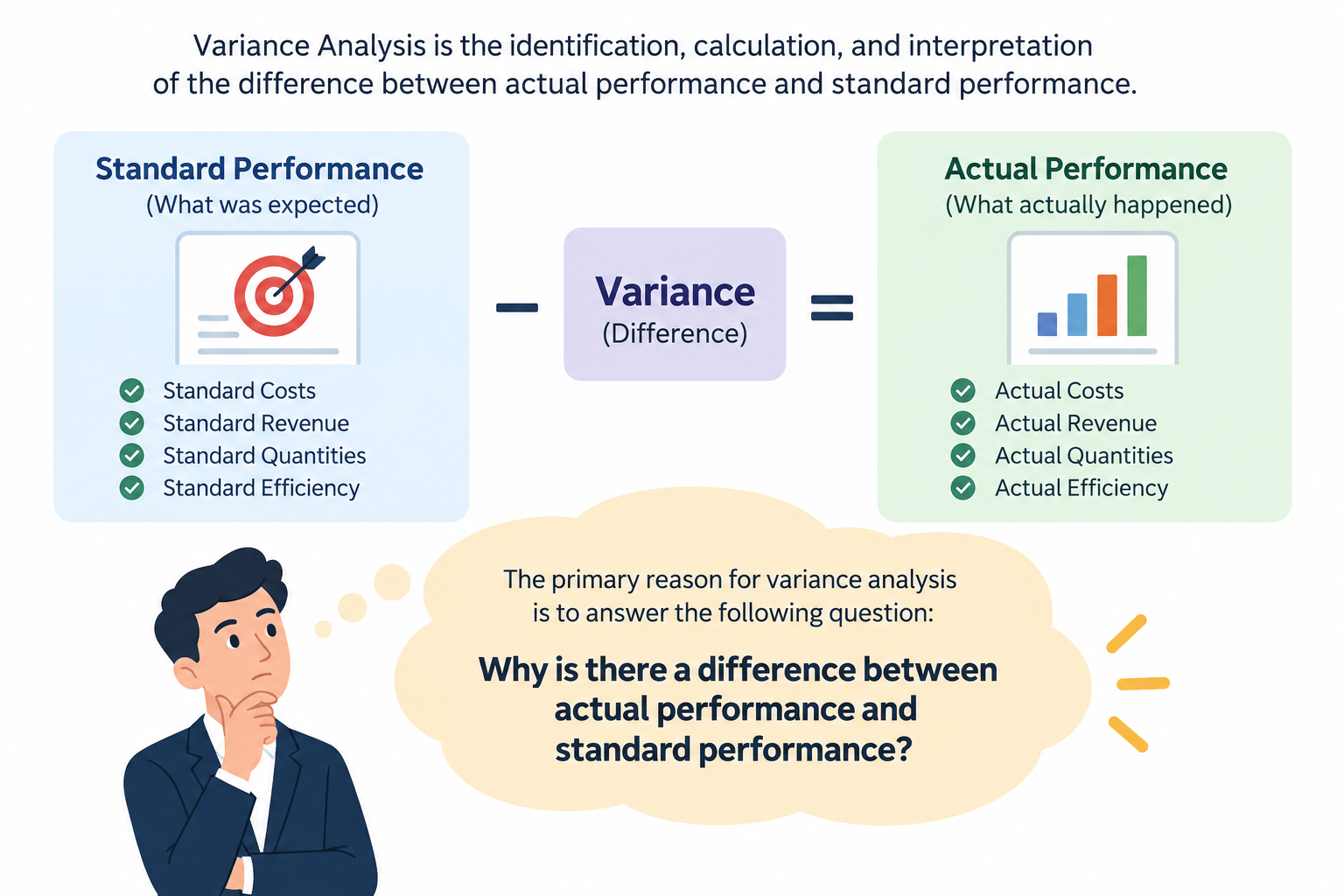
Why did the actual performance differ from the standard?
For instance, if the actual cost of material exceeds the standard cost of material, this may be due to:
Higher cost of material purchase
Higher usage of material
Wastage of material
Difference in the mix of material
Favourable and Adverse Variances
A variance is generally classified as either Favourable or Adverse.
Type | Meaning for Cost | Example |
Favourable | Actual cost is lower than standard cost | Standard ₹10,000, Actual ₹9,000 |
Adverse | Actual cost is higher than standard cost | Standard ₹10,000, Actual ₹11,000 |
Classification of Variance in Standard Costing
In a standard costing system, variances may be classified on the nature of cost element or performance involved. The important types of variance include Material Variance, Labour Variance, Overhead Variance, and Sales Variance.
Main Category | Important Variances |
Material Variances | Price, Usage, Mix, Yield |
Labour Variances | Rate, Efficiency, Mix, Yield |
Variable Overhead Variances | Expenditure, Efficiency |
Fixed Overhead Variances | Expenditure, Volume, Capacity, Efficiency |
Sales Variances | Price, Volume, Mix, Value, Margin |
Each variance is based on a unique cause of variance. For instance, the material price variance deals with the variation in price, while the material usage variance deals with quantity usage.
The Basic Logic Behind Variances
A useful way to understand the chapter is:
Cost = Price × Quantity
For labour:
Labour Cost = Rate × Hours
Therefore:
Change in price → Price Variance
Change in quantity → Usage Variance
Change in output → Yield Variance
Change in composition → Mix Variance
Why Standard Costing Matters?
The significance of Standard Costing and Variance Analysis lies in their ability to assist organisations in making comparisons between expected performance and actual performance. When actual costs exceed standards, management can identify the cause and rectify the situation.
Importance of Standard Costing
Cost Control: It enables one to find out whether actual cost is exceeding the standard cost.
Performance Evaluation: Performance can be evaluated against a benchmark that has been set beforehand.
Inefficiencies Highlighted: The management can find inefficiencies in the use of material, labour and expenditure in general.
Good Planning: It is a good planning tool.
Management by Exception: Attention may be paid only to important variances rather than looking into every minor deviation.
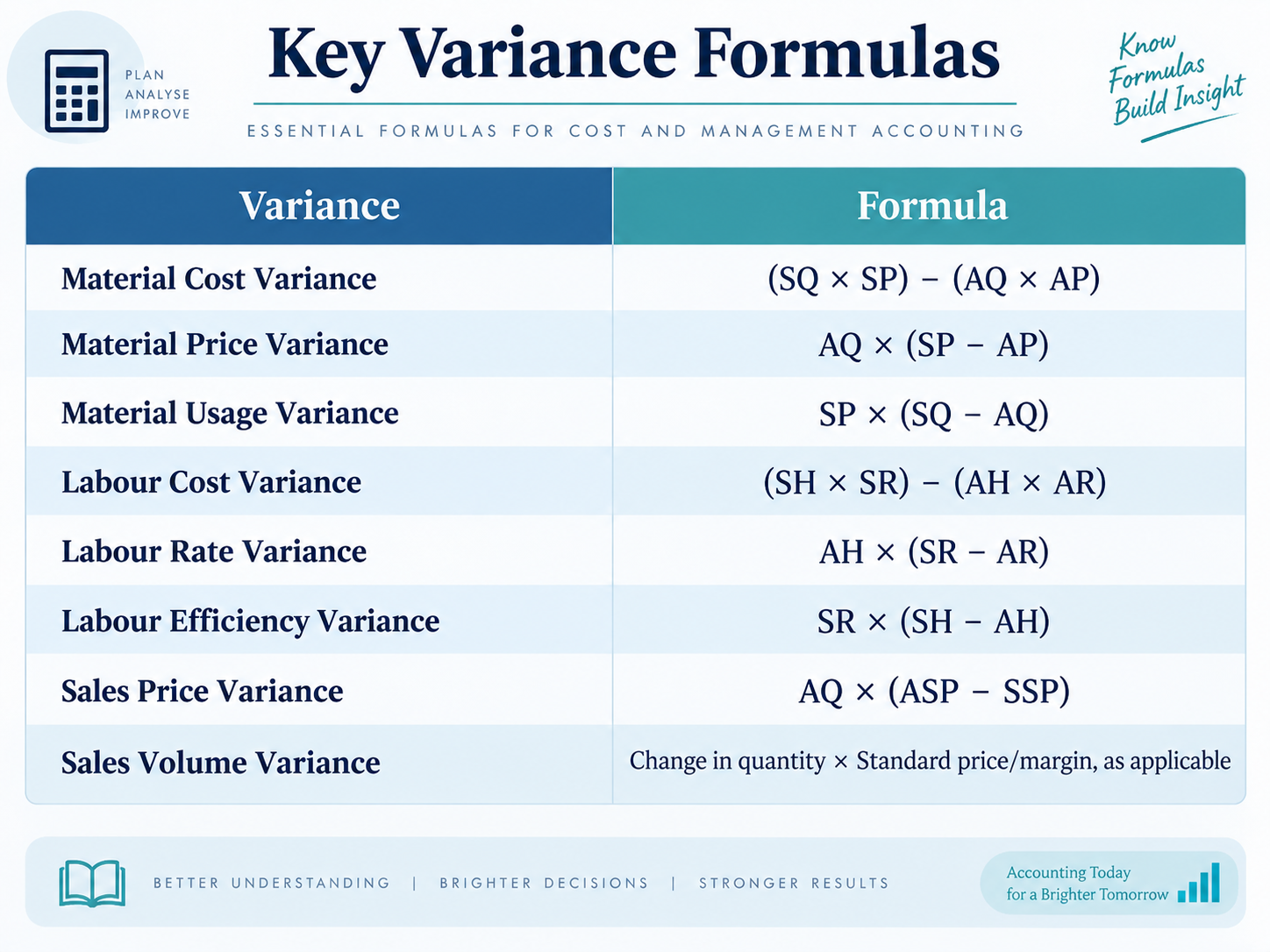
Standard Costing Variance Formulas Sheet
Worked Example: Material and Labour Variances
A company decided to produce 1,000 units of Product X. The standard cost card and actual results for the period are:
Item | Standard | Actual |
Material | 5 kgvperunit @ ₹20 perkg | 5,100 kg used, purchased @ ₹21 per kg |
Labour | 2 hours per unit @ ₹50 per hr | 2,100 hours worked @ ₹52 per h |
Common Mistakes to Avoid
Mistaking standard quantity for actual quantity
Employing actual price when calculating usage variance
Interchanging labour rate with labour efficiency
Failing to mention if it is favourable or adverse
Not considering actual output while finding standard quantity
Using wrong formulas in case of mix and yield variance
Not reconciling the component variances
Remembering the formulas without comprehending them
Watch Now: CA Himanshu Singla Cost and Management Accounting
Conclusion
There is no reason for the Variances under Standard Costing to remain as just another chapter of memory-based content. The important thing is to comprehend why there was any variation between the standard and the actual performance.
Variances related to materials concentrate on price and usage; labour variances concentrate on rate and efficiency; overhead variances cover expenditure, efficiency and volume, whereas sales variances cover price, volume and mix.
The best way for CA Inter students to approach this topic would be to start by comprehending the concept, then move to the formula and lastly solve numerical problems based on that.