Process Costing for CA Inter: The Complete Factory Journey Guide
Imagine raw sugarcane coming to the sugar mill from one end and going out to the other end in the packed form of sugar. In between, the cane does not get converted to sugar instantly, but it has to go through various departments like crushing, boiling, crystallisation, and packing.
Process costing is the way of calculating the cost incurred in the conversion process from raw material to a finished product. Whereas Job Costing is calculated on a per-job basis, process costing is about the cost of a manufacturing process.
This is a high-scoring topic in the CA Inter exam. However, to score good marks, you should have conceptual clarity of losses, transfers, and equivalent units.
How Himanshu Singla Sir Explains Process Costing in Class
Why will this chapter benefit CAtestseries students? Not due to the theory but due to its teaching style. Here are some things that make the way of teaching Process Costing by Himanshu Singla Sir special:
1. Through Animation-Based Lecture
Rather than explaining the formula from a PPT slide, Sir explains everything by creating an animation of the entire process flow on the screen – the physical movement of sugarcane from Process I to Process II to Process III. That is exactly why we used the same method in our "Factory Journey", because visual and animated representation makes the concept stick longer than a written formula ever will.
Watch now: CA Himanshu Singla Animated Lectures.
2. Through a simple Formula
Sir never starts with the formula; instead, he starts with creating the logic behind the concept – why normal loss is not charged as a cost and why abnormal loss is shown separately. Using practical factory examples, he writes the formula at the end, which helps students to derive the formula for themselves instead of memorising the formula blindly. This is one of the main reasons why the retention rate of students remains intact until exams take place.
3. Through Numerical Questions
Sir solves all the numerical questions following the same pattern – Total Cost → Normal Loss → Normal Output → Cost per Unit → Abnormal Loss/Gain → Process Account. Solving numericals following this sequence again is what makes students answer new questions under exam stress without panicking.
4. Mentoring
In addition to the lecture method, Sir’s mentoring style in CAtestseries entails clearing any doubt, solving problems personally, and checking on the practice sets such that the student with confusion regarding the treatment of abnormal gain and equivalents is never left alone. It is Sir’s mentoring method that takes a disciplined student from “understanding the concept” to “achieving 95+ marks in the exam.”

5. By using Revision Techniques Targeted towards Exams
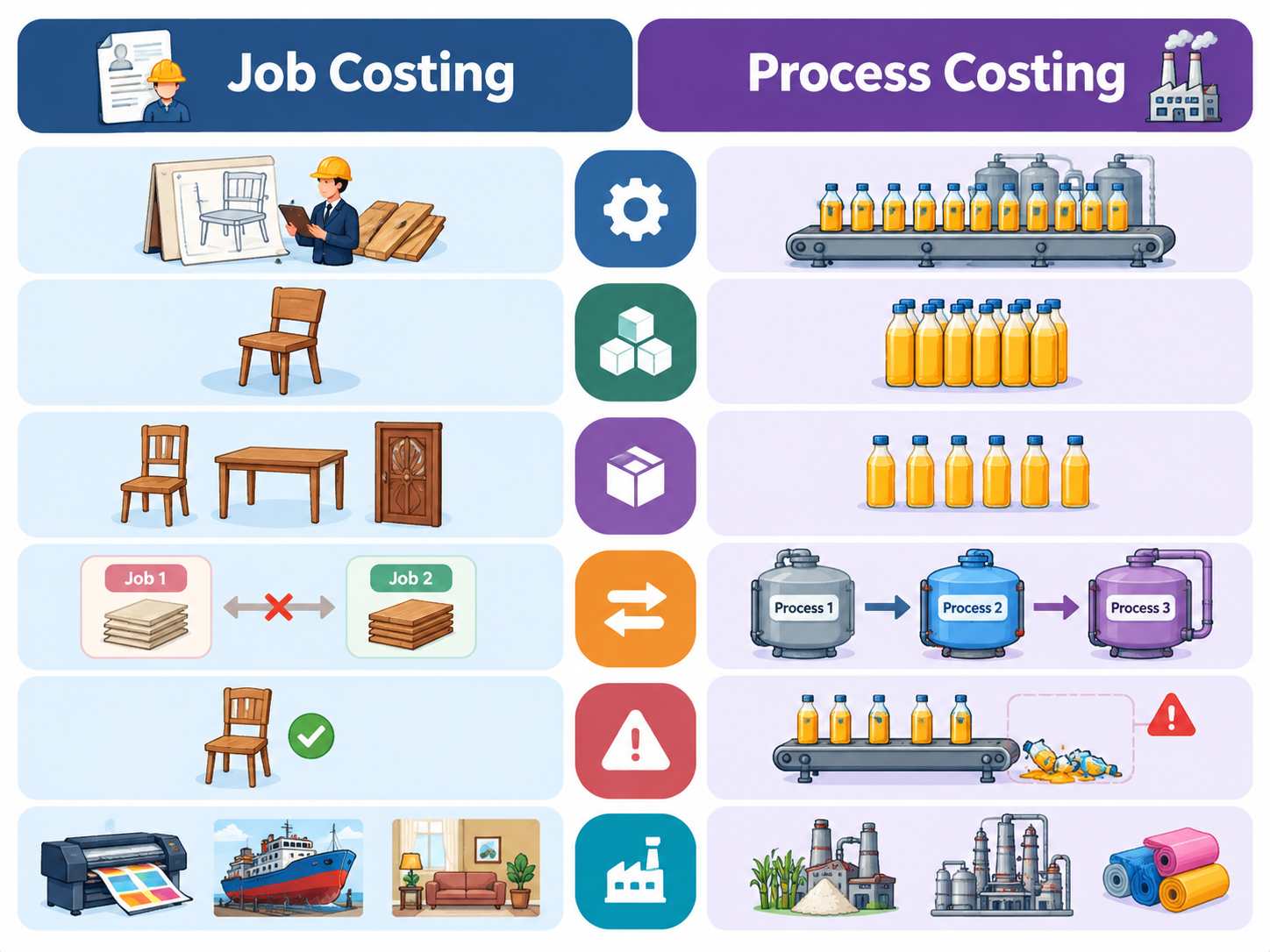
The classes end with revision capsules, which are formula sheets, comparative tables (such as the Job v/s Process costing table that is given below), and questionnaires for quick recollection of facts, which are intended to be used only before the exams but not before revising all the notes.
What is Process Costing?
Process Costing is a costing method where cost accounting is done in continuous industries when the finished product passes through two or more processes for completion. Costs are calculated for each process, and the total cost of the process is divided by the total units produced in the process to determine the cost per unit
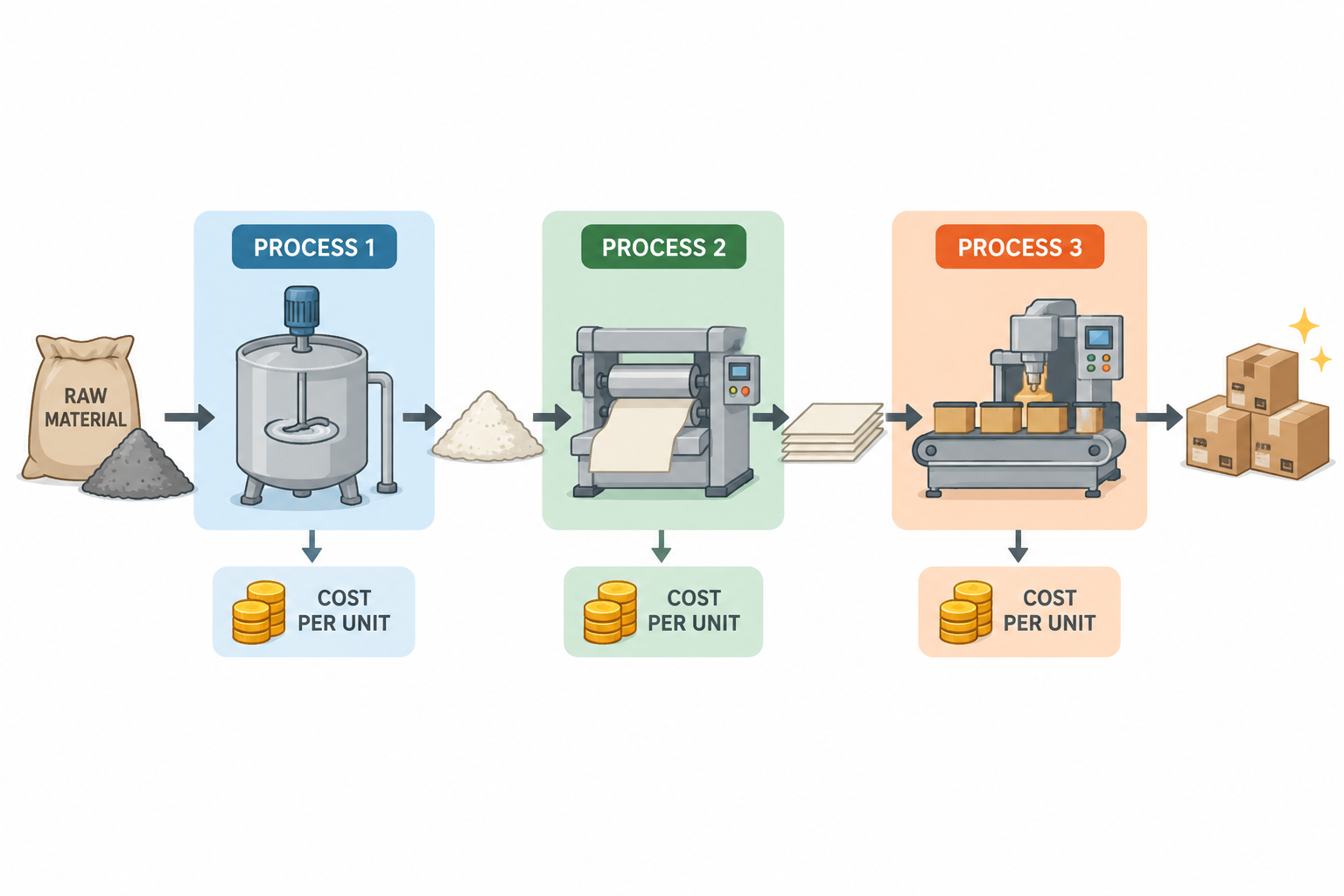
Industries in which Process Costing is applied:
Chemicals Manufacturing
Textile Mills
Sugar and Paper Industries
Oil Refineries
Cement Industries
Food Processing Industry
Dairy Products
Paint and Soap Manufacturing
Difference Between Job Costing and Process Costing
1. Job Costing
This costing technique is applied in a situation where production takes place in response to a customer order, such that each job becomes an individual cost unit. Costs (raw material, labour, and overhead) are accumulated separately for each job since different jobs tend to vary in terms of specification. Applied in industries like printing, ship construction, and interior decoration.
2. Process Costing
This is a costing technique that applies in a situation where there is continuous and mass production in which units become identical after passing through several processes. Accumulation of costs takes place separately for each process, and the costs are then divided by the number of units produced to give the cost per unit. Applied in industries like sugar mills, oil refineries, and textile mills.
Journey Through The Factory – Process Costing From One Stop To Another
Let's walk through a sugar factory, an evergreen example in CA class (because it covers everything so well).
Crushing: Sugarcane is introduced. It is crushed to obtain juice. Costs incurred (material, labour, and overhead) at this stop will be called Process I Cost.
Process of boiling and clarification: Juice produced from Process I becomes feedstock for Process II. More expenses will be incurred in this station (labor, steam, and chemicals).
Process of crystallisation: Feedstock from Process II is forwarded. Expenses are incurred for converting syrup to sugar crystals.
Packing: The final process where sugar is packed in bags for the market.
Process Costing Characteristics
Processing is continuous in nature, and the output is uniform.
Two or more processes are required to complete the production of the product.
The output of one process is used as the input of another process.
Costing is done by process and then is averaged per unit.
The losses, abnormal losses, and abnormal gains are very common due to the physical or chemical nature of processing.
By-products and joint products are common in such cases (e.g., molasses in a sugar mill).
Cost per Unit = Total Process Cost / Normal Output (Units).
Equivalent Production – The Journey to its Conclusion
There will always be some units at any given time that are not completed in the process. This means that it is impossible to consider an incomplete unit as if it is complete. This is why we convert the incomplete units into an equivalent of completed units by considering the degree of completion.
Equivalent Units = Actual Units in Process × Percentage of Completion
For instance, 200 units, which are 60% complete → Equivalent Units = 200 units × 60% = 120 units.
This is very important to come up with the statement of equivalent production and cost per equivalent unit – a basic concept in process costing.
Joint Products and By-products in the Course of Business Operations
In the process of business operations, apart from producing one product, the manufacturing firm may produce other products as well:
Joint Products: these are two or more valuable products which are produced at the same time during the production process.
By-products: those products of low value which are generated along with the main product (for instance, molasses along with sugar).
Conclusion
Process costing is merely the bookkeeping mirror of a factory process. Each process — be it crushing, boiling, crystallisation, or packing — will leave a trail of costs that needs to be captured, averaged, and transferred. With your understanding of the concept of "chain transfer" (output of one process = input for the next process) and the accounting for Normal Loss, Abnormal Loss, and Abnormal Gain, the whole chapter becomes an exercise in mechanical bookkeeping.