Best CA Inter FM Faculty | CA Chesta Chawla Review
FM is not only one type, i.e., a theory or numerical subject, unlike law or audit. It demands both conceptual and computational speed for understanding why, how, or when the formula works and for solving multi-step numericals under limited time. Thus, the exam pattern requires both accuracy and effectiveness in time management.
If a faculty member teaches only shortcuts, it may help you finish on time but cost you marks on the concepts or the format of the question.
The analogy can be made clear with the example of learning to drive a car:
Concepts = learning how car movements and traffic lights work with each other
Speed = ability to drive smoothly without hesitating
Practice = having experience with different circumstances such as road conditions, traffic, and rain, etc.
You can't drive a car and only know the rules or signals without practising on the road. Also, your knowledge is zero on the road without knowing the effective speed that a traffic road or non-traffic road needs; thus, an FM student, like a good driver, needs all three elements to work together.
This is CA Chesta Chawla's review to tell a genuinely better CA Inter faculty from an average one.
Why all three, not just one?
The reason FM faculty selection needs to build three elements—speed, concept, and question practice—together is that they are three aspects of the puzzle. Selecting only one will backfire on the others at some stages during preparation for exams.

If you choose only speed,
You might complete the exam on time, but you’ll face issues with the ICAI's twisted and dissimilar questions. Because speed without understanding the concept will lead to failure under new conditions.
If you choose only concepts,
You'll understand why or when a concept works, but it risks implementing the concept in real-time in the actual exam. FM questions are time-bound and multi-step. Deep understanding without quick implementation is like knowing every ingredient in a recipe but being too slow to cook the meal before the guests arrive.
If you choose only question practice,
You can relate to many problems, which is valuable, but if you take too much time in choosing and implementing concepts, you’ll struggle the moment while framing a question different from what you practised before.
Strategy to Build Speed, Concepts, and Practice Together in FM
Phase 1: Building concept stage
(while reading concepts)
Practice resources or faculty with a strong concept—here, you need not worry about speed.
Focus on implementing the formula irrespective of memorising it (like why NPV uses cash flows, etc.).
Solve basic examples while understanding and writing every step—here the focus is accuracy, not speed.
Make notes for quick revisions later.
Don't skip theoretical parts like assumptions, provisions, and definitions.
Phase 2: Building practice stage
(while revising concepts)
Now, start solving a variety of questions from study material, RTPs, MTPs, and PYQs
Start picking questions from different sources so you can't depend on or memorise only the faculty structure.
If you get any question wrong, identify where concepts are lacking or a calculation gap occurs.
Start maintaining an error-free answer by noting mistakes so that you avoid repeating them in the future.
Phase 3: Building speed stage
(while finally closing the concepts)
Attempt full papers and tests so that you can get the proper strength of questions and you can do timed practice.
Try to start solving questions in a shortcut way once you completely understand every concept.
Track average time and work to shorten it.
Review the formula daily for instant recall while seeing a question concerning the formula.
Why Faculty Selection Matters for FM Specifically
The answer to the question of why faculty selection matters for FM specifically can be resolved with the following aspects:
FM involves both concepts and calculations.
FM is a mixture of numerical and theoretical portions, where calculation of ratios, budgeting, working capital, and the cost of control arises along with the decision-making and analysis of the subject matter. Thus, a faculty member who can teach both to solve calculations within time and has strong strength in theory is always recommended by students to select as their mentors.
Practical exposure is required in the real world.
FM is not only formulas; it directly relates students to the business to teach how to allocate resources, raise capital, and manage the risks. Faculty with practical exposure in banking, finance, treasury, and other commerce markets can connect the book to real market decisions, case studies, etc.

Constant market updates
The regulations involved in cost of capital, capital structure, and dividend policy are totally influenced by regulatory bodies and legislation such as SEBI, RBI, Tax laws, and other company acts. Thus, if a faculty member is not updating their resources, students become outdated in the running market. This is especially tested in professional courses like CA, CS, MBA, or CMA.
Exam-oriented courses
A faculty member must have the ability to understand the examiner's expectations and have a marking structure for it. Faculty must know how to grasp numericals in the technical scheme for length calculations. Also, they know the importance of a structured answer in theoretical questions. A lack of exam-pattern awareness can turn a well-understood concept into poor scoring.
Ability to solve complexity
FM is a subject that has many confusing topics due to overlapping assumptions and formulas. Only good faculty can lead step-by-step logic irrespective of memorisation of the concept. They can help students understand complex topics with just a familiar example.
Mentoring for advanced thinking
FM is a subject that develops decision-making skills for students to execute in real-life business strategies. The correct faculty indeed involves analytical and advanced thinking, not only in calculation but also in implementing various decisions.
Red Flags to Avoid While Selecting Faculty
Overpromising guarantees
Be aware of institutes guaranteed for passing your exam in one attempt or cover FM in one month- like lines. It totally depends on students' own efforts, practice, or consistency. No one can claim it. Such guarantees often mislead students under time pressure and make them doubt their own strategies for preparation.
No support in doubt-solving
FM is a highly numerical-based subject. If a faculty member has no mechanism for doubt-solving sessions to clarify the students' doubts, students get stuck for a long time on a single question; hence, it is a major red flag for a faculty member who is not taking this topic as a serious concept.
Ignoring ICAI amendments
The faculty's syllabus and pattern completely depend on the ICAI study material. A faculty member having outdated teaching lectures and notes will always mislead students from their goal; always check the faculty's content against the latest attempts.

No structural strategy
Only concepts are not enough for studies; also, a chain of study material, a question bank, practice tests, and PYQs are important for faculty to provide as complements to the students. Due to extensive practice, lectures alone never complete all these requirements. Students must check the provided resources while seeking any faculty.
Best CA Inter FM Faculty Selection
Students just need to check the answer to the question before evaluating the faculty's approach: “Does this faculty help me grasp concepts effectively in limited time, and am I getting practice to get closer to the exam? This mechanism is absolutely provided by one of the best faculty, which is catestseries.org. There are a number of CAs who are giving their mentoring to students to achieve their goals.
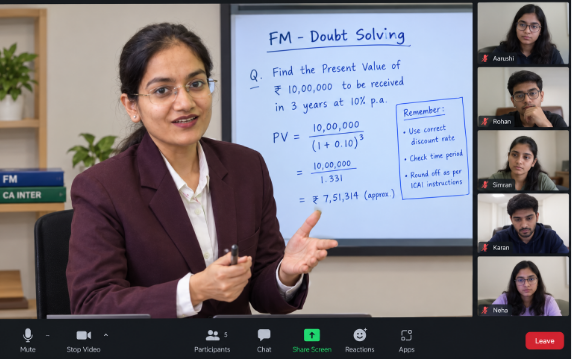
Talking about FM faculty, that's CA Chesta Chawla, who is one of the practising CAs and has experience in teaching CA students. She has all the attributes of a faculty member for FM. She is an expert in taking doubts and solving them. Also, she conducts a number of doubt sessions every month for students. She delivers lectures with updated ICAI modules and makes updates in a timely manner so that students can easily go through them without searching for any further documents.
Thus, a strong strategy for CA Inter FM preparation combines clarity with all three elements—speed, concepts, and practice. This helps students not only learn theory but also build exam-oriented speed.
How CA Chesta Chawla Helps to Achieve Speed, Concepts, and Practice Together in FM
In building concept
Simplify concepts: CA Chesta Chawla helps to break down complex topics into simple, logical, and understandable formulas.
Real examples: CA Chesta Chawla always tries to make a link between the concept and the real market. She smoothly makes a route for students while teaching topical concepts.
Deriving formulas: She never insists that students memorise formulas. Instead, she makes it easy for students to accept formulas.
catestseries.org Content by Chesta Chawla | Resources |
FM Concept Strategy | |
Question Bank | |
Subject Strategy | |
Charts |
In speed development
Shortcut methodology: CA Chesta Chawla helps to make shortcut formula patterns for better understanding by students, like time value of money, EOQ, etc.
Recognition pattern: For quick identification of questions, students should be trained to spot types of patterns followed without wasting time.
Drilling time: Building muscle memory on individual topics can be achieved; regular testing time for calculator-heavy areas.
In practicing
Practice sets: Start from basics to moderate to serious problems so that students build confidence without getting demotivated.
Analysis of past papers: Solving previous years' papers helps a lot in understanding question patterns and making schemes for attempting questions. CA Chesta Chawla herself looks at the matter; she arranges almost the last 5 years' question papers for students. And upgrades them regularly.
Identify error: She encourages the students to maintain regular mistake notes to get eliminated in the future.
Stages | Results |
Concept | Confidence under twisted questions |
speed | Time management |
Question practice | Accuracy with confidence |
Batch: Pricing, Format, and Duration
Students having concerns about enrolling can directly check on catestseries.org, as their plan and fee structure are:
Detail | What to Confirm |
Course fee | Free demo; paid regular batch. |
Validity | 12 months |
Format | Live and recorded |
Language | Hindi and English |
Doubt-solving mode | WhatsApp, forum, live Q&A, one-on-one calls |
App/platform access | Website: catestseries.org |
Batch Timing & Availability
Detail | Status |
Course Format | Recorded video lectures (also offered in a newer 3D-animated format across catestseries.org) |
Latest Batch (3D Animated Series) | Batch 1 — Registrations Full |
Next Batch | Batch 2—Yet to be launched on October 10, 2026 (Stay tuned for Batch 2 launch) |
Access Mode | Streamable on Android, iOS, laptop, and tablet |
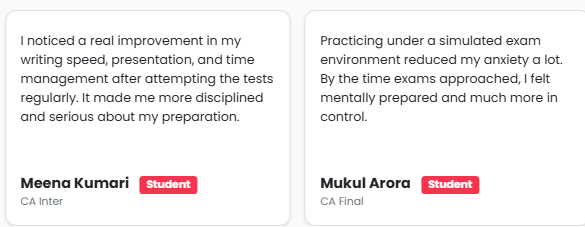
Students’ Feedback
Akash Kumar (CA Inter)
Ma'am, thank you so much for your heartfelt help in the preparation for the exam. You are a kind-natured person. The faculty helped me a lot with every issue. They not only provided me with the material, but they also always motivated me to do my best whenever I lost confidence. Thank you so much.
Surbhi Rani (CA Inter)
Respected team members, I am very grateful to you for being kind and supportive. Your doubt sessions helped me improve a lot. You helped me a lot with upgraded notes and extra question papers.
Conclusion
The question of students' capability, whether they can solve questions effectively under time pressure, is solved with catestseries.org without leaving any marks. CA Chesta Chawla is available for students in all aspects. She arranged a number of plans and batches for students to develop accuracy.
Ultimately, this CA Chesta Chawla FM review helps CA Inter students with a consistent, reliable approach to preparing for the November attempt.