
Marginal Costing for CA Inter: Complete Guide
Marginal Costing Explained: Definition, Examples, and Complete Guide
Marginal costing is one of the most important concepts in CA INTER under Cost and Management Accounting. Students need to understand this concept deeply with real-life examples. Faculty member Himanshu Singla explains these concepts in simple language and with real-life examples, making them easy for students to understand.
The figures on a balance sheet usually mean nothing to anyone until those numbers come alive. Therefore, instead of beginning with accounting equations, why not begin with a restaurant?
Why a Restaurant Explains Marginal Costing Better Than a Textbook
Keshav runs a small restaurant, The Spice Table. On one particular evening, as he prepares to close up the restaurant, he stops to ask himself a very interesting and thought-provoking question:
"What would be the additional cost incurred for serving one more customer during this evening, and is it worth it?"

CA Himanshu Singla
A practising Chartered Accountant and one of the core academic mentors at CAtestseries.org, CA Himanshu Singla combines practical experience with teaching, bringing both hands-on costing knowledge and classroom expertise to every session. He has been mentoring CA aspirants with a practical, concept-driven, and examination-focused teaching methodology, helping thousands of students simplify Cost & Management Accounting through logical explanations, practical illustrations, and structured learning techniques.

Highlights:
Practising Chartered Accountant and independent professional.
Designs notes, question banks, and revision papers for costing.
Well-known for resolving doubts of students 24x7
Has guided thousands of students through structured performance tracking and mentoring since joining CATestSeries.org
What is Marginal Costing?
Marginal cost is the amount a business spends to make one more product. It helps companies to identify how much they should produce and what prices to charge. Marginal costing is an accounting method where the costs can be classified into two categories:
Fixed costs: The cost that does not change with the number of units (or customers) served.
Variable costs: The cost that changes proportionately to the number of units manufactured or served.
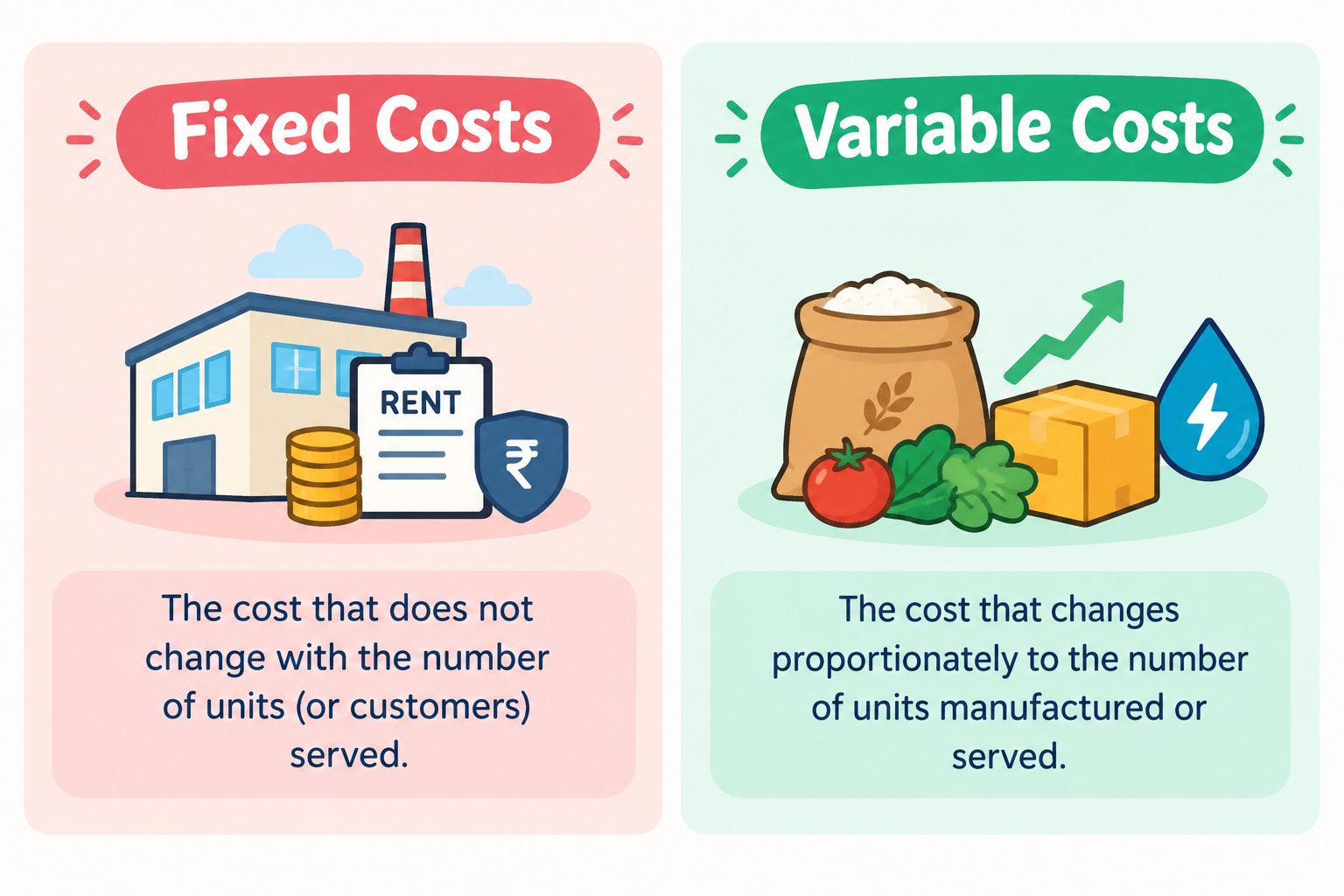
In other words, the marginal cost is the additional cost required to serve one more customer or dish for Keshav.
Formula for Marginal Costing?
Marginal Cost = Change in Total Cost ÷ Change in Quantity Produced
Marginal costing helps businesses answer questions like:
Should I accept a bulk order at a lower price?
Should I stay open for one more hour?
Which product or dish is actually worth selling?
What is the minimum price I can charge without losing money?
Real Examples of Marginal Cost
Keshav's restaurant has two broad categories of expenses. The first is fixed costs, which Keshav has to pay regardless of how many customers visit his restaurant.
Fixed Expense | Monthly Cost |
Restaurant rent | ₹60,000 |
Staff salaries (fixed) | ₹90,000 |
Equipment depreciation | ₹10,000 |
Insurance | ₹5,000 |
Total Fixed Cost | ₹1,65,000 |
Whether Keshav serves 10 customers or 1,000 customers this month, these costs do not change.
Variable Costs (these rise and fall with every dish served)
Variable Expense (per dish) | Cost |
Raw ingredients | ₹80 |
Packaging charges | ₹10 |
Gas and fuel used in cooking | ₹10 |
Total Variable Cost per Dish | ₹100 |
If Keshav sells one dish, his variable cost is ₹100. If he sells 500 dishes, his variable cost is ₹50,000. This is the cost that moves with volume.
Assumptions of Marginal Costing
The assumptions of marginal costing are:
Fixed costs remain unchanged within the relevant range of activity.
Costs can be accurately classified into fixed and variable components.
Production volume and sales volume are assumed to be equal.
Variable cost per unit remains constant.
The selling price per unit remains constant.
How to Calculate Marginal Costing?
Keshav charges ₹250 for each plate. This is because fixed cost does not vary depending on an additional plate; the marginal cost of producing an additional plate will be equal to the variable cost:
Marginal Cost per Plate = ₹100
In other words, Keshav spends ₹100 more to produce an additional plate, irrespective of the number of plates he has produced before that.
Contribution: A Key Aspect of Marginal Costing
The difference between the selling price and the marginal cost is known as the contribution. This is the contribution of each unit to cover fixed costs and later profit.
Contribution per Unit = Selling Price − Variable Cost
Item | Amount |
Selling Price | ₹250 |
Variable Cost | ₹100 |
Contribution per Plate | ₹150 |
P/V Ratio (Profit-Volume Ratio)
P/V Ratio (Profit-Volume Ratio) is the ratio that explains the percentage of contribution per rupee of the sales volume. This is one of the most commonly asked ratios in CA Inter marginal costing numericals because the break-even point and margin of safety can both be derived from this ratio.
P/V Ratio = (Contribution ÷ Selling Price) × 100
P/V Ratio = (₹150 ÷ ₹250) × 100 = 60%
It implies that out of every rupee Keshav earns by selling a plate, 60 paise goes to cover fixed cost and profit, and the remaining 40 paise covers the variable cost.
Example of Break-Even Point Calculation
The Break-Even Point (BEP) is a point of sale at which total contribution margin becomes equal to the fixed cost — Keshav neither earns profit nor suffers loss.
Break-Even Point (In Units) = Fixed Cost / Contribution per Unit
For Keshav:
BEP (Units) = ₹1,65,000 / ₹150 = 1,100 Plates per Month
Break-Even Point (In Value) = Fixed Cost / P/V Ratio
BEP (Value) = ₹1,65,000 / 60% = ₹2,75,000 per Month
Therefore, Keshav must sell precisely 1,100 plates (valued at ₹2,75,000) per month to make up for all his costs. Each additional plate after BEP contributes ₹150 directly to profit.
Margin of Safety
Margin of Safety (MOS) is an indicator that shows Keshav by how much the actual sales exceed the break-even sales. In other words, this margin shows by what amount Keshav can reduce his sales and still stay profitable.
Margin of Safety = Actual Sales – Break-even Sales
Alternatively, this formula can be used:
Margin of Safety = Profit ÷ P/V Ratio
Profit = Total Contribution – Fixed Cost
The higher the margin of safety, the better the business is equipped to sustain lower sales levels while still remaining profitable.
Difference between Marginal Costing and Marginal Revenue
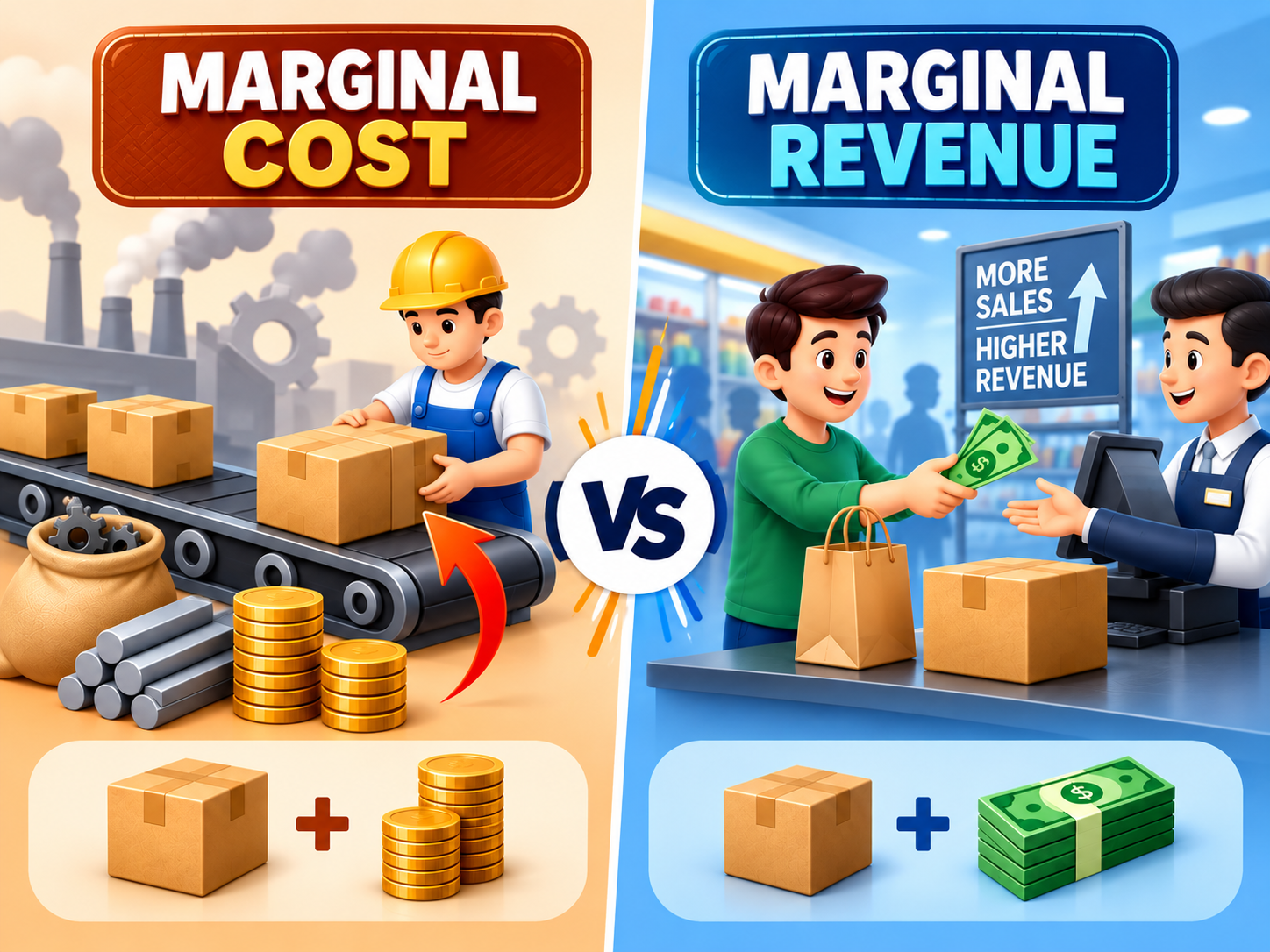
Marginal Cost: The extra expense incurred by a business in producing or selling an additional unit of its product or service. Marginal cost usually consists only of variable expenses such as raw materials and labour expenses, as fixed expenses do not vary with an additional unit. Marginal cost assists businesses in determining the lowest price at which selling an extra unit is profitable.
Marginal Revenue: The additional revenue earned by a business on account of selling an additional unit of its product or service. It is derived by dividing the change in total revenue by the change in quantity sold. Marginal revenue tends to fall with the increase in the quantity sold, especially when the price has to be reduced to sell extra units.
Basis | Marginal Costing(Marginal Cost) | Marginal Revenue |
Formula | Change in Total Cost ÷ Change in Quantity | Change in Total Revenue ÷ Change in Quantity |
Focus | Cost side of the business | Income side of the business |
Outcome | How much it costs to make "one more" | How much you earn from selling "one more" |
Used for | Pricing floor, break-even analysis, accept/reject decisions | Deciding optimal price/output level, especially in economics and pricing strategy |
The Practical Question: Should Keshav Agree to the Bulk Order?
Here, marginal costing truly comes into play in decision-making. A company calls Keshav and offers him a bulk order of 300 plates of dish for their office party, but at ₹120 per plate, much lower than his usual rate of ₹250 per plate. Keshav turns down the offer, thinking ₹120 is far too low.
However, let's use our marginal costing approach here. Fixed costs of Keshav have already been recovered by Keshav through his restaurant work this month. The additional cost incurred in agreeing to this order is the variable cost, which amounts to ₹100 per plate. Even at ₹120, he makes a contribution of ₹20 per plate.
Particulars | Per Plate |
Offered Price | ₹120 |
Variable Cost | ₹100 |
Extra Contribution | ₹20 |
Why does marginal costing matter in business?
The importance of marginal costing lies in the fact that, in practice, most business decisions have nothing to do with total cost but rather are about whether to produce an extra unit or an extra order or to operate for an extra hour. The concept of marginal costing filters out the fixed cost (which is not affected by the business decision) and concentrates on those costs which change due to business decisions. For CA Inter students, getting their fixed cost vs variable cost part right in accept/reject, shut-down, and pricing floor numericals is what examiners really care about.
How does marginal costing differ from absorption costing?
Absorption costing is a method of accounting that relates direct and indirect manufacturing costs to a product. It is also called full costing.
Basis | Marginal Costing | Absorption Costing |
Fixed cost treatment | Treated as a period cost, not charged to each unit | Spread across all units produced |
Focus | Cost behaviour (fixed vs. variable) | Total cost of production |
Useful for | Short-term decisions (pricing, bulk orders, shutdown decisions) | Long-term pricing and external financial reporting |
Profit calculation | Based on contribution | Based on full unit cost |
Inventory valuation | Only variable cost included | Fixed and variable cost included |
Keshav uses marginal costing internally for day-to-day decisions, but his accountant still uses absorption costing for official financial statements.
Key Factor (Limiting Factor) Analysis
Sometimes a business cannot produce or sell unlimited quantities of every product because one resource is in short supply. This constraint is called the key factor or limiting factor — it could be limited raw material, limited machine hours, limited labour hours, or even limited market demand.
When a key factor exists, ranking products purely by contribution per unit can be misleading. Products should instead be ranked by contribution per unit of the key factor.
Contribution per Unit of Key Factor = Contribution per Unit ÷ Units of Key Factor Required per Unit
Suppose Keshav's kitchen has only 100 hours of chef time available each week, and two dishes need different amounts of that time despite earning similar contribution per plate:
Dish | Contribution per Plate | Chef Time Required | Contribution per Chef Hour |
Dish A | ₹150 | 0.5 hours | ₹300 |
Dish B | ₹180 | 1 hour | ₹180 |
Even though Dish B earns a higher contribution per plate, Dish A is the more profitable choice when chef hours are the scarce resource, because it generates more contribution per hour of the limiting factor.
For CA Inter numericals, key factor analysis appears often in product-mix questions where multiple products compete for the same scarce resource. The rule to remember: rank products by contribution per unit of the key factor, not by total contribution or selling price alone.
How Marginal Costing Would Benefit Keshav the Most?
Setting prices: the minimum price at which he can sell without making any loss.
Taking up special orders: as was in the case of that large office order.
Product mix decision: choosing what dishes to sell in the case of a constrained production capacity.
Make or buy decision: whether to bake the bread himself or buy from a supplier.
Conclusion
Marginal costing removes all the unnecessary considerations associated with the fixed cost aspect and poses one simple question: How much will each extra unit cost and earn? The example of Keshav's restaurant shows that marginal costing is not confined only to figures and can be a very helpful method of analysis.
After making the distinction between fixed and variable costs, calculating contribution and break-even point, Keshav was able to price his items appropriately, analyse bulk buying and know the number of dishes he needs to sell in order to reach profitability. Every business whether in food, fashion, or software subscriptions can achieve the same.

Demo Class: CA Himanshu Singla Cost and Management Accounting
Register Now: CAtestseries.org