
Joint Products vs By-Products: Sugar Factory Example
Cost accounting may not become more practical until you connect it with something that you can visualise. And what better example than that of a sugar factory? From the process of crushing sugarcane, sugar, molasses, bagasse, and press mud emerge from raw material and joint cost. Hence, a sugar factory is the most suitable example for explaining joint products and by-products, which creates confusion among students of cost accounting and commerce.
This blog explains how a sugar factory creates them and provides a numeric illustration of joint cost allocation.
Definition of Joint Products
Joint products mean two or more products which are produced simultaneously with the same raw material and production process up to a point of separation called the split-off point. At the split-off point, the cost of each product cannot be identified separately because the cost is called the joint cost. After the split-off point, additional processing involved for each product until it is finally marketed.
Features of Joint Products:
Joint products result from a process involving a common material input.
Each cannot be produced without the others.
The sales value of each is usually substantial – none can be considered "minor".
Allocation of cost involves proper allocation techniques because the cost cannot be directly traced.
By-products Definition
A by-product refers to an additional product formed during the production of the actual product. By-products are different from joint products in that a by-product has relatively little sales value and is not the motive behind conducting the whole manufacturing process. The factory does not specialise in manufacturing by-products, but it only comes as an additional product of the process.
Characteristics of by-products:
By-products result from an incidental process and are not the objective of production.
It holds very low value as compared to the actual product in the market.
They do not require much processing after production.
Its cost is charged to the cost of the main product after credit for its net realisable value.
The Sugar Factory Example
When sugarcane is crushed and processed in a sugar mill, several outputs emerge from that single process:
Output | Nature | Use |
Sugar | Main output | Directly sold for consumption |
Molasses | By-product and Joint product (depends on value) | Used in the manufacture of alcohol and cattle feed |
Bagasse | By-product | Used as fuel in boilers |
Press Mud (filter cake) | By-product | Used as fertilizer/manure |
Joint Products vs. By-Products: Quick Comparison
A joint product is an important and valuable item manufactured as a result of a process that manufactures two or more main products simultaneously. On the other hand, by-products refer to secondary products resulting from the process of manufacturing the main product, usually having lesser value than the main product. The major distinction between them is their significance to total income.
Joint Cost Allocation: An Example
Suppose that a sugar company spends a total of ₹20,00,000 on crushing sugarcane at the split-off point and produces four products. The following table gives information regarding the output used in all three approaches.
Product | Quantity | Selling Price (Rs.) | Sales Value (Rs.) |
Sugar | 70 tons | 3,000 | 2,10,000 |
Molasses | 20 tons | 2,000 | 40,000 |
Bagasse | 20 tons | 2,000 | 40,000 |
Press Mud | 30 tons | 800 | 24,000 |
Total | 1,400 tons | — | 3,14,000 |
How Himanshu Singla Uses This Example in His Class
The sugar manufacturing company is one of the most popular ways that commerce lecturer Himanshu Singla uses to teach cost accounting. Instead of presenting this concept in plain text on slides, he creates his lecture through animation, and students actually get to see how the sugarcane goes through the process of being crushed and how sugar, molasses, bagasse, and press mud emanate from the initial process. With visual representation, it is easy to understand the moment of the split–off point, when the single process turns into separate products.
Watch Now: CA Himanshu Singla Animated Lectures
Typically, his mode of teaching involves the following four components:
Animation: The animation of the sugarcane crushing process shows each product or by-product "splitting off" from the main process. This allows the abstraction of joint costs to come alive as an actual visual rather than an intangible concept.
Graphs: Comparison graphs and joint cost allocation graph (similar to the sales value table as mentioned before) show the percentage split of joint costs visually.
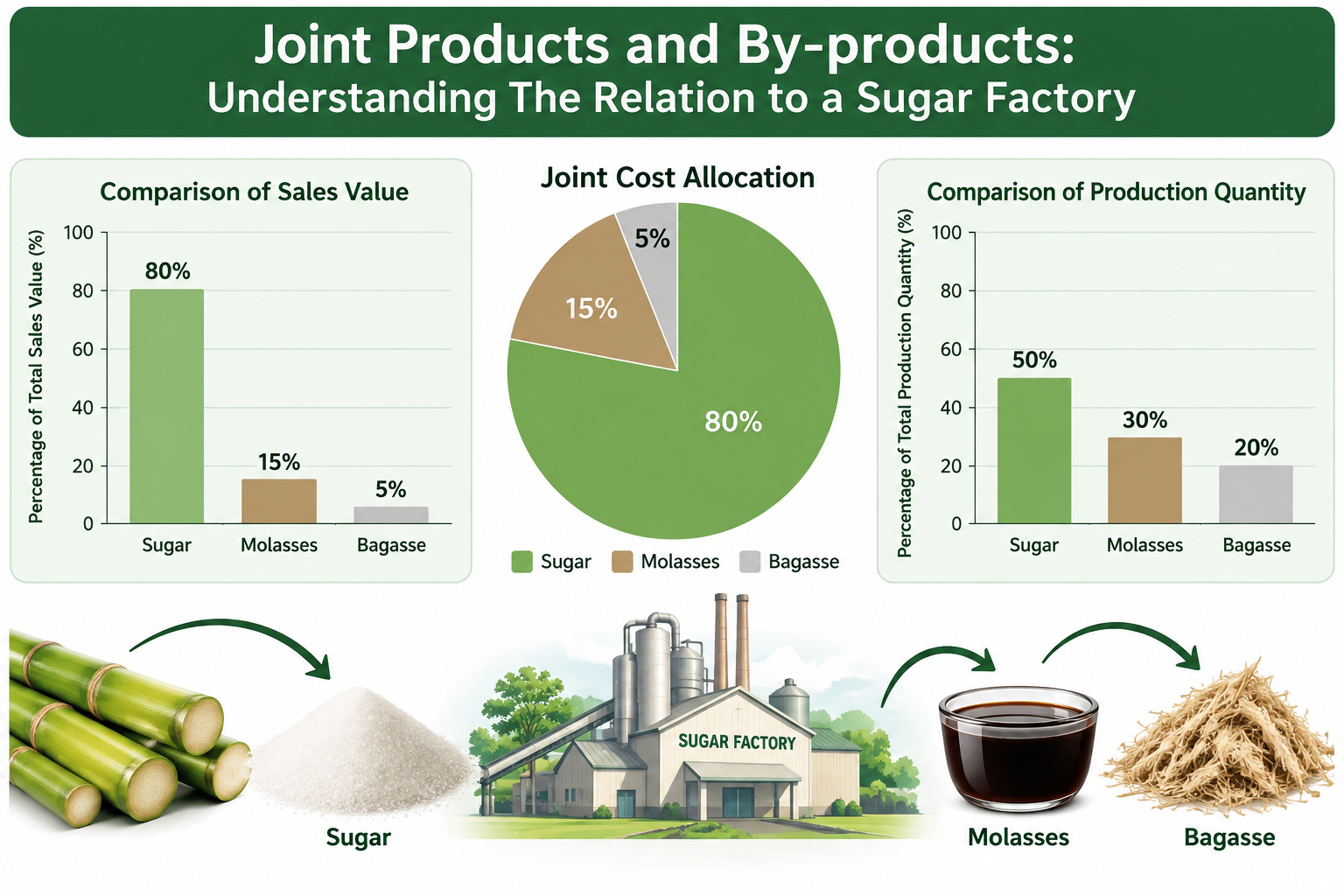
Notes: Concise, test-relevant notes are included with the lecture explaining joint costs, the definition of joint cost, the split-off point, joint cost and the distinction between joint products and by-products.
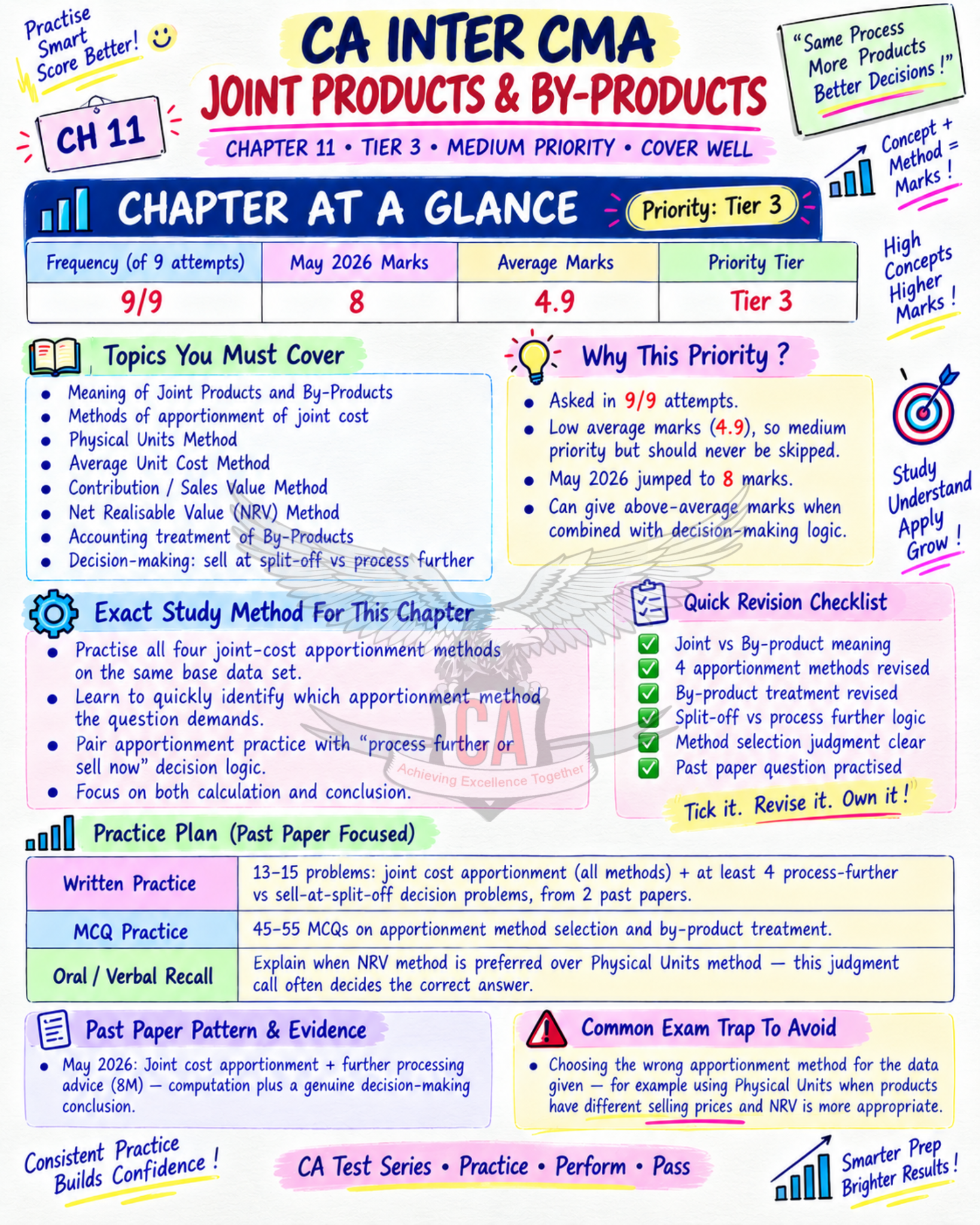
Practice questions: Once the concept is explained and the numericals are worked out, the student is asked to work out the practice questions on their own, like joint cost allocation on the basis of sales value, physical units or net realisable value
This formula – see it in animation, comprehend it using a graph, improve it by revising the notes, and finally, apply it using practice questions – this is what makes the example of the sugar factory memorable for a lot longer than a textbook illustration.
Conclusion
Both joint products and by-products are from a single process and share the same costs. However, how they are accounted for in cost accounting depends solely on their value. The sugar factory perfectly explains this concept. Sugar is the high-value main product, whereas molasses, bagasse, and press mud usually qualify as by-products.
However, in some cases, molasses may be considered a joint product, depending on how the firm values it. Learning the differences between joint products and by-products not only helps us to understand cost accounting better but is also very helpful when allocating costs and pricing the products. Visual examples, such as those shown by teachers like Himanshu Singla, help to learn these concepts more efficiently.
For more on the underlying accounting treatment, see the ICAI's Cost Accounting Standard on Joint Costs (CAS-19). You may also want to read our companion articles on the Physical Units Method and the Net Realisable Value Method in more detail.