
Every year, guidance on how to crack the CA Final exam fills the internet. Most of it follows the same pattern: start early, stay consistent, attempt mock tests, and revise thoroughly. All true. None of it is specific enough to be genuinely useful to a student sitting with six months on the clock and eight papers to prepare.
This guide is different. It is built around the specific variables that separate students who clear CA Final in their first or second attempt from those who repeat multiple times. It is honest about what actually changes your result and direct about what does not.
The Central Truth About Cracking CA Final
Before any study plan, revision schedule, or test series recommendation, there is one central truth about CA Final that determines every other preparation decision.
CA Final is not a memory examination.
ICAI does not design Final papers to test whether you can recall a provision. It designs them to test whether you can apply that provision to an unfamiliar scenario with professional-level reasoning and clarity. Students who prepare by maximising content coverage often discover through their results that coverage is not the bottleneck. Application and presentation are.
This single insight should change how you allocate your preparation time.
What Actually Determines a CA Final Result
Research into high-performer preparation patterns reveals three consistent variables:
Variable 1: Written practice under evaluated conditions
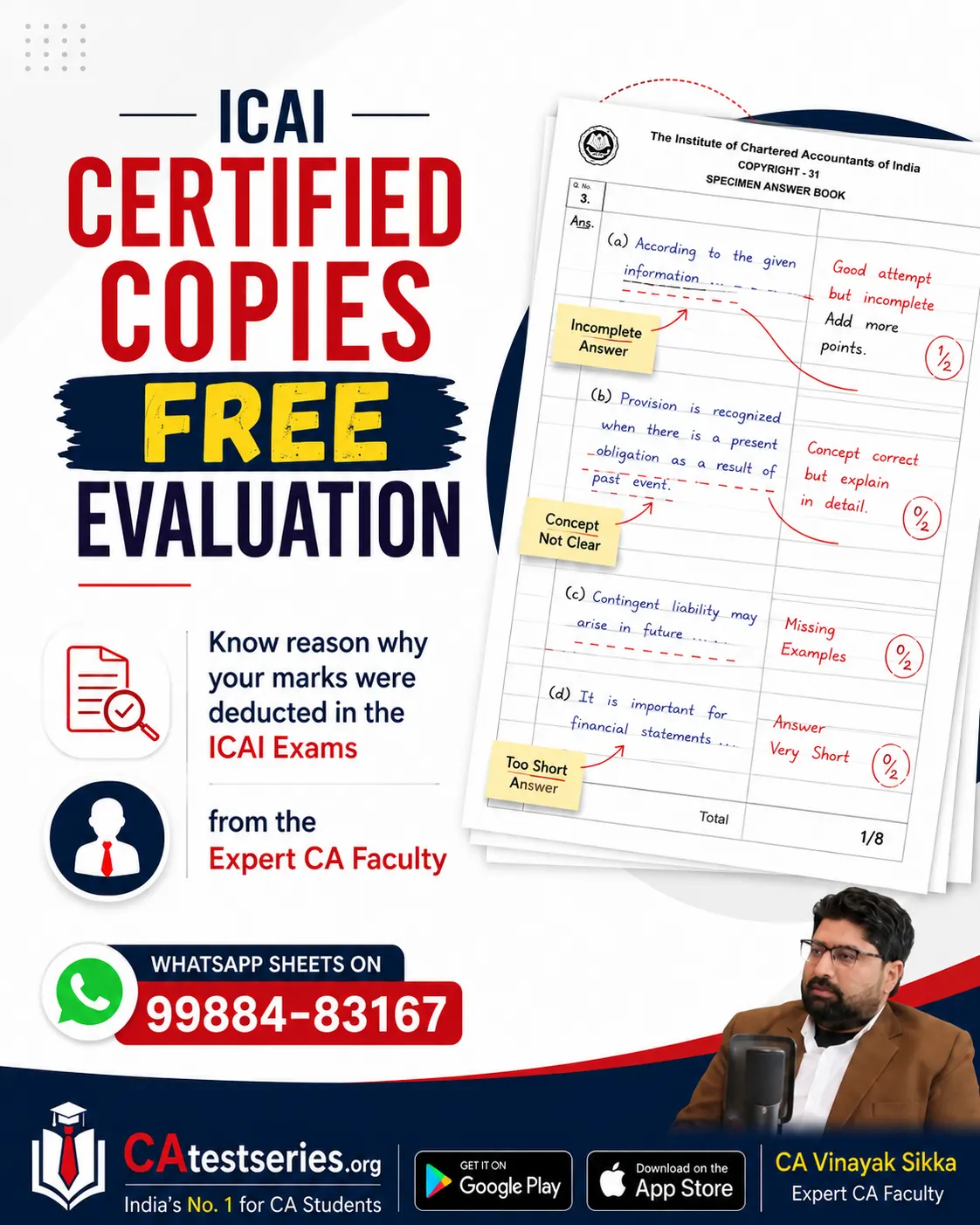
Students who clear CA Final consistently have one habit that struggling students almost universally lack: they write answers under timed conditions and get them evaluated by a qualified professional before the actual exam. Over 450 CA rank holders have been part of the CA Test Series ecosystem. The common thread is not a particular study schedule. It is consistent, evaluated, written practice.
Variable 2: Presentation quality, not just content accuracy
ICAI Final examiners assess answer structure, working note clarity, and logical flow alongside technical accuracy. Students who know the content but write poorly structured answers consistently underperform relative to their preparation. CA Test Series internal data shows a 6 to 12 mark improvement in presentation scoring among students who complete the full evaluated mock test programme. At CA Final, where group passes margins are often narrow, that range is decisive.
Variable 3: Targeted revision based on evaluated data, not instinct
Students who direct their revision based on analytics from multiple evaluated mock tests spend their preparation time on the subjects and question types that are actually costing them marks. Students who revise based on instinct or subject familiarity often spend the most time on the subjects they are already strong in.
The Preparation Framework That Works
Six Months to Four Months Before the Exam: Subject-by-Subject Foundation Building
At this stage, the goal is to cover the syllabus with genuine understanding rather than superficial familiarity. For each subject:
- Study through your primary resource (ICAI material, reference books, or revision lectures)
- Attempt a chapter-wise evaluated mock test on each major topic immediately after completing it.
- Review annotated feedback before moving to the next topic
- Build a running list of topics that the evaluation consistently flags as weak
The Syllabus for Test Series page shows exactly which subjects and topics are covered in the CA Final test series plans, so you can align your chapter-wise test practice with your study schedule.
Four Months to Eight Weeks Before the Exam: Full Group Mock Practice
Shift from subject-level tests to complete group paper mocks under timed conditions. At this stage, the goal is integrated paper performance rather than isolated subject accuracy.
Key focus areas:
- Complete each group paper without pausing the timer
- Track whether your performance holds consistently across the full three hours or deteriorates in the final hour
- Monitor group-wise score balance across multiple attempts
- Submit every paper for professional evaluation, no self-assessment
Final Eight Weeks: MTP and RTP Evaluation
ICAI releases Mock Test Papers and Revision Test Papers for each exam cycle. These are the highest-value preparation resources available in the final two months. Having them professionally evaluated, rather than self-assessed, provides a calibration against the actual exam standard that nothing else can replicate.
For plan options that include MTP and RTP evaluation, visit the CA Test Series for 2026 page.
Paper-Specific Strategy Notes for Cracking CA Final
Financial Reporting: Master the application of accounting standards to complex scenarios. Raw standard knowledge is not enough. Evaluated mock tests reveal whether your answer is demonstrating applied understanding or textbook recitation.
Strategic Financial Management: Build speed on core calculation types. SFM papers are time-intensive. Full paper mocks under timed conditions are the only way to build the calculation speed this paper demands.
Advanced Auditing: Write every audit answer as if you are advising a client, not answering an exam question. This framing shift produces more professional-sounding answers that examiners recognise as applied thinking.
Direct and Indirect Taxation: Stay current on amendments throughout your preparation. Tax law changes with each Finance Act and GST circular. Your mock tests should reflect the amendments applicable to your specific exam cycle.
Strategic Cost Management: Connect every costing analysis explicitly to the strategic context of the question. Cost calculations without strategic interpretation consistently underperform at the CA Final level.
What Does Not Work: Common CA Final Preparation Mistakes
- Studying without writing: Reading and understanding do not build writing fluency. You need timed, evaluated practice.
- Waiting for full preparation before testing: The entire purpose of mock tests is to reveal where you are not fully prepared, while time remains to fix it.
- Self-assessing subjective papers: You cannot objectively evaluate your own written answer. Professional evaluation is necessary.
- Ignoring evaluation annotations: The score is the least useful part of an evaluated sheet. The annotations are where improvement lives.
- Equal time allocation across all subjects: Data from your analytics should direct your time, not a symmetric schedule.
For plan pricing and inclusions across all CA Final preparation stages, visit the Fee Structure of Test Series page.