
Passing the CS or CMA examination is not a matter of reading more. Thousands of students who study thoroughly still fail because they have never practised writing answers under exam conditions, never received professional feedback on their presentation, and never experienced what it feels like to run out of time on a three-hour paper.
A CS and CMA test series addresses all three of those gaps. This page explains how evaluated test series practice works for CS and CMA students, what to look for when selecting a plan, and how to use the feedback cycle to convert your subject knowledge into exam-ready writing.
Why CS and CMA Students Need a Dedicated Test Series
CS and CMA are not CA. The syllabus is different, the examination pattern is different, and the professional context of each qualification is distinct. A test series built for CA students but extended loosely to CS and CMA is not the same as a test series designed with these qualifications in mind.
Here is what CS and CMA exam preparation specifically demands from a test series:
- Question sets aligned to the current ICSI or ICMAI syllabus and examination pattern
- Evaluation by professionals with relevant qualification-specific expertise
- Coverage of the correct exam cycle, since CS and CMA have June and December windows
- Subject-wise analytics that reflect the specific papers in each level
The CS and CMA test series on CA Test Series follows the same evaluation model as the CA programme: manual review by qualified professionals, annotated feedback, a marked sheet returned within 2 to 3 working days, and subject-wise performance analytics.
CS Test Series: What It Covers and Who It Is For
CS Foundation
CS Foundation is the entry point for students who have not entered through a graduate route. Papers cover Business Environment and Entrepreneurship, Business Management, Ethics and Communication, Business Economics, and Fundamentals of Accounting and Auditing.
Foundation-level test practice focuses on building written answer discipline early. Students who develop structured answer habits at Foundation carry them through Executive and Professional with a measurable advantage.
CS CSEET
The CS Executive Entrance Test is a computer-based examination that tests English, Logical Reasoning, Economic and Business Environment, and Current Affairs. Test series practice at the CSEET level focuses on MCQ accuracy, speed, and pattern familiarity.
CS Executive
CS Executive spans two modules covering Company Law, Setting up of Business Entities and Closure, Tax Laws, Economic, Commercial and Intellectual Property Laws, Securities Laws and Capital Markets, Financial and Strategic Management, and Company Accounts and Auditing Practices.
At the executive level, the papers are substantially subjective. Students need to evaluate their written answer practice to understand how their answers hold up against the standard that a CS examiner applies.
CS Professional
CS Professional is the final and most demanding level, covering Advanced Company Law, Secretarial Audit Compliance Management and Due Diligence, Corporate Restructuring, Insolvency Liquidation and Winding Up, Information Technology and Systems Audit, Financial Treasury and Forex Management, Ethics Governance and Sustainability, Drafting Pleadings and Appearances, and Multidisciplinary Case Studies.
At the professional level, case study and application-based questions dominate. Evaluation at this level requires deep expertise and close reading of how your answer applies professional judgement to the scenario, not just whether your content is accurate.
To see the specific CS plan options available for the June 2026 exam cycle, visit the CS Test Series for Jun 2026 page.
CMA Test Series: What It Covers and Who It Is For
CMA Foundation
CMA Foundation covers Fundamentals of Business Laws and Business Communication, Fundamentals of Financial and Cost Accounting, Fundamentals of Business Mathematics and Statistics, and Fundamentals of Business Economics and Management.
Foundation-level practice focuses on building core written answer structure and MCQ accuracy alongside each other. The same chapter-wise test approach used at CA Foundation applies equally here: test one topic at a time, evaluate, and fix gaps before moving to full paper mocks.
CMA Inter
CMA Inter is a substantial step up in complexity. It covers Direct Taxation, Laws and Ethics, Financial Accounting, Cost Accounting, Operations Management and Strategic Management, Financial Management, Business Valuation Management, and Indirect Taxation.
At Inter level, cost accounting and financial management papers require clean working notes and traceable calculations. Tax papers require current amendment accuracy. Evaluated mock tests at this level identify whether your presentation matches your content knowledge.
CMA Final
CMA Final is the qualification-completing examination and the most demanding. It covers Corporate Laws and Compliance, Strategic Financial Management, Strategic Cost Management, Direct Tax Laws and International Taxation, Corporate Financial Reporting, Indirect Tax Laws and Practice, Cost and Management Audit, and Strategic Performance Management and Business Valuation.
Case-study-based and application-heavy papers at the CMA Final require exactly the kind of professional evaluation that tells you whether your answers demonstrate the judgment level ICMAI examiners are looking for.
For the full plan options available for the June 2026 CMA exam cycle, visit the CMA Test Series for Jun 2026 page.
How the Evaluation Process Works for CS and CMA Students
The evaluation process for CS and CMA tests follows the same model as the CA programme:
Submission: Complete your paper under timed conditions and submit digitally. The platform is fully online. Students in India, Nepal, the UAE, and Oman can submit tests without geographic restriction.
Assignment: Your paper is assigned to a qualified evaluator with relevant subject expertise.
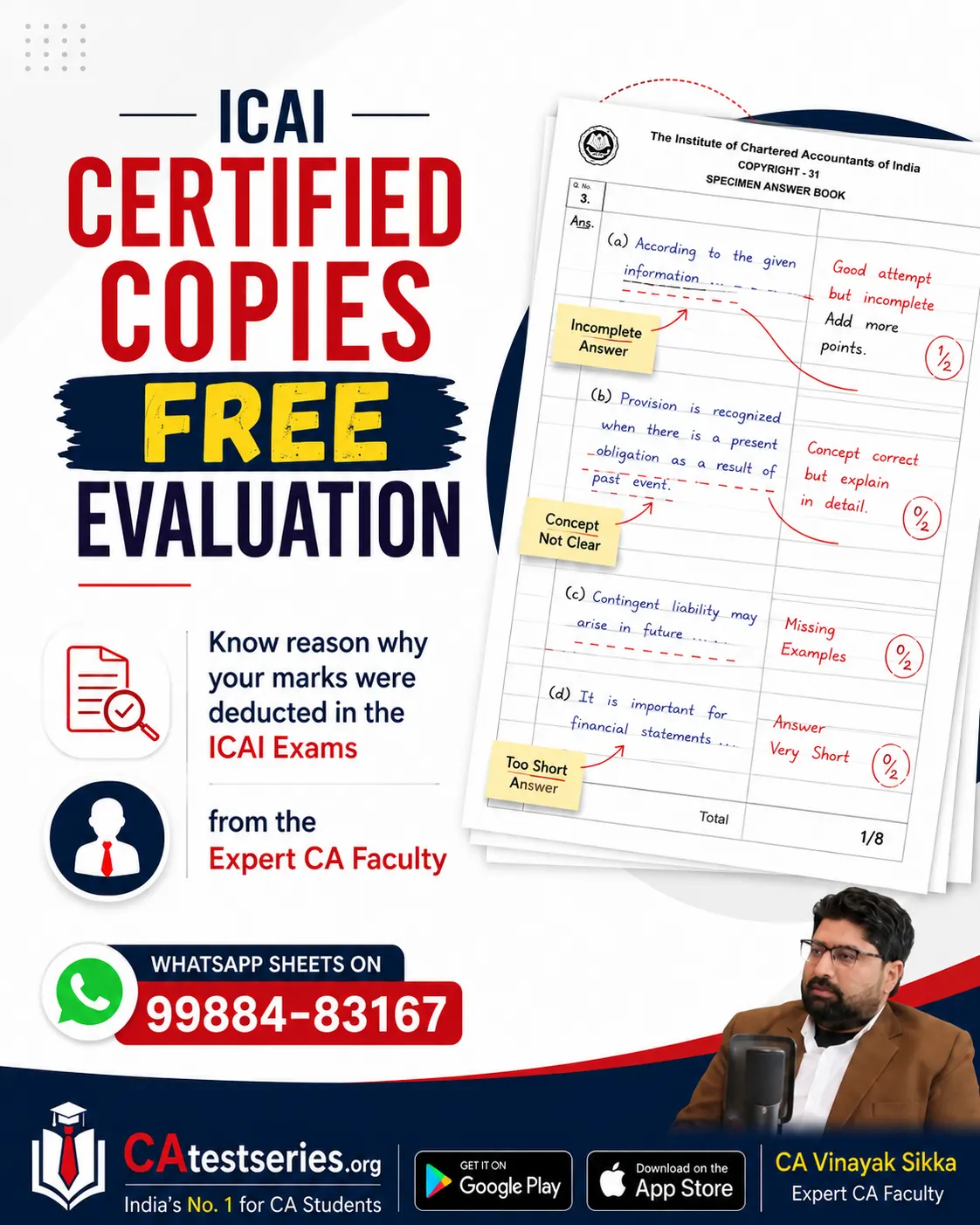
Evaluation: Every answer is marked with annotations covering content accuracy, completeness, and presentation quality. The evaluator identifies where your answer structure is costing you marks, not just where your content is wrong.
Return: Your annotated sheet is returned within 2 to 3 working days of submission.
Analytics: A subject-wise performance report is generated alongside your evaluated sheet. This report tracks your performance across multiple attempts and identifies trends.
Planning Your CS or CMA Test Series Schedule
Regardless of which qualification you are preparing for, the three-stage preparation model applies:
Stage 1: Chapter-Wise Tests (3 to 4 months before the exam) Test one topic at a time as you complete your revision. Submit every paper for evaluation. Do not self-assess.
Stage 2: Full Paper Mocks (4 to 8 weeks before the exam) Attempt complete papers under timed exam conditions. Track performance across subjects using your analytics report.
Stage 3: Revision Paper Evaluation (Final 3 to 4 weeks) Use final-stage papers to calibrate your preparation. Submit every paper for professional evaluation. Use annotated feedback for last-round corrections.
To confirm which subjects and papers are covered in your specific plan, review the Syllabus for Test Series page before enrolling.
What to Look for When Choosing a CS or CMA Test Series Plan
Before selecting a plan, apply these filters:
- Does the plan cover all subjects in your module or level?
- Is the evaluation done by a qualified professional, not an automated system?
- Is the turnaround time clearly stated and consistent with your revision schedule?
- Does the plan include MTP or equivalent revision paper evaluation?
- Are subject-wise analytics included alongside the evaluated sheets?
For full plan details and pricing by CS and CMA level, visit the Fee Structure of Test Series page. This gives you complete visibility into what each plan includes before you enrol.
Combining CS and CMA Test Practice with CA Preparation
A significant number of students pursuing CS or CMA are also CA students or CA aspirants. For those students, the CA test series ecosystem on the same platform allows you to manage multiple qualification preparations without switching between providers.
The CA Test Series for 2026 covers Foundation, Inter, and Final levels across the CA programme, while the CS and CMA test series plans run on the same evaluation infrastructure. Analytics and evaluation sheets for all qualifications are accessible through the same platform.