
CA Inter is the point where the CA journey becomes genuinely demanding. The jump from Foundation to Inter is significant. Papers are longer. Answers are subjective. The syllabus spans eight subjects across two groups. Students who sail through Foundation on reading and memory alone often find that Inter requires something different: the ability to write coherent, well-structured answers under time pressure.
That is exactly what a CA Inter mock test series is built to develop.
What Makes CA Inter Different from the Foundation
Before understanding how a mock test series helps at the Inter level, it is worth being clear about what has changed.
At Foundation, most questions are objective. You select an answer or write a short response. At Inter, you are writing full answers to case-based questions across subjects like Accounting, Law, Cost and Management Accounting, Taxation, and Audit.
This means two things:
- You can know the content perfectly and still lose marks if your answer is poorly structured
- Time management becomes critical because every paper is three hours long
A CA Inter mock test series addresses both. It gives you repeated practice writing full answers, and it builds the internal clock that tells you when to move on from a question.
Group 1 and Group 2: Planning Your Mock Practice
CA Inter has two groups. Whether you are attempting one or both in your upcoming exam cycle, your mock test practice should be planned around that.
If you are attempting Group 1 only: Focus on Accounting, Law, Cost and Management Accounting, and Taxation. Use chapter-wise tests early and move to full group mocks as the exam approaches.
If you are attempting Group 2 only: Cover Advanced Accounting, Auditing, Enterprise IT Systems, and Strategic Management. The same phase structure applies.
If you are attempting both groups together: Alternate between groups during your mock practice so neither receives less attention than the other. Track performance separately for each group using your analytics report.
The CA Test Series for 2026 plans are structured to accommodate both single-group and both-group preparation.
The Role of Chapter-Wise Tests at the Inter Level
Many Inter students skip chapter-wise tests and move directly to full mocks. This is a mistake.
Chapter-wise tests serve a specific function: they isolate your understanding of one topic at a time and reveal whether you can write a complete, well-structured answer on that topic when it is the only subject in front of you. When you move to full mocks without this foundation, weak chapters hide inside the larger paper. You may score adequately overall but have significant blind spots that cost marks on specific question types.
Use chapter-wise tests for every subject before attempting full mocks. Get them evaluated, not self-assessed. The feedback you receive at this stage corrects habits before they become patterns.
A Realistic Week-by-Week Practice Schedule
Here is a simple framework for building a CA Inter mock test series into your preparation calendar:
8 to 12 weeks before the exam: Attempt one chapter-wise test per subject per week. Submit for evaluation. Review returned sheets and rewrite weak answers before the next test.
4 to 8 weeks before the exam: Move to full subject-level tests covering complete papers. Focus on time management and full-paper coverage. Use your analytics from the Syllabus for Test Series to confirm you are covering every topic.
2 to 4 weeks before the exam: Attempt MTP and RTP papers under exam conditions. Submit for evaluation and focus specifically on closing the gaps identified in your analytics.
How Evaluation Works and What You Get Back
When you submit a CA Inter mock test at CA Test Series, this is what happens next:
- A practising Chartered Accountant is assigned to your paper
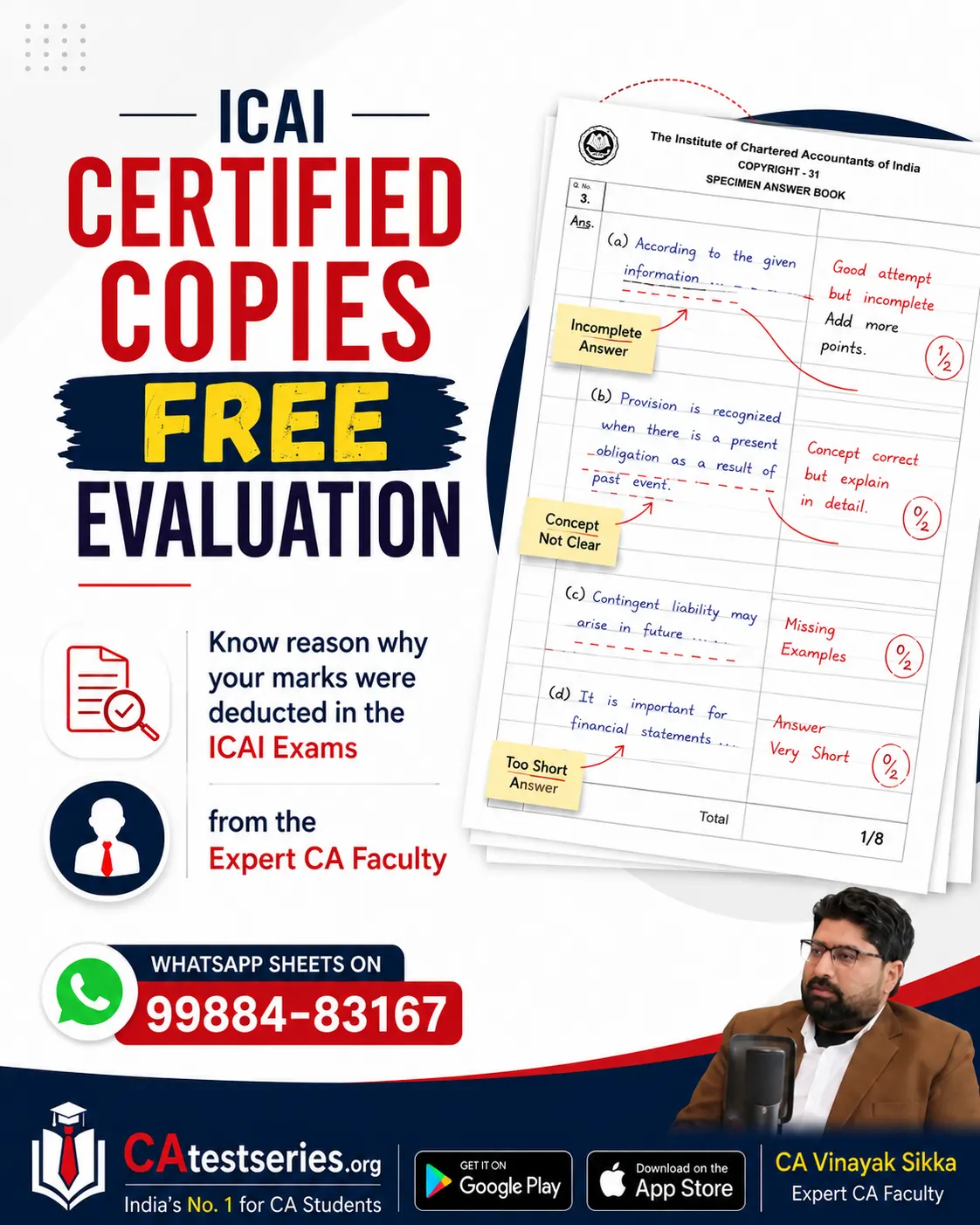
- Each answer is marked with annotations covering both content and presentation
- Your evaluated sheet is returned within 2 to 3 working days
- A subject-wise performance breakdown is generated in your analytics report
The presentation feedback is specific. It tells you where your answer structure cost you marks, not just where your content was wrong. For Inter students developing their writing habits for the first time, this distinction is essential.
What the Analytics Report Tells You
Your analytics report is a diagnostic tool, not a progress certificate. After each evaluated test, look at:
- Which subjects are consistently below your target score?
- Which question types (case studies, calculations, theory) are losing the most marks?
- Is your performance improving across multiple tests in the same subject?
- Are there subjects where your content is strong, but the presentation is pulling down your score?
Use the answers to these questions to direct your revision time. Students who engage with analytics at this level of detail make measurably better use of their preparation time than those who look only at their total score.
Supporting Your Test Practice with the Right Resources
Test practice works best when it is running alongside strong conceptual revision. If you are a Foundation student considering the transition to Inter-level preparation, building your conceptual base early pays dividends. The CA Foundation Video Lectures and Books page is a relevant starting point for students in that transition phase.
For Inter students who want to understand the full plan and cost structure before enrolling, the Fee Structure of Test Series provides a clear breakdown of what each plan includes.