
Type "CA Foundation notes PDF" into any search engine, and within seconds, you have access to hundreds of downloadable documents. Handwritten notes, typed summaries, chapter compilations, past paper analysis, and formula sheets. All free. All immediately available.
So why do thousands of students who have every PDF they could need still fail CA Foundation?
The answer is not a knowledge gap. It is a performance gap. Notes, PDFs, and study material give you information. They do not tell you whether you can use that information to write an exam-quality answer under timed pressure, in the format an ICAI examiner expects, with working notes clear enough to earn full marks.
This page explains what CA Foundation notes PDFs are useful for, where they fall short, and what you need alongside them to build preparation that actually produces results.
What CA Foundation Notes PDFs Are Good For
Let us be fair. Notes and PDFs serve a genuine purpose in CA Foundation preparation. Used correctly, they are efficient study tools.
Where they add real value:
- Consolidating large chapters into manageable revision summaries
- Providing formula sheets for Quantitative Aptitude quick reference
- Offering mnemonics and structured lists for Business Laws provisions
- Summarising key concepts in Business Economics for rapid pre-exam review
- Providing worked examples for Accounting topics before attempting practice problems
The specific use case where PDFs are most effective:
Chapter summaries and formula references used immediately before a chapter-wise mock test. You review the key points from a chapter, then attempt an evaluated test on that chapter. The PDF helps you recall what to write. The evaluated test tells you whether what you actually write meets the standard required.
That combination is where PDF notes and evaluated practice work together productively.
Where CA Foundation Notes PDFs Fall Short
Here is the honest limitation that most students discover only after a poor result.
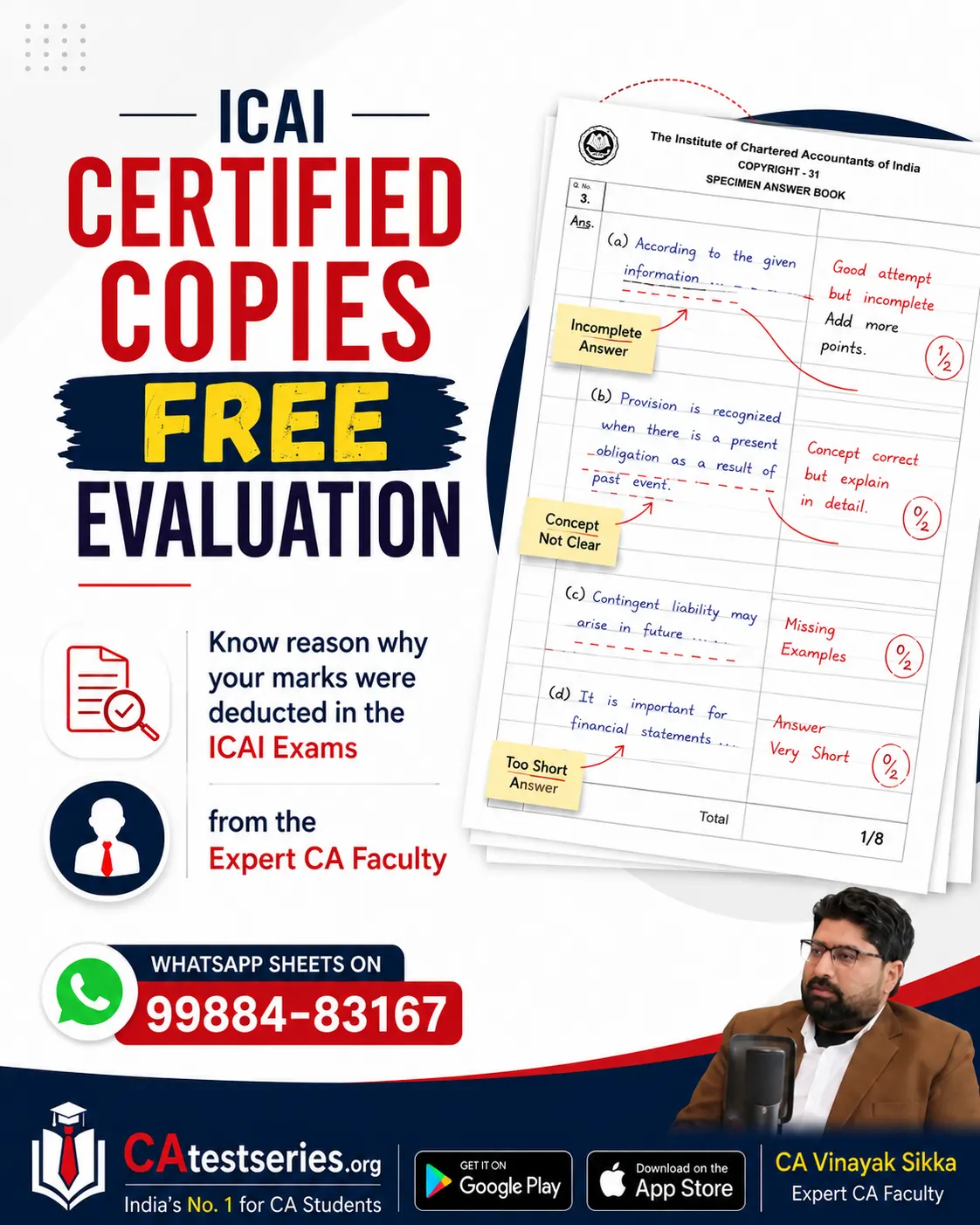
A PDF cannot tell you whether your Accounting answer is presented correctly. It cannot tell you whether your Law answer follows the four-step structure an ICAI examiner expects. It cannot tell you whether your working notes are clear enough to earn method marks even if your final figure is wrong. It cannot tell you whether you can complete a full paper within three hours.
These are execution gaps, not knowledge gaps. And notes cannot close execution gaps. Only writing evaluated answers under timed conditions can do that.
The students who perform best at CA Foundation are not those with the most comprehensive PDF collection. They are those who write the most evaluated answers and engage most seriously with the feedback those evaluations provide.
Paper-by-Paper: What Notes Provide vs What You Still Need
Paper 1: Principles and Practice of Accounting
What notes provide: Formats for financial statements, classification of accounts, worked examples for specific transaction types.
What notes cannot provide: Whether your working notes are traceable under examination conditions, whether your financial statement format is technically correct when produced under time pressure without reference material, whether your answer completes every required component.
What closes the gap: Written answer evaluation by a practising CA. The annotated sheet tells you exactly where your Accounting answers are losing marks due to presentation rather than content.
Paper 2: Business Laws
What notes provide: Summaries of key provisions, case law references, definitions of key terms.
What notes cannot provide: Whether your answer applies the provision to the specific scenario in the question, whether your answer follows the required four-step structure, whether your conclusion is clearly stated.
What closes the gap: Evaluated Law mock tests where the annotator specifically identifies at which step in the structure your answer falls short.
Paper 3: Quantitative Aptitude
What notes provide: Formula references, solved examples, step-by-step method guides.
What notes cannot provide: Whether you can apply these methods accurately under timed conditions on unfamiliar question formats.
What closes the gap: Timed MCQ practice with accuracy tracking across multiple attempts. The Syllabus for Test Series page confirms which QA topics and question formats are covered in Foundation-level test plans.
Paper 4: Business Economics
What notes provide: Conceptual summaries, diagrams of market structures, macroeconomic framework overviews.
What notes cannot provide: Whether you can apply these frameworks to the application-based MCQ formats ICAI uses at Foundation level.
What closes the gap: MCQ practice sets that test application rather than recall.
Building a Preparation System That Goes Beyond PDF Notes
The students who clear CA Foundation efficiently are not the students with the best notes. They are the students who use notes as one tool within a broader preparation system.
A complete CA Foundation preparation system includes:
- Primary study through ICAI material or structured video lectures
- Chapter summaries and formula references in PDF or notebook format for revision
- Chapter-wise evaluated mock tests for Papers 1 and 2 after completing each topic
- MCQ accuracy tracking for Papers 3 and 4
- Full paper mocks under timed conditions, 5 to 7 weeks before the exam
- MTP and RTP evaluation in the final 3 weeks
For Foundation students combining structured lecture content with test practice, the CA Foundation Video Lectures and Books page provides resources that work alongside this system directly.
For a complete overview of Foundation test series plans currently available, including chapter-wise and full paper options, visit the CA Test Series for 2026 page.
For full pricing and plan details at the Foundation level, visit the Fee Structure of Test Series page.
The One Thing PDF Notes Will Never Tell You
No matter how comprehensive, accurate, or well-organised a set of CA Foundation notes PDF is, it cannot tell you this: whether the answer you write in the examination hall will satisfy an ICAI examiner reading it for the first time with no knowledge of what you know.
That answer only comes from submitting your written work to a qualified evaluator and reading what they say about it.
Notes are the input. Evaluated mock tests are how you find out whether the input is being converted into output that earns marks.