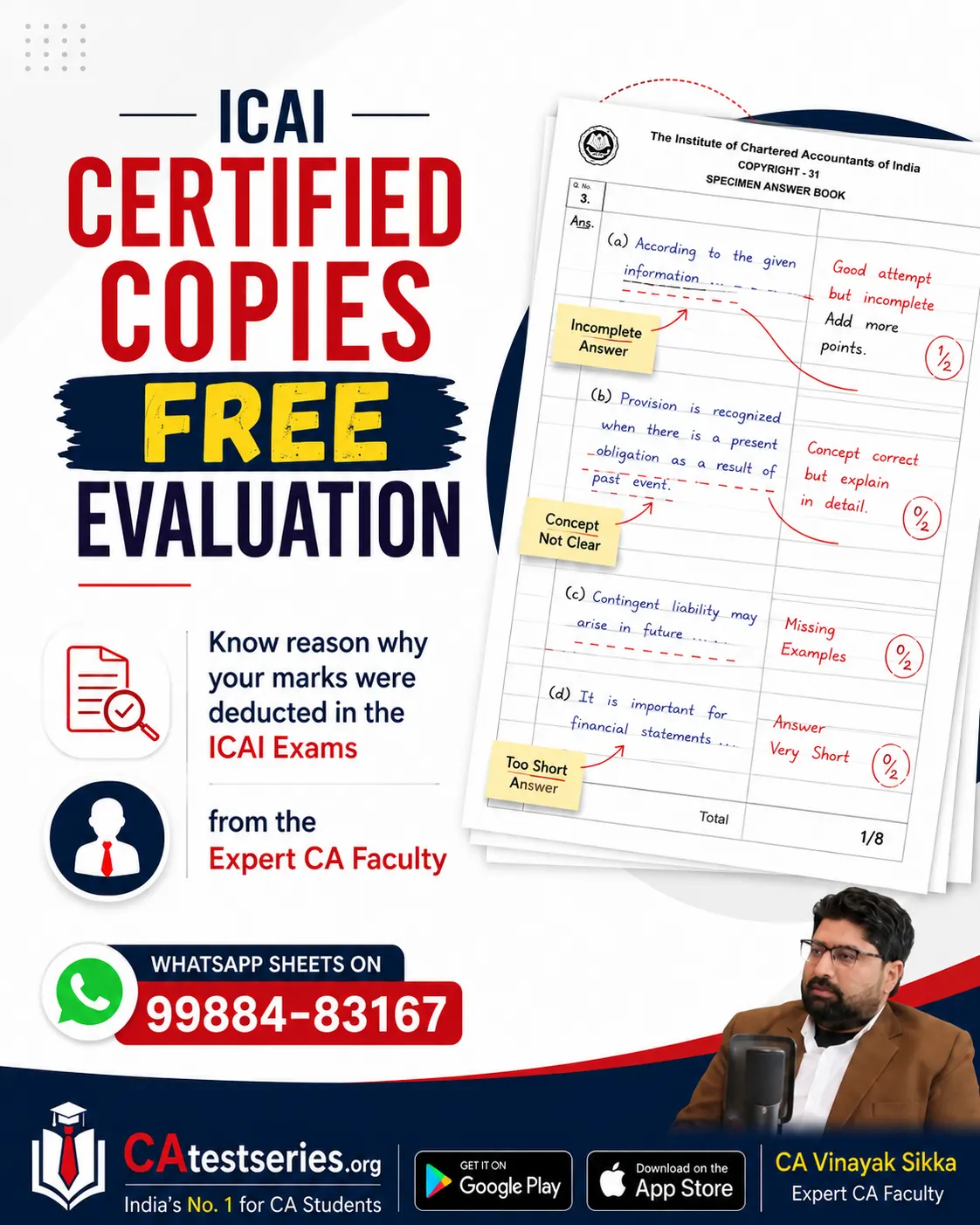

Ask a CA Foundation student whether they have attempted mock tests, and most will say yes. Ask them whether those mock tests were professionally evaluated, and most will say no. Ask them whether they rewrote weak answers after receiving annotated feedback, and almost none will say yes.
This gap between attempting a CA Foundation mock test and actually using it as a preparation tool is why so many students who studied thoroughly still underperform in their actual exam. A mock test is not a checkbox. It is the beginning of a feedback loop. This page explains how that loop works, why it matters more than most students realise, and how to build it into your Foundation preparation from the start.
What a CA Foundation Mock Test Actually Measures
CA Foundation tests two fundamentally different skills across its four papers.
Knowledge: What you understand about Accounting, Business Laws, Quantitative Aptitude, and Business Economics. This is what reading and revision build.
Performance: Whether you can express that knowledge accurately and clearly in a timed exam environment. This is what a mock test measures.
The gap between these two things is the single most common reason CA Foundation results disappoint despite adequate preparation. Students know the subject. They cannot yet perform it on a three-hour paper. A CA Foundation mock test reveals this gap. A professional evaluation tells you exactly where it exists and how to close it.
The Four Papers and What Mock Tests Reveal for Each
Paper 1: Principles and Practice of Accounting
Mock tests for Paper 1 reveal:
- Whether your working notes are traceable or presented as floating numbers without clear workings
- Whether your financial statement formats are technically correct or contain structural errors
- Whether you are completing all required components of an answer or truncating under time pressure
- Whether your final figures are correct but your method marks are being lost due to incomplete workings
Self-assessed Accounting answers rarely reveal any of these gaps because you know what you meant to include. An evaluator reading only what you wrote will find every gap.
Paper 2: Business Laws
Mock tests for Paper 2 reveal:
- Whether your answers follow the four-step structure expected at the Foundation level
- Whether you are applying the provision to the specific scenario in question or merely restating the provision
- Whether your conclusion is clearly stated or implied
- Whether you are addressing every element of a multi-part question
The most common feedback on Foundation Law papers is that students reach the explanation stage and stop before completing the application and conclusion. This is invisible in self-assessment because you know the application in your head. It is visible to every evaluator who reads only your page.
Paper 3: Quantitative Aptitude
Mock tests for Paper 3 reveal:
- Which topic areas consistently produce errors
- Whether errors are due to concept gaps or calculation mistakes under time pressure
- Whether your MCQ answer selection speed is adequate for the paper's time requirements
Evaluated QA practice with accuracy tracking across multiple attempts shows whether specific topic areas are systematic problems or random errors. Systematic errors require revision. Random errors under time pressure require more timed practice.
Paper 4: Business Economics
Mock tests for Paper 4 reveal:
- Whether your conceptual understanding translates into correct answer selection on application-based MCQs
- Which framework areas (demand-supply, market structures, national income) are producing the most errors
- Whether your elimination approach to uncertain questions is statistically sound
How to Run a Complete CA Foundation Mock Test Cycle
A single mock test produces limited value. A cycle of tests run consistently across your preparation period produces measurable improvement. Here is the cycle:
Step 1: Complete a topic or chapter through your study material or video lectures.
Step 2: Attempt a chapter-wise mock test on that topic within 48 hours. No notes. Time yourself.
Step 3: Submit Papers 1 and 2 for professional evaluation. For Papers 3 and 4, track your accuracy score.
Step 4: When your Paper 1 or 2 evaluation sheet returns within 2 to 3 working days, read every annotation before looking at your total score.
Step 5: Separate marks lost due to content errors from marks lost due to presentation errors. These require different corrective actions.
Step 6: Rewrite every answer that received presentation-specific feedback before attempting the next chapter's test.
Step 7: Move to the next chapter and repeat.
This cycle converts a CA Foundation mock test from a single-data-point activity into a preparation system.
For Foundation students combining lecture study with mock test practice, the CA Foundation Video Lectures and Books page provides structured resources that integrate directly with this chapter-by-chapter cycle.
Free Mock Tests vs Evaluated Mock Tests at Foundation Level
The CA Test Series app offers a free MCQ-based test series with instant results. For Papers 3 and 4, this is a genuinely useful revision tool. Objective papers are well-served by instant-result accuracy tracking.
For Papers 1 and 2, which are fully subjective, free instant-result tests are not available because subjective papers cannot be meaningfully auto-assessed. Professional evaluation is the only way to receive the presentation and content feedback that actually improves your Paper 1 and 2 scores.
Students who rely only on free MCQ tools are well-prepared for Papers 3 and 4 and underprepared for Papers 1 and 2. For the qualification's two highest-complexity subjective papers, paid evaluation plans are not optional for students who want to clear the Foundation reliably.
Confirm subject coverage and plan inclusions before enrolling at the Syllabus for Test Series page. For full pricing across Foundation-level plans, visit the Fee Structure of Test Series page.
For an overview of all current Foundation, Inter, and Final test series plans, visit the CA Test Series for 2026 page.
When to Start and How to Pace Your Foundation Mock Tests
Start: As soon as you complete your first chapter of any subject. Do not wait until the full syllabus is covered.
Pace: One chapter-wise evaluated test per major topic across your preparation period. Two to three full paper mocks in the six to eight weeks before the exam. MTP and RTP evaluation in the final three to four weeks.
Minimum before exam day: Two to three full paper mock attempts with professional evaluation for Papers 1 and 2. Multiple timed MCQ practice sets for Papers 3 and 4. At least one round of MTP evaluation.