
Embarking on the prestigious chartered accountancy journey in India begins with conquering the highly competitive entry-level CA Foundation exam. Under the recently implemented guidelines set forth by the Board of Studies, candidates must navigate restructured papers specifically designed to evaluate foundational professional competence. Utilizing high-caliber prep methodologies and understanding the core mechanics of the examination format can easily elevate a student's preparation from average to outstanding. For more information, explore the Syllabus for Test Series.
Structural Evolution and Current Frequency of the Entrance Test
Navigating the Shift to a Thrice-Yearly Examination Cycle
In a major regulatory overhaul designed to alleviate candidate stress and streamline career progress, the Institute of Chartered Accountants of India increased the frequency of this entry-level examination to three times annually. This structural shift allows aspiring finance professionals to schedule their exam attempts strategically across January, June, and September sessions without the fear of losing an entire academic year to a single setback. In practice, having more frequent testing windows reduces the intense psychological pressure on students and allows for highly customized study timelines that align with individual learning paces.
Classifying the Core Demands of Subjective and Objective Formats
The current assessment framework maintains a distinct dual format by dividing the curriculum into two descriptive papers and two objective multiple-choice papers. Papers 1 and 2 demand comprehensive handwriting skills, analytical step-by-step calculations, and proper legal cross-referencing, whereas Papers 3 and 4 require rapid quantitative logic and swift mathematical elimination under tight time constraints. Successful candidates recognize that these contrasting paper formats necessitate two completely different exam-day mindsets and problem-solving techniques. For more information, explore the CA Test Series.
Table 1: Comprehensive Paper Breakdown of the New Scheme
Paper Identification | Primary Subject and Core Syllabus Focus Areas | Assessment Type | Exam Duration | Maximum Marks |
Paper 1 | Accounting (Focusing on foundational concepts, journal ledgers, and preparation of financial statements) | Subjective and Descriptive | 3 Hours | 100 Marks |
Paper 2 | Business Laws (Focusing on commercial contracts, partnership regulations, and corporate compliance frameworks) | Subjective and Descriptive | 3 Hours | 100 Marks |
Paper 3 | Quantitative Aptitude (Comprising Business Mathematics, Logical Reasoning, and Descriptive Statistics) | Objective and Multiple Choice | 2 Hours | 100 Marks |
Paper 4 | Business Economics (Covering fundamental microeconomics, macroeconomics, and national income accounting concepts) | Objective and Multiple Choice | 2 Hours | 100 Marks |
Registration Milestones and Investment Breakdowns
Step-by-Step Navigation of the Online Self Service Portal
To initiate their professional journey, candidates must complete a fully digital registration process managed through the official Self Service Portal of the regulatory body. Uploading high-resolution educational documents, verifying qualifying certificates, and paying the standardized fees are mandatory steps to secure an active student profile. Failure to input accurate biographical details or complete the verification pipeline can lead to administrative holds that delay your target attempt.
List 1 (OL) - Sequential Portal Registration Protocol
Access the official Self Service Portal dashboard and register as an active new student user.
Enter detailed biographical information, contact details, and precise geographical location parameters.
Upload certified scanned copies of your official Class 10 and Class 12 mark sheets securely.
Execute the online payment transaction for the standard foundation registration fee structure.
Receive the official Board of Studies registration confirmation email and download your student card.
Eligibility Rules and Necessary Financial Investments
While the regulatory body permits provisional registration immediately after a student completes their Class 10 examinations, actual physical appearance in the examination hall requires clearing the Class 12 board assessments. Furthermore, candidates must respect a mandatory four-month study period between their official registration date and the first day of the actual exam month. Aspirants should also budget meticulously for the comprehensive fee schedule to ensure all exam-related materials are officially procured without logistical interruptions; reviewing the Fee Structure of Test Series can help plan these investments effectively.
Table 2: Breakdown of Financial Investment and Registration Parameters
Administrative Category | Indian Students Fees (INR) | International Candidates Fees (USD) | Validity and Revalidation Term |
Course Registration Cost | ₹9,000 | $700 | Valid for 3 years from registration date |
Official Prospectus Fee | ₹200 | $20 | One-time fee paid at initial entry |
Standard Exam Form Fee | ₹1,500 | $325 | Paid per individual physical attempt |
Performance Criteria and Negative Marking Dynamics
Understanding the Subject-Wise and Aggregate Score Thresholds
Securing a qualifying status in the entry-level chartered accountancy examination requires satisfying a strict dual-layered grading matrix. Candidates must achieve a minimum score of 40% in each of the four individual subjects to prevent automatic failure in that specific subject. Concurrently, the cumulative score across all subjects must reach a minimum aggregate of 50%, representing 200 marks out of the maximum 400 marks.
List 2 (UL) - Minimum Passing Standards by Individual Paper
Paper 1 requires a minimum of forty marks to avoid failing the subjective accountancy segment.
Paper 2 demands a minimum of forty marks to pass the intensive mercantile law evaluation.
Paper 3 mandates a minimum of forty marks to clear the quantitative aptitude examination paper.
Paper 4 requires a minimum of forty marks to satisfy the comprehensive business economics assessment.
The total aggregate of all four papers combined must equal at least two hundred marks.
Strategic Mitigation of Negative Marking Penalties
Unlike the subjective portions of the exam, the objective multiple-choice formats in Papers 3 and 4 enforce a strict penalty mechanism to discourage arbitrary guessing. For every incorrect selection, a candidate suffers a deduction of 0.25 marks, whereas unattempted questions are simply graded at zero. Consequently, students must cultivate a rigorous question selection rule to protect their hard-earned score from getting eroded by careless guessing; resources such as the CS Test Series offer targeted practice to sharpen this discipline.
List 3 (UL) - Tactical Approaches to Handle Objective Papers
Solve high-confidence problems first to build an unshakeable base score early.
Eliminate highly illogical options before making any calculated guessing decisions.
Leave questions completely blank if you cannot narrow options down to two choices.
Track exam time carefully to ensure adequate seconds are allocated per question.
Tactical Preparation Blueprints and Practice Methods
Enhancing Performance Through Simulated Trial Exams
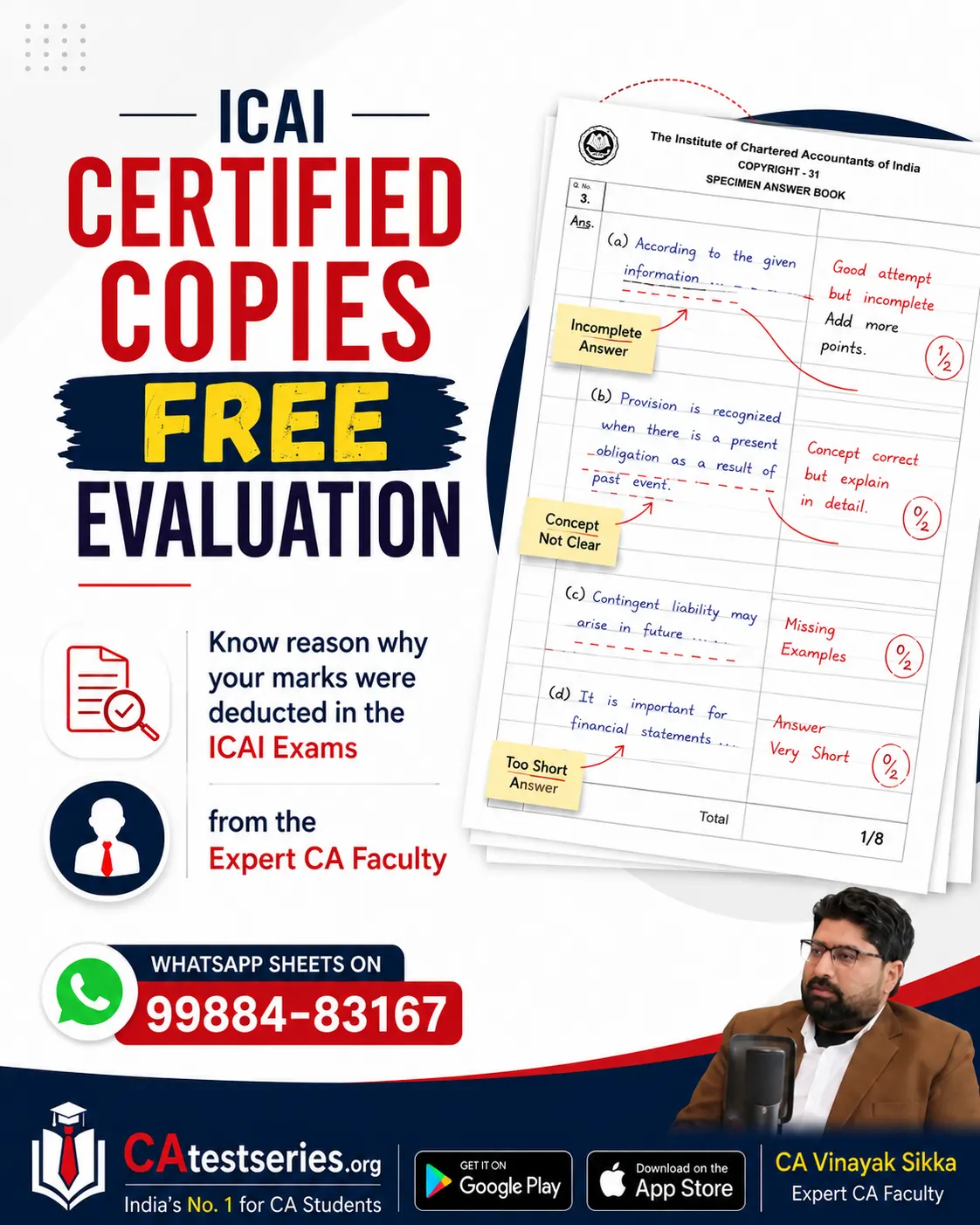
Attempting multiple full-length mock examinations under authentic exam-day constraints is the absolute fastest way to identify fatal knowledge gaps before the actual test. Professional feedback indicates that analyzing detailed step-by-step examiner evaluations helps candidates significantly improve their handwriting presentation in descriptive law papers. Students preparing for CA Final levels also benefit from building these habits early, and starting with a diagnostic mock at Catestseries delivers a personalized feedback sheet that optimizes your revision schedule.