
The CA Foundation course serves as your gateway to entering the prestigious field of chartered accountancy in India. Administered by the Institute of Chartered Accountants of India, this introductory level builds your conceptual framework in accounting, business laws, quantitative aptitude, and economics. Navigating this entry point requires a deep understanding of the newly streamlined exam patterns and registration deadlines. For more information, explore the Syllabus for Test Series.
Deconstructing the Updated CA Foundation Syllabus and Structure
Comprehensive Overview of the Four Core Papers
The modern syllabus is strictly divided into four distinct academic papers designed to test diverse competency levels. While Papers 1 and 2 require descriptive answers, Papers 3 and 4 are entirely objective and feature negative marking for wrong attempts. This balanced format ensures that candidates possess both analytical skills and structured written expression before moving to the intermediate phase.
Paper Number | Subject Title | Exam Format | Total Marks | Duration |
Paper 1 | Accounting | Subjective (Descriptive) | 100 Marks | 3 Hours |
Paper 2 | Business Laws | Subjective (Descriptive) | 100 Marks | 3 Hours |
Paper 3 | Quantitative Aptitude | Objective (MCQs) | 100 Marks | 2 Hours |
Paper 4 | Business Economics | Objective (MCQs) | 100 Marks | 2 Hours |
Passing Criteria and Negative Marking Mechanics
Achieving success in this examination depends on meeting two distinct, independent passing criteria set by the council. Candidates must secure a minimum score of forty percent in every individual paper while simultaneously reaching a fifty percent overall aggregate. Neglecting the negative marking penalty of zero point two five marks on objective papers often prevents students from achieving this mandatory aggregate. For more information, explore the CA Test Series.
Step-by-Step Registration and Eligibility Guidelines
Entry Requirements and Document Verification
Aspiring candidates can officially register for the initial level after successfully passing their class tenth examinations. However, you can only sit for the physical exam once you complete your class twelfth board papers from a recognized education board. The eligibility rules allow students from science, arts, or commerce streams to transition seamlessly into this professional stream.
Access the official online Self Service Portal of the Institute of Chartered Accountants of India.
Create a student login ID by verifying your mobile number and personal email address.
Fill out the online registration form with your accurate personal and educational history.
Upload scanned copies of your class tenth and twelfth marks sheets.
Pay the registration fees online using credit cards, debit cards, or net banking.
Print the generated transaction receipt and the registration form for future reference.
Fee Structure and Registration Validity Period
The financial commitment for completing your initial enrollment remains uniform across the country for all Indian domestic students. Once registered on the portal, your account and candidacy validity remain active for a total period of four consecutive years. If your credentials lapse before you clear this level, you must undergo a systematic revalidation process to continue. Students exploring the Fee Structure of Test Series can plan their overall preparation budget more effectively alongside registration costs.
Student Category | Registration Fee | Prospectus Cost | Subscription Fee (Optional) | Total Amount Payable |
Indian Domestic Student | Rs. 9,000 | Rs. 200 | Rs. 400 | Rs. 9,600 |
International Candidate | $700 | $20 | $40 | $760 |
Practical Preparation Strategies for the New Scheme
Leveraging Official ICAI Study Modules and Mock Tests
Candidates must prioritize the official study material provided by the board as their primary resource for concept clarification. Combining these resources with systematic answer writing practice on professional platforms helps bridge the gap between memory and exam execution. For instance, using a reliable CA Test Series helps you identify formatting errors and conceptual gaps under simulated examination conditions.
Official study modules provide complete conceptual clarity and contain examples that frequently appear in actual exams.
Revision test papers offer a comprehensive review of statutory updates and modifications made to the syllabus.
Mock test papers evaluate your speed and identify weak areas that require additional study.
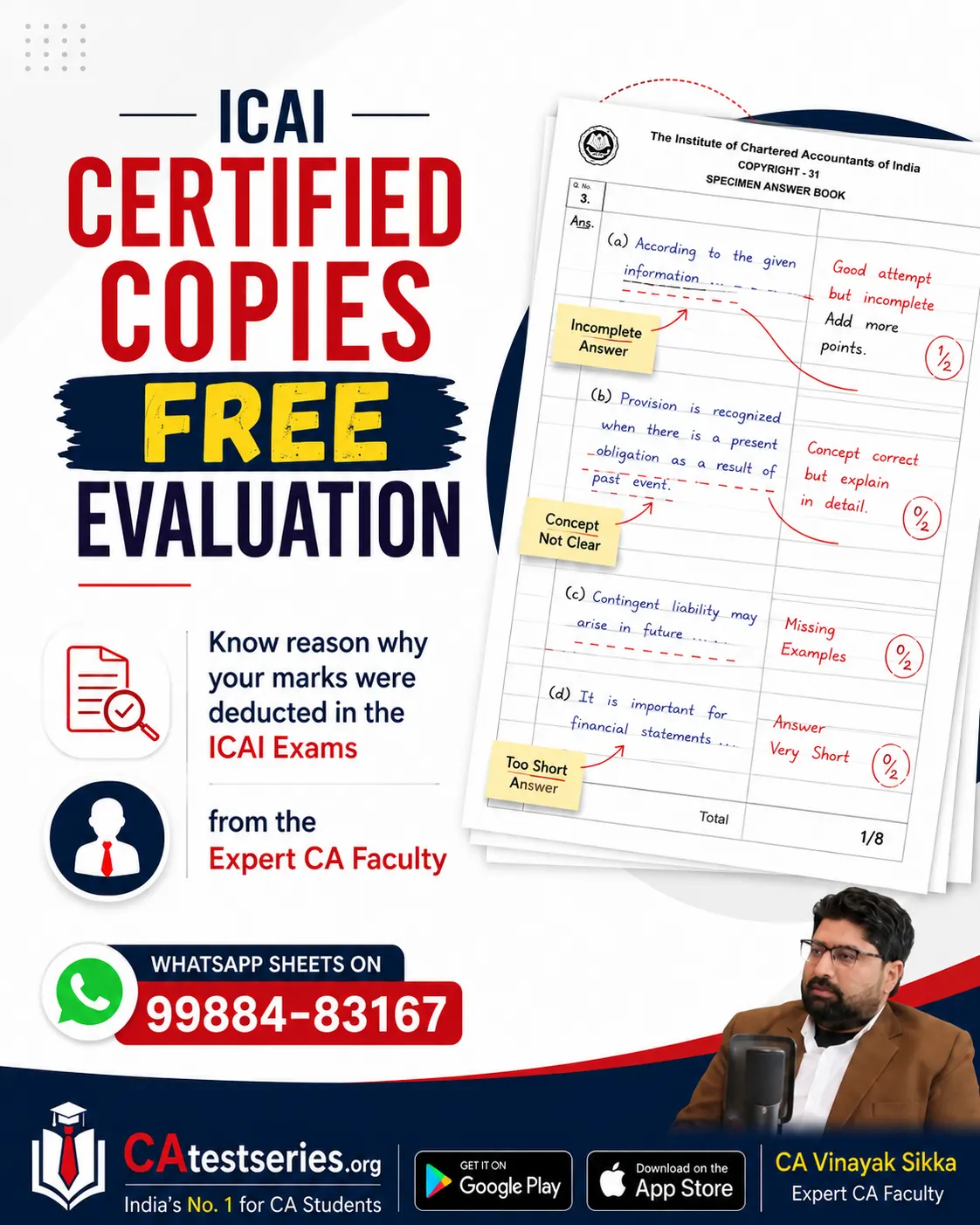
Evaluated test series provide detailed analysis of mistakes to ensure you format your descriptive solutions.
Previous question papers offer valuable insight into paper structures and marks allocation trends of examiners.
Mastering Time Management and Descriptive Writing Techniques
Time allocation behaves differently across subjective papers and objective papers during the physical testing hours. While three hours are allowed for drafting comprehensive accounts and law solutions, objective sections must be finished within two tight hours. Developing structured templates for legal answers helps maximize your marks while preserving valuable writing time during these long descriptive exams.
Write concise summaries of basic legal provisions to build conceptual memory.
Solve practical calculation questions daily to improve your writing speed on financial ledgers.
Dedicate separate study blocks for reviewing mathematics and logical reasoning to avoid fatigue.
Highlight key legal terminology and accounting formulas inside your study sheets.
Practice writing full mock sessions within strict three-hour limits to build endurance.
Evaluation Metrics and Avoiding Common Preparation Mistakes
Critical Differences Between Old and New Schemes
The revised scheme introduced by the regulatory council eliminates several secondary business correspondence topics to focus heavily on core business law concepts. This change shifts the exam weightage toward advanced commercial acts, making old question papers partially obsolete for modern candidates. Studying current modules updated for the 2026 cycle remains the only way to avoid mastering outdated legal provisions. Candidates pursuing CA Final should also note how foundational concepts evolve across levels.
Business Correspondence and Reporting is completely removed to accommodate detailed commercial law provisions.
Business and Commercial Knowledge was discarded to expand the coverage of economics concepts.
Modern contracts and specialized acts receive higher relative weightage inside the new business laws paper.
Subjective assessment now focuses on deep legal analysis and generating structured financial statements.
Negative marking mechanisms for incorrect objective answers remain active at one-fourth mark per mistake.
Overcoming Conceptual Flaws and Exam Anxiety
Many students fail not due to lack of effort but because they treat objective papers as pure guessing games. To combat this issue, a regular schedule of timed practice tests using the CS Test Series can stabilize your accuracy and reduce panic. Consistently examining your mistakes helps you form a realistic strategy for the actual examination hall.
Download the Official 2026 Study Syllabus
Ensure your preparation aligns with the latest Institute rules by reviewing the complete Syllabus for Test Series and planning your weekly schedule accordingly.