
You have spent months, possibly years, preparing for the CA Final. The syllabus is vast, the papers are long, and the margin between passing and failing a group can be narrow. At this stage of your CA journey, the quality of your practice matters more than the quantity of your study hours. A CA Final test series is not supplementary preparation. It is the mechanism that converts your subject knowledge into exam-ready writing, and the feedback loop that tells you, before results day, whether that conversion is actually happening.
This page explains how the CA Final test series works, what to expect at each stage of preparation, and how to use it as a complete evaluation system rather than a last-minute confidence check.
Why CA Final Demands a Test Series More Than Any Other Level
CA Foundation and Inter prepare you for the format. CA Final tests your professional judgement.
Papers at this level are not asking you to recall a provision or complete a calculation. They are asking you to apply a standard to a case, advise a client, and present your reasoning in a way that reflects how a qualified CA thinks.
ICAI examiners at the Final level are assessing three layers simultaneously:
- Whether your content is technically accurate
- Whether your application to the specific scenario is correct
- Whether your answer is presented with the clarity and structure expected of a professional
Students who study thoroughly but do not write regularly under evaluation almost always underperform on the third layer. Presentation is not cosmetic. At CA Final, it is a scoring category in practice even when it is not labelled as one.
The platform's internal data shows a 6 to 12 mark improvement in presentation scoring among students who complete the full CA Final test series programme through CA Test Series.
What the CA Final Test Series Covers
Group 1 Papers
Group 1 of CA Final includes Financial Reporting, Advanced Financial Management, Advanced Auditing and Professional Ethics, and Direct Tax Laws and International Taxation. Each paper has distinct answer formats, from calculation-heavy SFM questions to narrative-heavy audit and law responses.
A test series that covers Group 1 must evaluate both formats, and feedback must address not just content errors but how you shift presentation style between a calculation paper and a theory-application paper.
Group 2 Papers
Group 2 covers Strategic Cost Management, Elective Papers, and Indirect Tax Laws. The variety of question types within this group is significant. Effective test series coverage at the Group 2 level includes scenario-based questions, multi-part calculations, and structured professional responses.
MTP and RTP Coverage
ICAI releases Mock Test Papers and Revision Test Papers for each exam cycle. These are the highest-value practice resources available because they most closely mirror what will appear in the actual exam. Any serious CA Final test series plan should include MTP and RTP evaluation, not just self-attempt. Confirm coverage before enrolling by reviewing the Syllabus for Test Series.
The Evaluation Process: From Submission to Feedback
Here is what happens after you submit a CA Final test at CA Test Series:
Assignment: Your paper is assigned to a practising Chartered Accountant with relevant subject expertise.
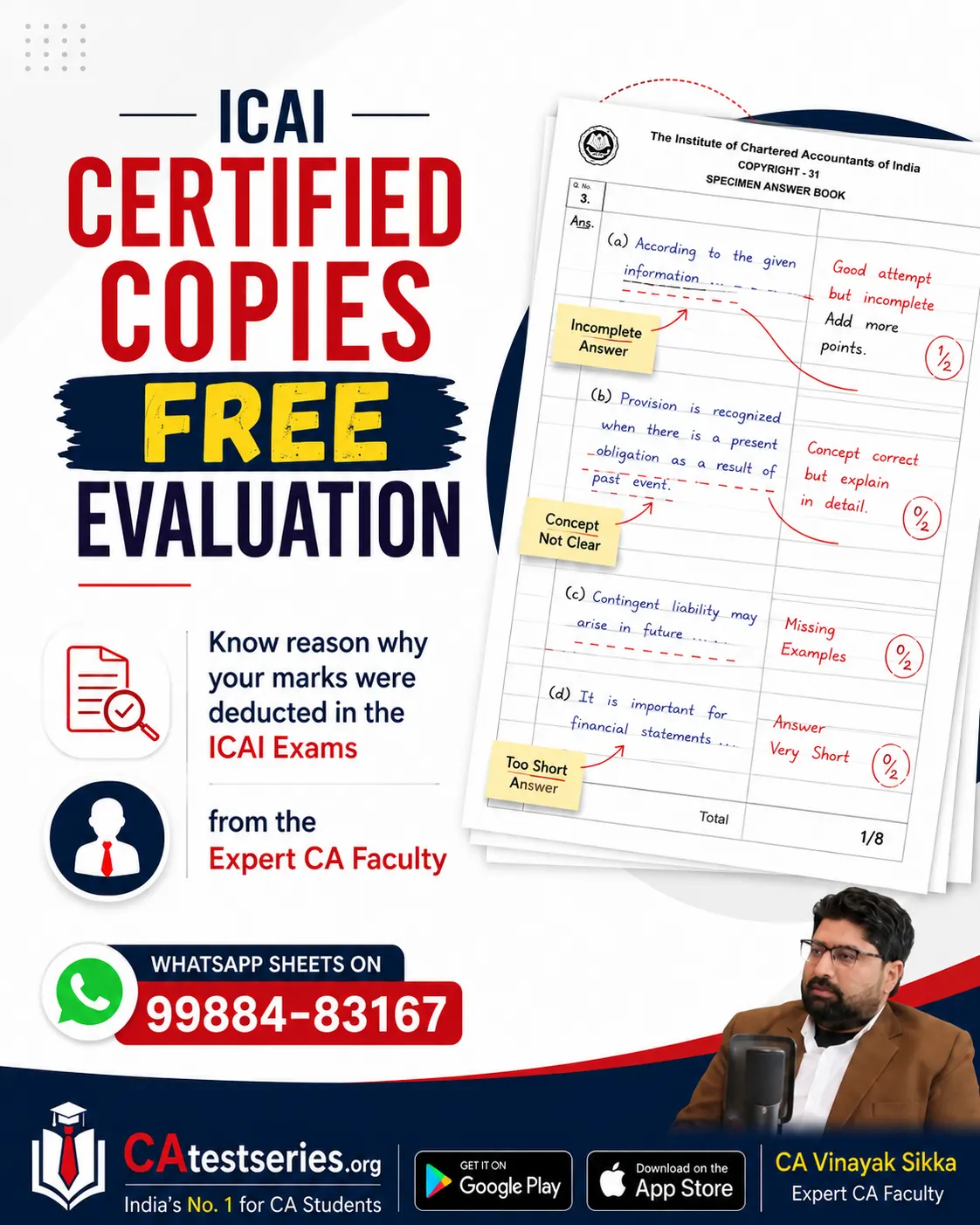
Marking: Every answer is marked with annotations. The evaluator identifies content errors, incomplete applications, and presentation problems, including missing headings, disorganised working notes, and unclear conclusions.
Turnaround: Your evaluated sheet is returned within 2 to 3 working days. This is a human evaluation and the timeline reflects the depth of review involved.
Analytics: A subject-wise performance report is generated alongside your annotated sheet. This report shows which papers, sections, and question types are costing you the most marks.
Action step: Rewrite marked-down answers applying the feedback before attempting your next test.
This process is not automated. AI is used only in the analytics reporting layer. The evaluation itself requires professional judgement that no automated system can apply to a CA Final answer.
How to Structure Your CA Final Test Series Calendar
3 to 4 Months Before the Exam: Subject-Wise Testing
Begin with individual subject or chapter-wise tests rather than full papers. This stage reveals gaps while you still have time to address them through targeted revision.
Approach at this stage:
- Attempt one subject-level test per week
- Submit for evaluation immediately; do not self-assess
- Review annotated feedback before moving to the next subject
- Rewrite weak answers using evaluator comments
6 to 8 Weeks Before the Exam: Full Group Mocks
Move to complete group papers attempted under timed exam conditions. The focus shifts from subject-level gaps to integrated performance across a full paper.
At this stage, track:
- Whether you are completing papers within three hours
- Which subjects within a group consistently pull your group average down
- Whether your presentation quality holds across a long paper or deteriorates in the final hour
Final 4 Weeks: MTP and RTP Evaluation
Dedicate the last four weeks entirely to ICAI-released papers submitted for evaluation. Do not attempt these papers without getting them evaluated. The annotated feedback on MTP and RTP papers gives you a calibration on the exact format and difficulty level of your actual exam.
For plan options that cover all three stages, including MTP and RTP evaluation, visit the Fee Structure of Test Series.
Reading and Acting on Your Evaluated Sheet
Receiving your evaluated sheet is step one. What you do in the 48 hours after receiving it determines whether the test series actually improves your score.
Follow this sequence with every returned paper:
- Read every annotation before looking at your total score
- Separate marks lost due to content errors from marks lost due to presentation problems
- Content errors require additional subject revision
- Presentation errors require rewriting practice using the evaluator's structural feedback
- Update your analytics-based revision plan before the next test
Students who review evaluated sheets this way and consistently rewrite weak answers show the most measurable improvement across their test series cycle. This is also the pattern most associated with the 450+ CA rank holders who have been part of the CA Test Series preparation ecosystem.
Free vs Paid: What the Distinction Means at the Final Level
The free test series available through the CA Test Series app includes MCQ-based tests with instant results. At CA Final, where every paper is subjective and three hours long, this is insufficient preparation on its own.
What free plans do not offer:
- Written answer evaluation by a practising CA
- Annotation and presentation feedback
- Subject-wise analytics from evaluated papers
- MTP and RTP evaluation
Paid plans provide all of the above. For CA Final students, the paid evaluation model is not optional. The subjective nature of Final papers means that without professional evaluation, you have no reliable way to know how your answers will be received by an ICAI examiner.
To see exactly what is included in each paid plan at the Final level, visit the CA Test Series for 2026 page and select your group or both-group option.
Supporting Resources Alongside Your Test Series
A test series produces the best results when it runs alongside strong conceptual revision. For CA Final students using revision lectures as part of their pre-mock preparation, the sequence that works best is a revision lecture followed immediately by a mock test on the same subject, followed by evaluation and feedback review.
Students who pair their Final test series with structured revision resources consistently show better score trajectories than those who use the test series in isolation.
For students at earlier stages of the CA journey who want to understand the full test series structure across all levels, the CA Inter Test Series and Foundation-level options are available on the same platform.