
CA Final is the last exam standing between you and your CA qualification. The papers are long, the marking is detailed, and the margin for error is narrow. Students who pass CA Final consistently on their first or second attempt are almost always students who have done serious mock test practice with proper evaluation.
This is a practical guide to using a CA Final mock test series effectively, covering what to attempt, when to attempt it, and how to extract maximum value from every evaluated sheet.
Why CA Final Specifically Needs a Mock Test Series
CA Final is not a memory exam. It tests application, professional judgement, and the ability to structure complex answers under time pressure. The papers across both groups span law, financial reporting, audit, strategic financial management, direct tax, and indirect tax. Each subject has its own language, its own answer format, and its own marking logic.
No amount of reading prepares you for the experience of sitting for a three-hour CA Final paper and writing continuously. That experience has to be practised.
Specific reasons mock tests are critical at the final level:
- Papers are three hours long with no margin for slow starts
- Every question demands structured, well-presented answers
- Case-study formats require applied thinking, not recall
- Time pressure at this level causes students to leave questions incomplete
- Presentation scoring is proportionally more impactful at Final than at any other level
The Three Phases of CA Final Mock Test Preparation
A CA Final mock test series is most effective when it runs across three distinct phases rather than being compressed into the final weeks before the exam.
Phase 1 - Subject-Wise Testing (2 to 4 months before exam): Focus on individual subjects one at a time. This phase identifies which subjects are strong, which need more revision, and where presentation habits are weakest.
Phase 2 - Group-Wise Full Mocks (4 to 8 weeks before exam): Attempt complete group papers under timed conditions. Review your performance analytics to see which subjects within each group are pulling your group average down.
Phase 3 - MTP and RTP Evaluation (Final 4 weeks): Use ICAI-released papers for your final evaluation cycle. These papers reflect the closest approximation of actual exam conditions available before your result. Confirm coverage in the Syllabus for Test Series before enrolling in an MTP/RTP-specific plan.
What Every CA Final Mock Evaluation Should Include
When you submit a CA Final answer to CA Test Series, here is what the evaluation process covers:
- Manual review by a practising Chartered Accountant
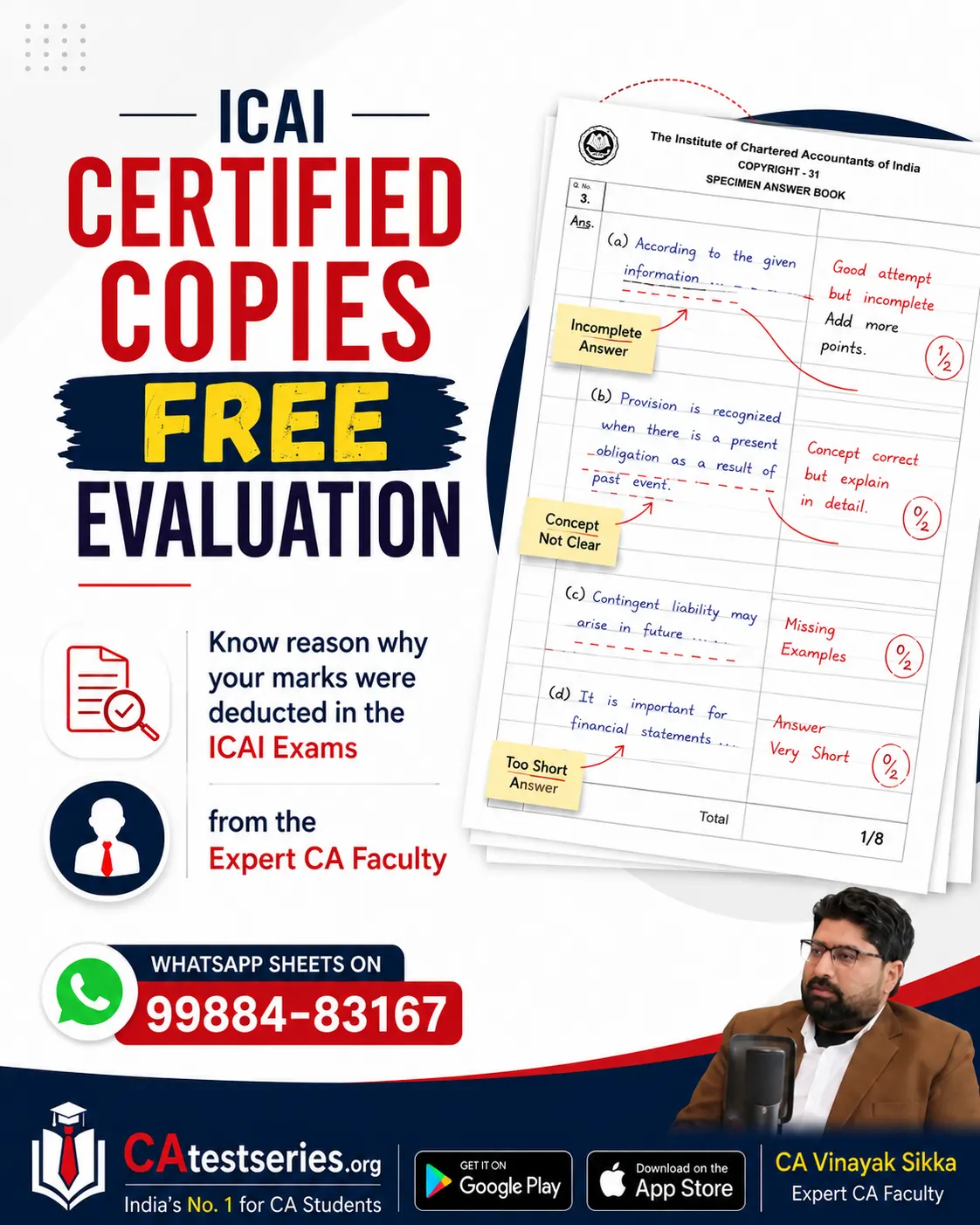
- Annotation of every answer, including content gaps and structural comments
- Specific feedback on answer presentation, use of headings, and logical flow
- Subject-wise scoring breakdown in the analytics report
- Return of the evaluated sheet within 2 to 3 working days
This is a human evaluation. It is not automated. AI is used only in the analytics layer to generate your performance report. The evaluation itself requires the kind of professional judgement that only a practising CA can apply to a Final-level paper.
How to Handle Low Scores on CA Final Mocks
Low mock scores cause anxiety. That anxiety is understandable but counterproductive if it causes you to avoid further testing. Here is the right frame: a low score on a mock is information. A low score on the actual exam is the consequence of ignoring that information.
When you receive a poor result on a CA Final mock:
- Do not skip the next test. Write it sooner, not later.
- Focus your review on the annotated feedback, not the total score.
- Identify whether the loss came from content gaps or presentation failures.
- Content gaps require more study. Presentation failures require more writing practice.
- Track your score trajectory across multiple tests, not individual results.
The CA Test Series for 2026 plans include analytics that make score tracking across multiple attempts straightforward.
Group 1 vs Group 2: Balancing Your Mock Practice
CA Final students typically attempt either one group or both groups in a given exam cycle. Your mock test practice should mirror your exam registration.
If you are attempting both groups together:
- Alternate between Group 1 and Group 2 mock papers rather than finishing one group before starting the other
- Use your analytics to ensure neither group is being neglected
- In Phase 3, attempt to complete the MTP and RTP papers for both groups
If you are attempting one group:
- Concentrate your mock practice on that group's subjects
- Still use the full paper format for each subject rather than splitting it
Check the Fee Structure of Test Series to confirm whether your plan covers one group or both, and whether MTP/RTP evaluation is included.
The Presentation Factor at the CA Final Level
At CA Final, presentation is a scoring category in practice, even if it is not labelled that way. Examiners at this level are assessing whether you think like a professional. That means:
- Using correct technical vocabulary
- Presenting calculations in a clean, readable format
- Structuring longer answers with appropriate headings
- Completing every section rather than leaving partial answers
The platform's internal data points to a 6 to 12 mark improvement in presentation quality among students who complete the full programme. At CA Final, where pass margins are tight, that range is significant.