
CA Final is the last examination between you and the letters ACA after your name. For most candidates, it represents years of preparation, multiple articleship cycles, and a personal investment that extends well beyond study hours. Getting it right matters enormously.
A CA Final mock test series is not a preparation luxury. At this level, it is the tool that tells you, before your actual result, whether your written answers are meeting the professional standard ICAI expects. This guide covers everything you need to know about using a CA Final mock test series strategically, from your first subject-wise test to your final MTP evaluation.
The CA Final Standard: What Examiners Are Actually Measuring
Understanding what ICAI examiners assess at the CA Final level changes how you use a mock test series.
At Foundation and Inter, examiners check whether you know the subject. Finally, they check whether you think like a Chartered Accountant. This distinction produces three specific assessment layers in every CA Final paper:
- Technical accuracy: Is your content correct under the applicable standard, provision, or framework?
- Applied reasoning: Have you applied that technical knowledge correctly to the specific scenario in the question?
- Professional presentation: Is your answer structured, clearly written, and logically organised in a way that reflects professional-level output?
A student who achieves the first two layers but fails the third loses the marks that their preparation deserved. A CA Final mock test series with professional evaluation is the only preparation tool that gives you feedback on all three layers simultaneously.
What a CA Final Mock Test Series Must Include
Not every test series claiming to serve CA Final students delivers the evaluation depth this level demands. Before selecting a plan, verify these specific inclusions:
Human evaluation by a practising CA Automated grading cannot assess applied reasoning or professional presentation quality. CA Final papers require a qualified reader. Confirm that evaluation is human throughout, not just at the analytics layer.
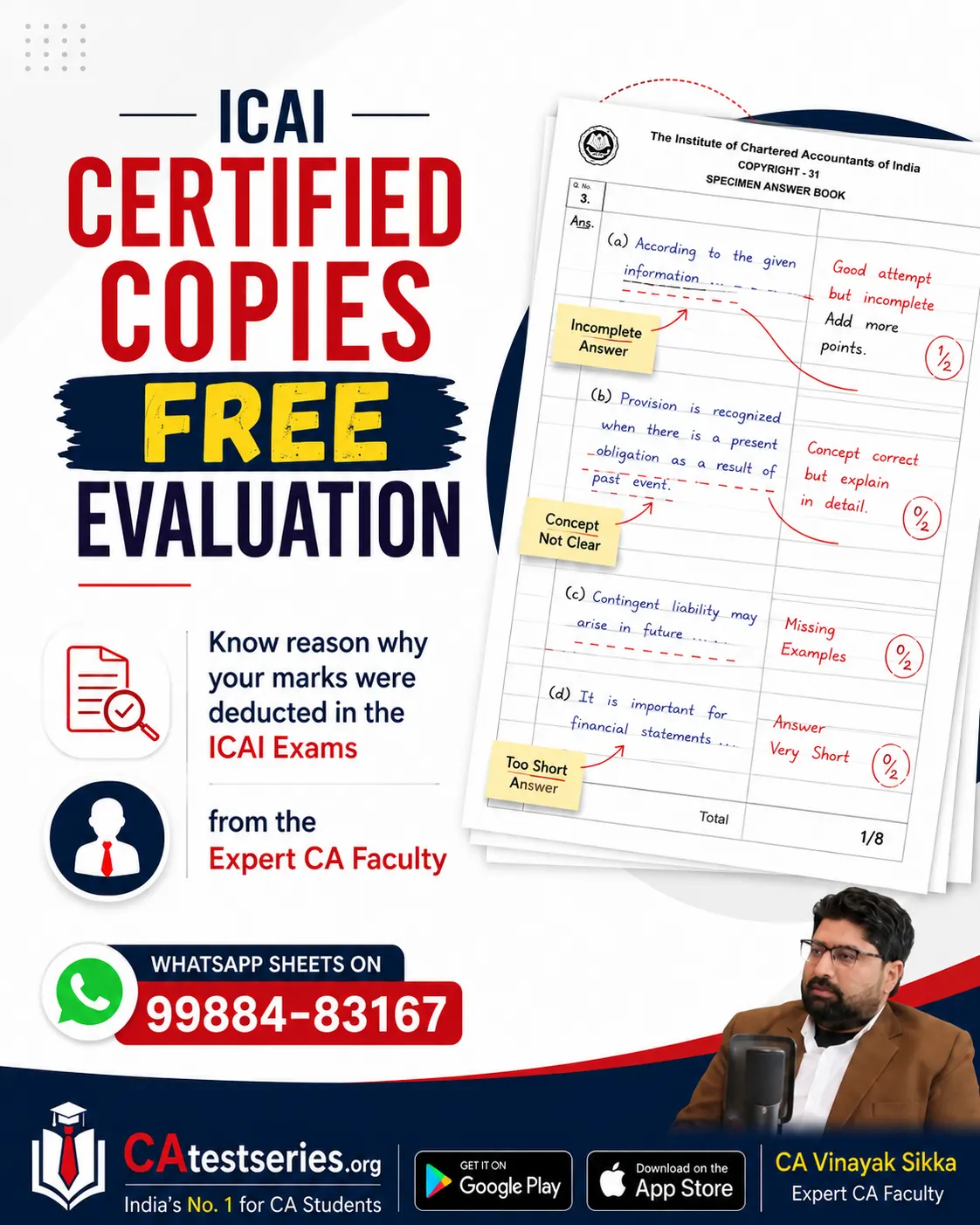
Annotation of every answer A score alone tells you where you stand. Annotations on every answer tell you why and how to improve. Evaluation that provides only numerical feedback is insufficient at the final level.
Presentation-specific feedback Content corrections are necessary but not sufficient. Feedback on answer structure, working note clarity, use of headings, and logical flow is what builds the presentation improvement documented across CA Test Series students at 6 to 12 marks per paper.
MTP and RTP evaluation ICAI releases Mock Test Papers and Revision Test Papers for each exam cycle. These are the most accurate pre-exam calibration tools available. A CA Final mock test series that does not include evaluated MTP and RTP practice is missing its most valuable component.
Subject-wise analytics across multiple attempts Score trends across multiple tests are more informative than any individual result. Analytics that track which papers, question types, and sections are consistently underperforming give you data to direct your preparation.
Confirm that all of these components are included in your plan by reviewing the Syllabus for Test Series page before enrolling.
Group-by-Group Strategy for CA Final Mock Test Practice
Group 1: Financial Reporting, Advanced Financial Management, Advanced Auditing, and Direct Tax
Financial Reporting: Mock test evaluation here focuses heavily on whether your accounting treatment is correctly applied, not just whether your final figures are right. Working note clarity and standard citation are specifically assessed.
Advanced Financial Management: SFM papers combine numerical accuracy with strategic interpretation. Both are marked independently. Track these components separately in your analytics to identify whether your gap is computational or interpretive.
Advanced Auditing and Professional Ethics: Scenario-based questions dominate. Evaluation checks whether your answer applies the auditing standard to the specific situation or merely restates it. These two outcomes look similar to a self-assessing student. They look very different to a qualified evaluator.
Direct Tax Laws and International Taxation: Tax papers require amendment accuracy for your specific exam cycle. Every tax mock test should reflect the Finance Act applicable to the attempt you are preparing for.
Group 2: Strategic Cost Management, Elective Papers, and Indirect Tax
Strategic Cost Management: The application of cost frameworks to strategic business scenarios is what separates adequate SCM answers from strong ones. Evaluation at this level checks whether your costing analysis connects logically to the strategic context.
Indirect Tax Laws and Practice: Complex multi-transaction GST scenarios require a systematic approach and clear working. Evaluated mock tests reveal whether your structure holds under pressure.
The Month-by-Month Preparation Calendar
4 to 5 months before the exam
Begin subject-wise mock tests for your highest-complexity papers: Financial Reporting, SFM, and SCM are strong starting points. Submit every test for evaluation. Read every annotation before checking your score.
8 to 10 weeks before the exam
Shift to full group paper mocks under timed conditions. Three hours per paper. Both groups if registered for both. Track group-wise performance trends. If Group 2 is consistently below Group 1, reallocate your test cycles and revision time before the exam.
Final 4 weeks
MTP and RTP evaluation only. Do not self-assess any paper in the final month. Use the annotated feedback from this phase for your last-round presentation and application quality improvements.
For all CA Final mock test series plan options, visit the CA Test Series for 2026 page.
Reading Your Evaluated Sheets at the Final Level
The annotation review process at the CA Final level is where the most improvement is generated. Follow this protocol with every returned sheet:
- Read the evaluator's comment on each answer before moving to the next
- Categorise every mark lost as either a content error or a presentation error
- Content errors require subject revision
- Presentation errors require rewriting practice using the evaluator's structural feedback
- After reviewing the full sheet, update your revision priority list before the next test
- Rewrite every answer that received presentation-specific annotation
Students who engage with this process across five to six evaluated papers consistently show the steepest score improvement trajectories across their preparation period.
For pricing and plan inclusions at the CA Final level, visit the Fee Structure of Test Series page.