
Preparing for the CA Final Financial Reporting exam requires a meticulous understanding of the latest structural changes and evaluation patterns implemented by the ICAI. Reviewing previous attempts, particularly the 2025 and 2026 cycles, reveals a clear shift toward application-oriented, Ind AS-heavy testing. This comprehensive guide provides a strategic breakdown of the question paper trends, passing standards, and critical preparation blueprints.
Structural Evolution and Marks Distribution under the Current Syllabus
The Interplay between MCQs and Descriptive Problems
The current CA Final FR paper structure features a mandatory thirty percent multiple choice question section that tests the highly granular theoretical and practical understanding of Indian Accounting Standards. In contrast, the remaining seventy percent of the paper consists of comprehensive, multi-step descriptive problems that require deep analytical computation and professional judgment. Evaluating past examinations reveals that the descriptive section heavily relies on consolidated financial statements and intricate fair value measurement scenarios.
Trend Analysis of Marks Allocation Across Chapters
The examination board systematically weights different chapters to ensure a highly balanced and rigorous evaluation of professional accounting standards. Analyzing the questions from recent attempts proves that core financial reporting areas such as Business Combinations, Financial Instruments, and Consolidation remain heavily prioritized by the evaluators. Candidates must carefully plan their daily study schedules around these high-weightage chapters to optimize their overall scoring potential, and reviewing the Syllabus for Test Series can help align preparation with the most tested areas.
Chapter Name | Average Weightage (Marks) | Primary Focus Area | Difficulty Rating |
Business Combinations (Ind AS 103) | 16 to 20 Marks | Consolidated financial statements and corporate acquisitions | High Difficulty |
Financial Instruments (Ind AS 109) | 12 to 16 Marks | Classification, measurement, and hedge accounting rules | High Difficulty |
Revenue from Contracts (Ind AS 115) | 8 to 12 Marks | Five-step revenue model and performance obligations | Medium Difficulty |
Share-based Payment (Ind AS 102) | 6 to 10 Marks | Equity-settled and cash-settled payment transactions | Medium Difficulty |
Presentation of Financials (Ind AS 1) | 4 to 8 Marks | Disclosure requirements and current asset classification | Low Difficulty |
Analysis of Critical Indian Accounting Standards
Focusing on Business Consolidation Frameworks
Consolidation and business combinations consistently form the structural backbone of the descriptive segment of the comprehensive examination paper. Candidates are frequently evaluated on their technical ability to compute goodwill, calculate non-controlling interests, and handle complex chain holding corporate structures. Mastery over these specific standards is absolutely critical because they regularly account for the largest single descriptive problem presented in the physical paper.
Demystifying Financial Instruments and Measurement
Ind AS 109 and Ind AS 113 present significant preparation challenges due to their highly abstract theoretical frameworks and complicated practical application demands. The question paper often tests intricate adjustments like compound financial instruments, amortized cost calculations, and multi-tier fair value hierarchy levels. Preparing for these topics requires solving diverse conceptual scenarios from past exam papers to understand the examiner's specific correction preferences and marking methodologies. For more information, explore the CA Test Series.
Ind AS 116 Leases: Focus on lessee accounting models and complex sale-and-leaseback transactions.
Ind AS 19 Employee Benefits: Focus on actuarial gains, defined benefit plans, and leave encashment valuations.
Ind AS 36 Impairment of Assets: Focus on identifying cash-generating units and calculating recoverable amounts.
Ind AS 12 Income Taxes: Focus on temporary differences and tax base calculations.
Tactical Methodology to Analyze Past Papers
Sequential Steps for Self-Evaluation
Approaching historical exam documents with a highly structured and disciplined plan is far more effective than reading them in a passive manner. Candidates should begin by attempting these papers under strict three-hour exam conditions to accurately gauge their real-time writing speed and computational accuracy. This rigorous practice helps students pinpoint lingering conceptual gaps and understand how to budget their limited time across different complex sections.
Obtain the official question paper and print it to replicate actual exam booklet environments.
Complete the full paper within the designated three-hour time limit without using reference materials.
Compare your handwritten answers with the official suggested solutions issued by the board of studies.
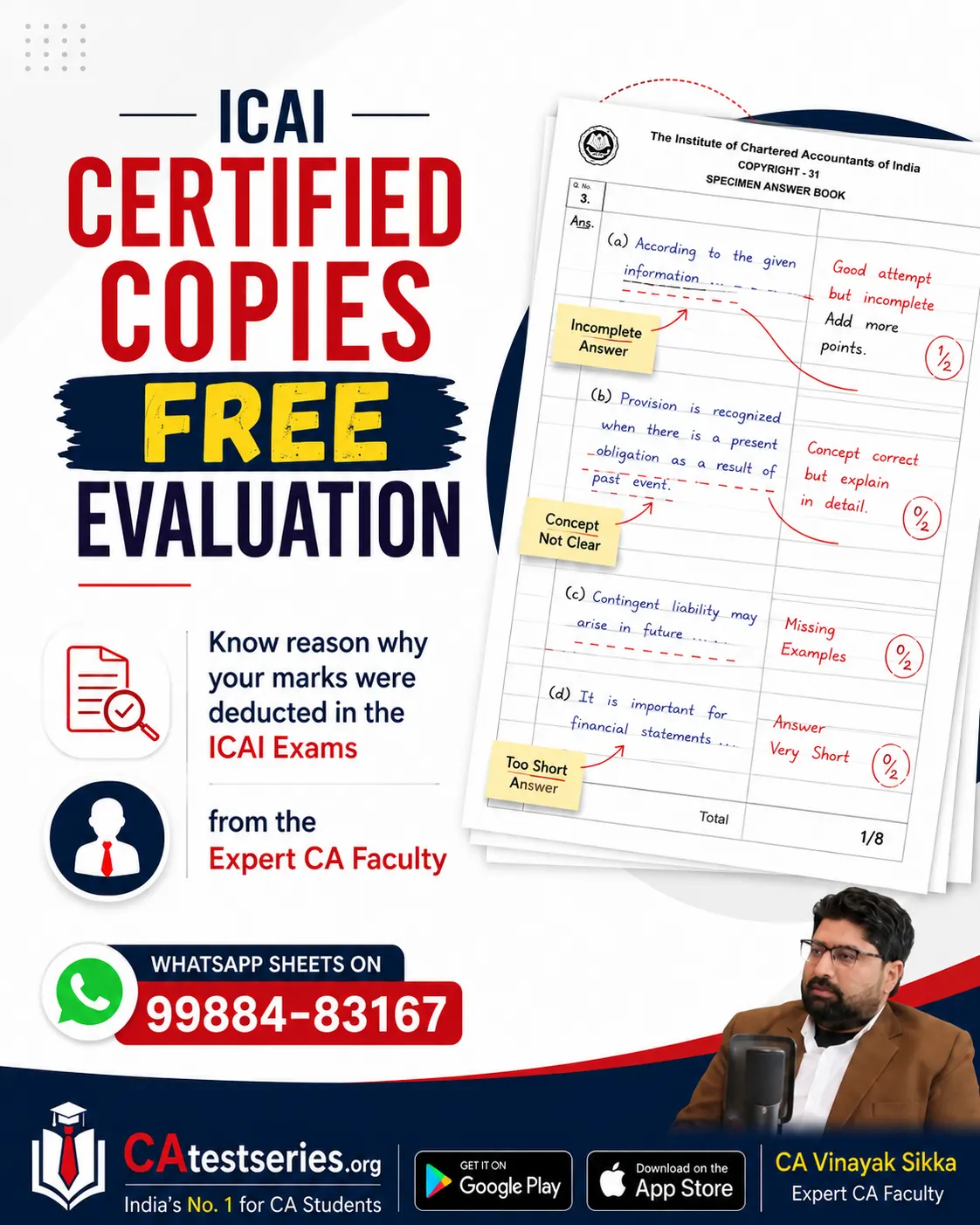
Mark error zones in red ink to highlight recurrent mathematical slips or formatting mistakes.
Create summary cards for complex Ind AS disclosure requirements missed during self-evaluation.
Re-attempt identified weak questions after forty-eight hours to secure complete conceptual clarity.
Leveraging Suggested Answers and Marking Keys
Studying official suggested answers reveals the precise step-by-step presentation guidelines and specific mark allocation schemes preferred by professional evaluators. Many candidates lose valuable marks simply because they omit vital working notes or fail to reference the correct Indian Accounting Standard numbers in their solutions. Reviewing these official solutions helps you align your handwritten answer structure directly with the expectations of the national correction committee, and checking the Fee Structure of Test Series can help you plan your mock test investments efficiently.
Avoiding Presentation Errors and Optimizing Exam Strategy
Common Structural Pitfalls in Student Solutions
A highly common mistake among aspirants is the incorrect structuring of consolidation adjustment journals and complex balance sheet presentation formats. Evaluators consistently note that students struggle to explain the qualitative academic reasons behind choosing specific accounting treatments. Practising with a reliable CA Test Series ensures that students receive highly detailed, personalized feedback on these specific presentation nuances.
Error Category | Common Student Mistake | Ideal Best Practice | Expected Impact |
Working Notes | Omitting detailed calculations | Provide step-by-step working notes clearly | Prevents step-marking loss |
Ind AS Citation | Ignoring standard numbers completely | Quote exact Ind AS numbers and titles | Establishes professional authority |
MCQ Guesswork | Rushing through objective questions | Use elimination methods systematically always | Secures thirty marks baseline |
Balance Sheet Format | Using arbitrary scheduling formats | Follow Division II of Schedule III strictly | Guarantees neat presentation |
Time Allocation and Stress Reduction Blueprints
The sheer length and complexity of the financial reporting paper causes many students to leave highly scoring questions completely unattempted. Developing a strict time-allocation schedule where you spend a predetermined number of minutes per mark is vital to completing the entire exam successfully. Evaluating your mock progress using the CS Test Series and similar professional review resources can elevate your preparation standards and build the confidence necessary to clear the paper.
Complete at least two full syllabus mock exams to build physical and mental endurance.
Maintain a dedicated journal for complex Ind AS adjustment entries for quick revision.
Avoid learning brand-new topics in the final forty-eight hours before the scheduled examination.
Carry all essential stationery and calculated backups to prevent unnecessary panic.