
Every year, a small number of CA students achieve All India Ranks. The gap between them and the rest of the batch is rarely about intelligence or study hours alone. It is about the quality of their practice, the consistency of their feedback cycles, and the deliberate way they prepare their written answers.
This page looks at what an AIR 1 CA test series actually involves, what rank-holders do differently in their preparation, and what any CA aspirant can learn from that approach, regardless of their starting point.
The Rank-Holder Preparation Model
CA rank-holders are not a mystery. Many of them have shared their preparation strategies publicly, and the patterns are consistent:
- They start test series practice earlier than most students
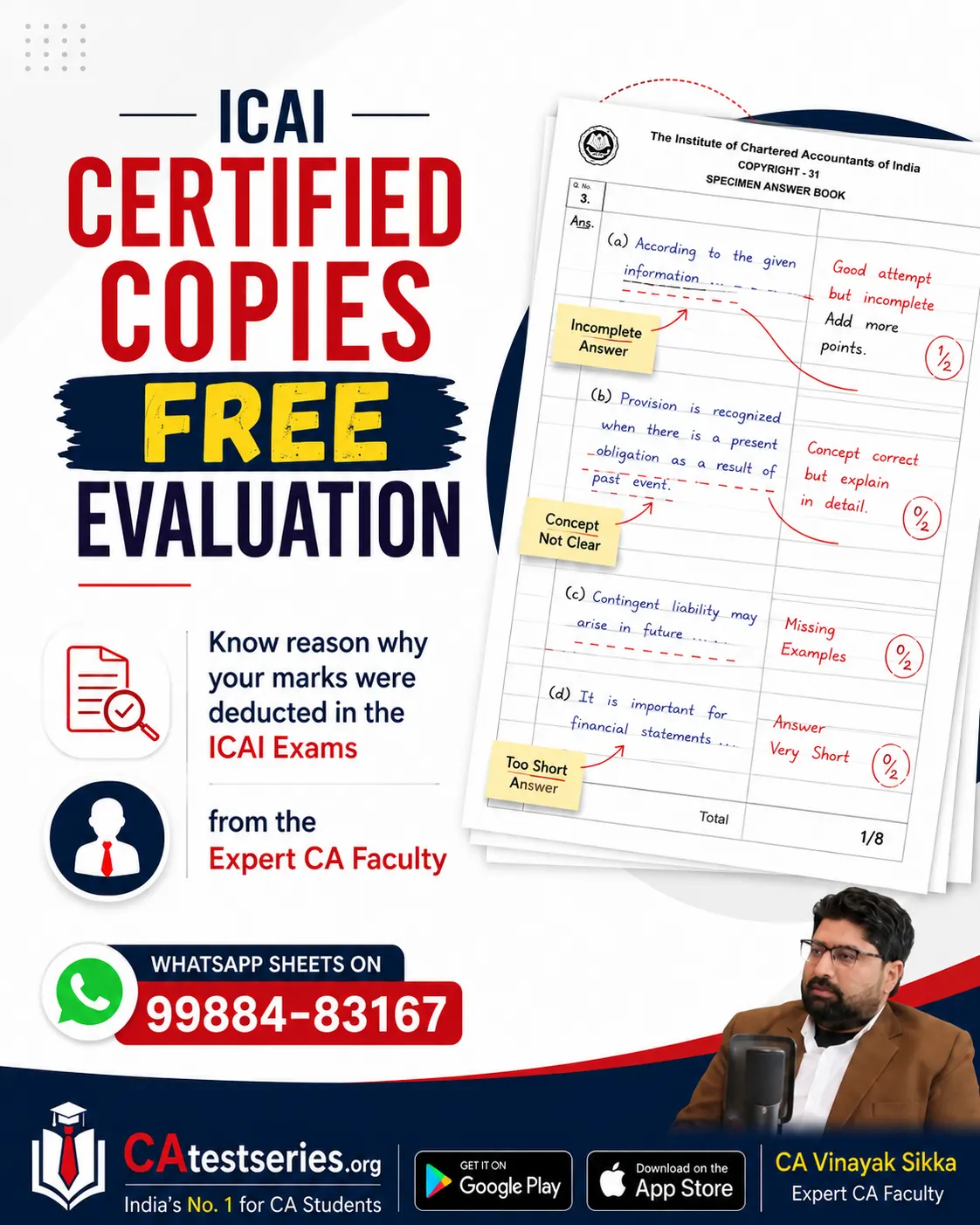
- They prioritise written answer evaluation over self-assessment
- They treat every evaluated sheet as a detailed brief, not just a score
- They work specifically on presentation quality, not only content accuracy
- They attempt MTP and RTP papers under timed, exam-like conditions
The AIR 1 CA test series is not a separate product. It is the same test series used with a higher level of discipline and intentionality. Over 450 CA rank holders have used CA Test Series as part of their preparation.
Why Written Evaluation Is Non-Negotiable for Rank-Level Scores
To score at the AIR level, you need to be consistently close to full marks across a wide range of questions. That means you cannot afford to lose marks on presentation, even when your content is correct.
ICAI examiners read hundreds of papers. Well-structured answers with clear headings, logical flow, and clean presentation stand out. Poorly structured answers, even with correct content, are harder to mark favourably and often lose 2 to 4 marks per question.
This is why the platform's data shows a 6 to 12 mark improvement in presentation scores among students who complete their full test series programme. For a rank-aspirant, that range can determine everything.
The CA Test Series for 2026 includes presentation-specific feedback in every evaluated sheet, which is what makes it relevant for students targeting top ranks.
How Rank-Level Students Use Chapter-Wise Tests
Most students treat chapter-wise tests as an optional warm-up. Rank aspirants treat them as mandatory diagnostic tools.
Here is the approach that separates high performers at the chapter-wise stage:
- Attempt the test without referring to notes
- Submit for evaluation, not self-checking
- Read every annotation on the returned sheet before checking the score
- Rewrite every answer that lost marks, applying the feedback
- Move to the next chapter only after the previous one meets a personal benchmark
This cycle takes longer than simply reading the next chapter. But it means that by the time a rank-aspirant sits for a full mock, they have already identified and corrected most of their subject-level gaps.
The Role of MTP and RTP Papers in Rank Preparation
ICAI releases Mock Test Papers and Revision Test Papers ahead of each exam cycle. These are the closest approximation of actual exam papers available to students before results day.
Rank aspirants do not just attempt these papers. They get them evaluated. They compare their approach to ICAI-pattern questions with what the evaluator identifies as correct structure and content. They use the Syllabus for Test Series to confirm that MTP and RTP coverage in their plan matches the papers ICAI has released for their specific exam cycle.
In the final four weeks before the exam, MTP and RTP evaluation is the single most important practice activity available.
Time Management: The Invisible Rank-Separator
Among students who know the syllabus equally well, time management separates ranks. CA papers are long. Questions are worth different marks. Students who have practised under timed conditions know exactly how long each question type should take. Students who have not often run out of time on the final questions.
A full mock test series, taken under exam conditions, builds this instinct. After three to five full mocks with evaluation, you develop an internal clock for how much time any given question format deserves. This is not something you can build by reading about time management.
What an Evaluated Sheet Reveals That Self-Assessment Cannot
Self-assessment is biased. You know what you meant to write, so you tend to read it more favourably than an examiner would. An evaluator reads only what is on the page.
A marked sheet from a practising CA will show you:
- Your answer was marked down despite correct content, because of poor structure
- Which points did you think were sufficient but were actually incomplete
- Where you used terminology incorrectly or ambiguously
- Which sections of your answer were skipped or undervalued by the evaluator
This information is not available from answer keys alone. It requires a human reader. CA Test Series assigns each paper to a practising Chartered Accountant, and sheets are returned within 2 to 3 working days with annotations throughout.
Building Consistency Across All Subjects
AIR candidates are rarely weak in one specific subject. They are consistently strong across multiple subjects and both groups. That consistency requires a test series plan that covers all subjects, not just the ones you are confident in.
When reviewing your plan, check the Fee Structure of Test Series to confirm what subjects are covered at your level and whether both groups are included in a single plan or priced separately.
Consistency across subjects is built through repeated evaluation cycles. One strong mock result is not enough. The benchmark should be sustained performance across multiple attempts.
Foundation Students Aiming for Ranks
If you are at the Foundation level and already thinking about ranks, the preparation logic is the same, just applied to Foundation-level papers. Pairing your test series with strong conceptual preparation gives you the foundation that rank-level Inter and Final results are built on. The CA Foundation Video Lectures and Books page has structured resources to support that early preparation.