
There is a pattern that repeats across CS Executive students every attempt cycle. The student finishes the syllabus. They feel reasonably prepared. They sit the exam, write eight subjective papers across two modules, and receive a result that does not reflect how much they studied.
The reason this happens is not a lack of effort. It is a specific gap between knowing content and writing scorable answers under three-hour exam conditions. This gap exists at every subjective professional examination level, and CS Executive is no exception.
The CS executive test series addresses this gap directly. It puts students through timed mock exam conditions, produces evaluated answer sheets with written professional feedback, and tracks performance trends across multiple attempts. The result is preparation that builds both knowledge and the ability to deliver that knowledge in the exact format ICSI's examiners reward.
CS Executive at a Glance: Eight Papers, Two Modules
CS Executive is the second level of the Company Secretary program under ICSI. Students who have cleared the CSEET or hold qualifying degree exemptions are eligible to register.
Module 1 Papers
- Jurisprudence, Interpretation and General Laws
- Company Law
- Setting Up of Business Entities and Closure
- Tax Laws
Module 2 Papers
- Corporate and Management Accounting
- Securities Laws and Capital Markets
- Economic, Business and Commercial Laws
- Financial and Strategic Management
Each paper is three hours long and fully subjective. Passing requires a minimum of 40 marks per paper and 50% aggregate per module. CS Executive examinations are held by ICSI in June and December each year.
Why Subjective Exam Practice Cannot Be Skipped at CS Executive
Paper Volume Creates Cumulative Pressure
Eight fully subjective papers across two modules means eight separate three-hour writing demands per attempt if sitting for both simultaneously. Students who have not built answer-writing stamina and pace through mock test practice regularly discover during the exam that they cannot maintain answer quality across a full module.
Section References Are Not Optional
CS Executive papers, particularly Company Law and Tax Laws, require answers to cite correct section references within responses. Writing the correct legal principle without the correct section number costs marks. Writing both correctly, but presenting them in the wrong order or format costs marks. This level of formatting precision is only built through evaluated practice, not through reading.
Amendment Sensitivity Across Multiple Papers
Company Law, Tax Laws, Securities Laws, and Economic Laws are all updated regularly through legislation, SEBI notifications, and RBI circulars. CS Executive answers that apply outdated provisions are marked incorrect, regardless of how well the answer is structured. Students who have practiced current-attempt questions through a test series are more likely to apply updated provisions accurately under exam pressure.
What the CS Executive Test Series Covers
Paper-Wise and Full-Module Mock Tests
Students can choose:
- Individual paper mock tests for targeted practice in specific subjects
- Full-module simulations covering all four papers in each module under combined time conditions
- Multiple test sets per paper to avoid over-familiarity with a single question set
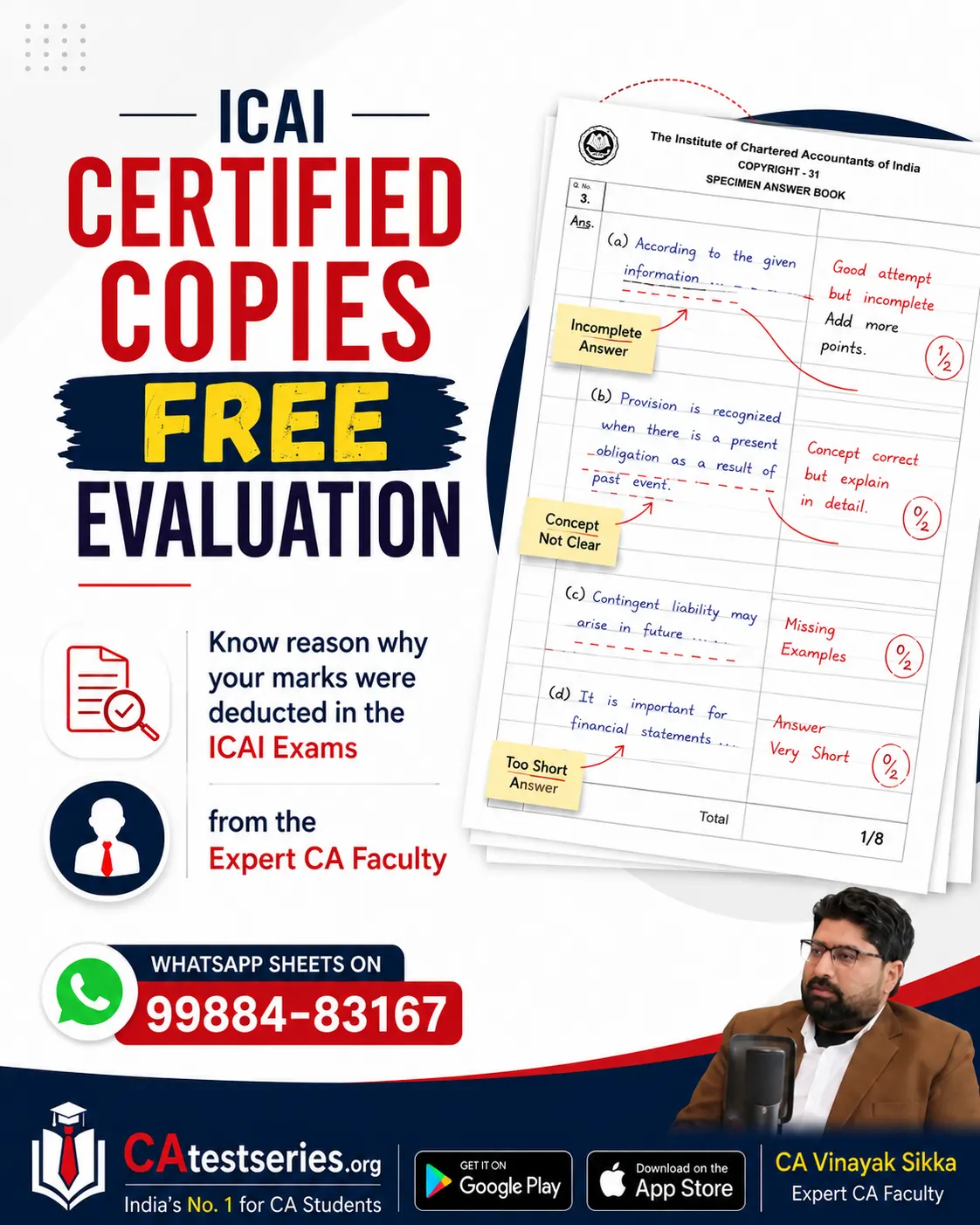
Professional Evaluation of Handwritten Answer Sheets
After each mock test, students submit their handwritten answer sheets for review by qualified CS professionals and experienced ICSI faculty. Each submission is evaluated on:
- Legal accuracy, including correct citation of section references
- Answer structure and alignment with ICSI marking norms
- Completeness relative to the marks available per question
- Specific identification of marks lost and targeted improvement guidance
This is not a score sheet. It is written professional feedback that gives students actionable direction for improving each paper.
Performance Tracking Across Tests
After each evaluated test, students receive data showing:
- Marks by paper and section
- Error patterns by type: content, presentation, or time management
- Trends across successive test attempts
- Priority revision areas based on where the largest scoring gaps remain
How to Use the CS Executive Test Series Across a Four-Month Preparation Cycle
Months 1 to 2: Paper-wise practice alongside content revision
As you complete each paper in your study schedule, attempt a paper-wise mock test before moving to the next subject. Submit each for evaluation. Use the feedback to adjust your understanding of what each answer requires in format and depth before the next paper begins.
Month 3: Full-module simulations
Once all papers in a module are complete, run a full four-paper module simulation. Focus on whether you can maintain answer quality across the full three-hour duration for each paper without running short at the end.
Month 4: Targeted retest and amendment consolidation
Return to papers where the evaluated feedback showed the largest gaps. Attempt additional paper-wise tests for these subjects. Confirm that the Tax Laws and Securities Laws content reflects current amendments before finalizing revision.
For structured CS Executive mock test plans with professional evaluation, CS Test Series for June 2026 provides paper-wise and module-wise enrollment options.
CA students pursuing CS Executive alongside CA Intermediate or CA Final can access CA Test Series for 2026 for parallel CA-level preparation with the same evaluated practice model.
Before enrolling, confirm which CS Executive modules and papers are covered in your plan by reviewing the test series syllabus.
Students simultaneously pursuing CMA qualifications can find structured exam practice aligned with their CMA syllabus through CMA Test Series for June 2026.
For those at the very beginning of their professional qualification journey who are also considering CA Foundation alongside CSEET, CA Foundation video lectures and books offer foundational support for the CA side of that parallel preparation.