
The Cost and Management Accountancy program under ICMAI is one of India's most respected professional qualifications, and the Intermediate level is where the real depth of the CMA curriculum begins. With eight papers spanning financial accounting, cost accounting, taxation, law, operations management, and company accounts, the CMA Intermediate tests both technical knowledge and the ability to write structured, professional answers under exam pressure.
Most CMA Intermediate students understand the content they need to cover. Fewer understand that knowing the content and performing in an exam are two different skills. The ability to write correct, well-presented answers quickly, under a three-hour time limit, with no reference materials, requires a kind of practice that reading study notes does not provide.
That is the gap the CMA inter test series is built to close.
What Is the CMA Intermediate Examination?
CMA Intermediate is the second stage of the CMA program offered by ICMAI, the Institute of Cost Accountants of India. Students who have cleared the CMA Foundation or hold qualifying educational exemptions are eligible to register.
The Two-Group, Eight-Paper Structure
CMA Intermediate consists of eight papers across two groups of four papers each. Both groups are fully subjective with three-hour durations per paper.
Group 1 covers:
- Business Laws and Ethics
- Financial Accounting
- Direct and Indirect Taxation
- Cost Accounting
Group 2 covers:
- Operations Management and Strategic Management
- Cost and Management Accounting and Financial Management
- Company Accounts and Audit
- Additional paper as per the current ICMAI scheme
Students may appear for one group or both per attempt. ICMAI conducts CMA Intermediate examinations in June and December each year.
Passing Criteria
- Minimum 40 marks in each paper within the attempted group
- Minimum 50% aggregate across all four papers in the group
Both conditions must be met. A student who achieves a strong aggregate but falls below 40 in any single paper does not pass.
Three Reasons the CMA Inter Test Series Is Not Optional
Reason 1: Subjective Exams Require Practiced Formatting
Every CMA Intermediate paper is fully subjective. ICMAI examiners follow specific marking schemes that reward structured presentation. In financial and cost accounting papers, working notes are part of the answer. A correct final figure without showing intermediate steps loses marks. In law papers, answers without section references lose marks even when the legal reasoning is correct.
None of this is taught by reading. It is built through submission, feedback, and correction.
Reason 2: Taxation Papers Are Amendment-Sensitive
The Taxation paper in Group 1 changes with every Finance Act. Direct tax provisions, GST rates, and compliance thresholds are updated regularly. A student who prepares using study material from a previous attempt without checking for current-attempt amendments carries a real risk in the exam.
A test series built for the current attempt includes questions based on applicable provisions, helping students practice applying current law rather than defaulting to outdated figures under pressure.
Reason 3: Cost Accounting Demands Speed
Cost Accounting problems in Group 1 require not just methodological accuracy but calculation speed. Standard costing, process costing, and marginal costing problems involve multi-step workings under tight time allocations. Students who solve problems slowly at home often discover they cannot complete the same problems within mark-weighted time limits in the exam hall.
Repeated timed practice under exam conditions is the only way to build this speed before the actual exam.
What the CMA Inter Test Series Includes
Paper-Wise and Full-Group Mock Tests
The test series provides:
- Full-length paper simulations under timed conditions for all eight papers
- Subject-specific tests for papers where targeted improvement is needed
- Multiple question sets per paper to avoid over-reliance on any single test set
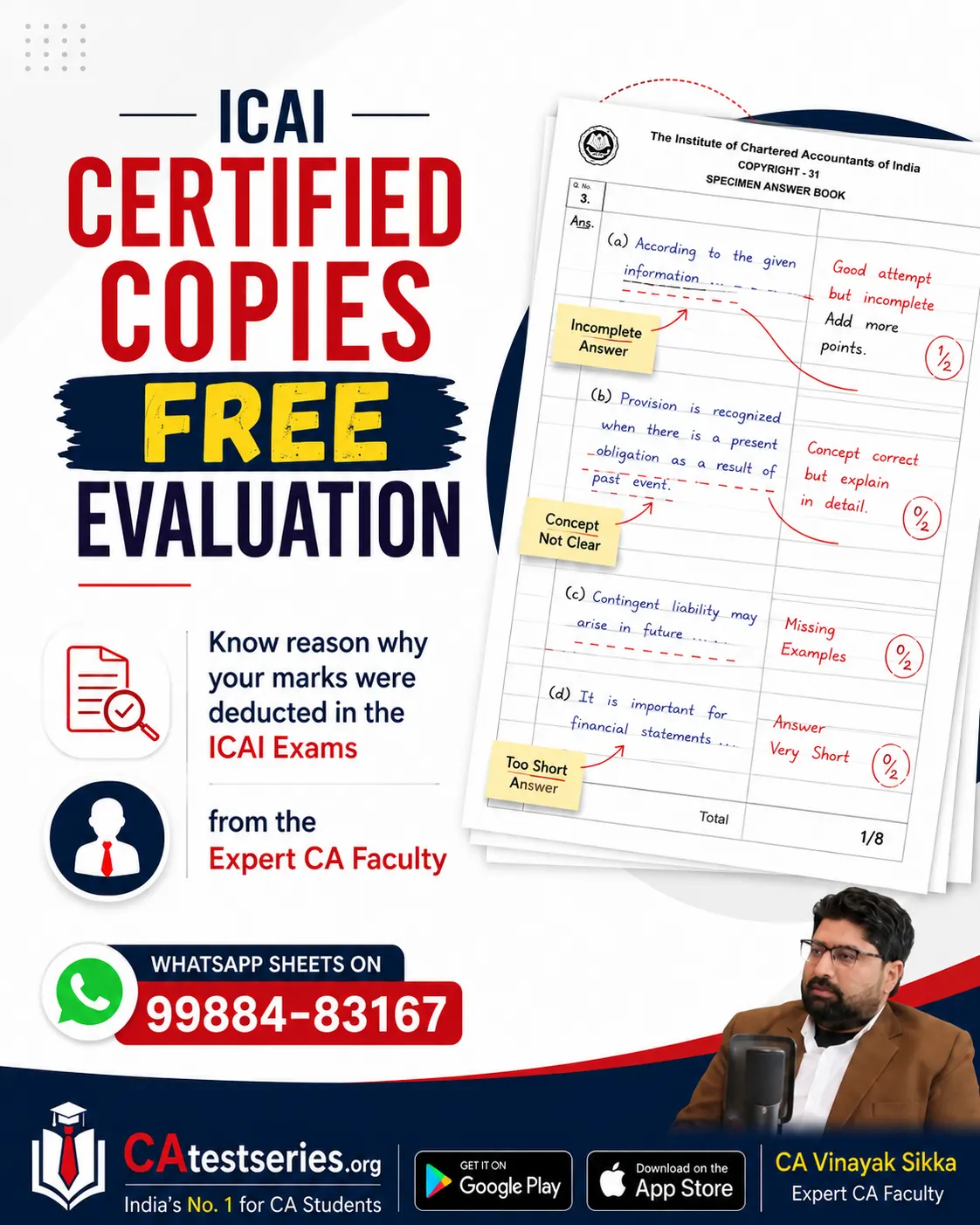
Expert Evaluation of Handwritten Answer Sheets
Students submit handwritten answer sheets after each mock test. Evaluation by qualified CMA professionals and experienced ICMAI faculty covers:
- Technical accuracy across numerical and theoretical questions
- Working note format and completeness in cost and financial accounting papers
- Section citation accuracy in law papers
- Specific marks lost per question with improvement guidance
CA Test Series provides this professional evaluation layer through its structured CMA program, giving students an external expert perspective that self-checking cannot replicate.
Performance Analytics Across Attempts
After each evaluated test, students receive:
- Marks broken down by paper and section
- Error type analysis: content gap, presentation gap, or time management gap
- Trends across successive test attempts
- Priority revision areas for the remaining preparation window
A Phase-by-Phase Schedule for CMA Intermediate Test Series
Three to four months before the exam: Begin paper-wise testing as you complete each subject in your study plan. The Law and Ethics paper should be tested early to identify section-referencing habits. Cost Accounting testing should begin as soon as core methods like standard costing and process costing are studied.
Two months before the exam: Complete a first full round of all papers in your target group. Review all evaluated feedback. Prioritize revision for papers where feedback shows presentation gaps, as these are faster to address than deep content gaps.
One month before the exam: Run full-group simulations. Attempt all four papers across the week in sequence. This builds exam endurance and reveals whether answer quality holds across a full group-sitting.
Final two weeks: Focus on high-error areas from evaluations. Avoid full papers. Use topic-wise practice for specific weak sections and review working note formats for numerical papers.
Explore CMA test series plans for Intermediate and Final levels
Students also preparing for CA Intermediate or CA Final alongside CMA can access CA Test Series for 2026 for structured CA-level mock test practice using the same evaluated model.
Students pursuing CS alongside CMA can access CS Test Series for June 2026 for Company Secretary exam preparation in parallel.
Before enrolling, confirm the CMA Intermediate paper and group coverage by reviewing the test series syllabus.
Foundation-level students progressing toward CMA Intermediate who are also considering CA can build early CA conceptual grounding through CA Foundation video lectures and books.