
Every professional qualification begins somewhere. For Cost and Management Accountancy students, that somewhere is the CMA Foundation. It is the entry point of one of India's most recognized accounting qualifications, and what it demands in terms of preparation is often underestimated by first-time students.
There is a common assumption at the Foundation level: because the content is introductory, the preparation can be casual. The truth is more nuanced. CMA Foundation papers are fully subjective. Every paper requires handwritten answers. Numerical papers require showing complete workings in the correct format. Law papers require structured responses with cited provisions. Time pressure is real, and exam format demands are specific.
The CMA Foundation test series exists to prepare students for all of this before it catches them off guard in the actual exam.
The CMA Foundation Examination: Four Papers, Clear Objectives
CMA Foundation is the first stage of the CMA program under ICMAI. Students who have completed Class 10+2 or equivalent and are enrolled with ICMAI are eligible to appear. Exams are held twice a year in June and December.
Paper 1: Fundamentals of Economics and Management
This paper covers introductory macroeconomic concepts, including demand and supply, national income, banking and monetary policy, alongside basic management principles covering planning, organizing, staffing, directing, and controlling.
Questions are a mix of short answers, definitions, and applied scenario questions drawn from economic and business contexts.
Paper 2: Fundamentals of Accounting
This is the most numerical of the four Foundation papers. It covers:
- Double-entry bookkeeping and journal entries
- Ledger posting and trial balance preparation
- Trading, profit and loss account, and balance sheet
- Basic depreciation and provisions
Every numerical answer must show complete workings. Final figures without supporting entries or calculations lose step marks.
Paper 3: Fundamentals of Laws and Ethics
This paper tests introductory legal awareness across foundational legislation, including the Indian Contract Act, Sale of Goods Act, and basic ethical principles relevant to professional practice.
Law answers must follow a structured format: identify the applicable law, state the relevant provision, apply it to the given facts, and conclude clearly. Students who write generally correct legal responses in unstructured prose consistently score below their knowledge level.
Paper 4: Fundamentals of Business Mathematics and Statistics
This paper is entirely numerical and tests:
- Ratio, proportion, and percentages
- Simple and compound interest
- Arithmetic and geometric progressions
- Statistical measures: mean, median, mode, standard deviation
- Correlation and index numbers
Speed and accuracy both matter. Students who solve problems correctly but slowly frequently run out of time before completing the paper.
What the CMA Foundation Test Series Does That Self-Study Cannot
It Reveals Format Problems Before They Cost Marks
A student who has read accounting examples but never independently written a full trading account from scratch under time pressure does not yet know whether they can do it correctly in an exam. An evaluated mock test that returns feedback on missing entries, incorrect column formats, or absent working notes gives that student the chance to fix the problem while it still matters.
It Builds Calculation Speed in Paper 4
Business Mathematics and Statistics require a combination of formula recall and calculation speed. Most students practice problems at a pace where they can stop and check their work midway through. In the exam, that option is not available. Timed mock tests condition students to complete calculations within the mark-weighted time limit and build the habit of moving forward rather than rechecking.
It Creates an Early Feedback Loop
Starting mock test practice early in the preparation cycle creates a feedback loop. Rather than discovering presentation weaknesses in the actual exam, students identify and address them in the test series. This is the single biggest preparation advantage that structured practice provides.
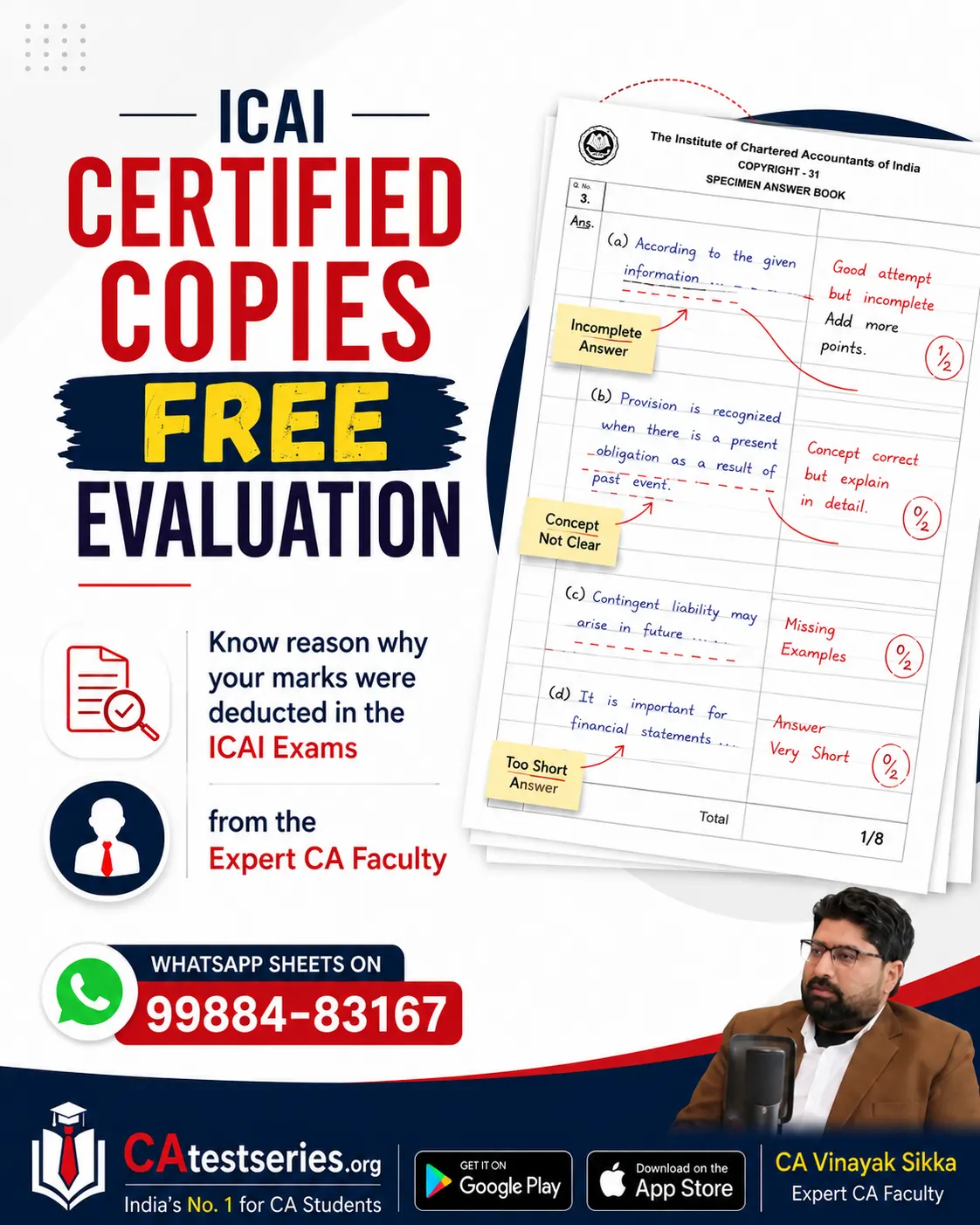
CA Test Series supports this approach with professional evaluation of submitted answer sheets, giving CMA Foundation students the kind of actionable, written improvement guidance that their own review of a solution key cannot replicate.
A Stage-by-Stage Preparation Schedule for CMA Foundation
Weeks 1 to 4: Study each paper topic by topic Do not begin full mock tests yet. Solve numerical problems independently, without looking at solutions first. For Paper 3, practice writing structured legal answers from memory on topics you have already studied.
Weeks 4 to 7: Topic-wise testing begins As you complete each topic area, use topic-wise mock tests to confirm comprehension and identify gaps. Submit Paper 2 and Paper 3 topic answers for evaluation to get early feedback on working note format and answer structure.
Weeks 7 to 10: Full paper simulations Begin full three-hour paper simulations for each of the four papers. Strictly enforce the time limit. Do not stop early or allow extra time. Submit answer sheets for Papers 1, 2, and 3 for professional evaluation.
Final weeks before exam: Review and targeted revision Focus only on error types and topics flagged in your evaluated feedback. Do not introduce new content. Practice specific question types where accuracy or speed is still inconsistent.
Enroll in the CMA Foundation and Intermediate test series
As you progress from Foundation to CMA Intermediate and eventually CMA Final, CA Test Series provides structured mock test preparation at every level of the CMA program. For CA-level mock test needs, if you are also pursuing CA alongside CMA, CA Test Series for 2026 covers CA Foundation through CA Final.
Students who are also beginning the CA Foundation alongside the CMA Foundation can access CA Foundation video lectures and books to support parallel conceptual building.
Before enrolling in any plan, verify that all four Foundation papers are covered by reviewing the test series syllabus.
For peers or colleagues pursuing the CS program, CS Test Series for June 2026 provides equivalent structured practice for ICSI examinations.