CA Inter Advanced Accounting Lectures by CA Vinayak Sikka
CA Intermediate and advanced accounting require more than simply learning how to record journal entries. The concept, related accounting standard, and its applications must be clear to students.
The lecture by CA Vinayak Sikka emphasises concepts, questions, and journal entries, which makes it easier for the students to grasp the idea behind the accounting treatment.
About CA Vinayak Sikka
The speciality of CA Vinayak Sikka lies in his efforts towards simplifying complicated accounting theories through his teachings. These include the following:
Concept-oriented learning
Journal entry explanations
Examples
Problem-solving techniques
Visual animations
Exam-oriented preparation
Revisions
His major emphasis lies on making the students understand the ‘why’ behind an accounting transaction.

Importance of Advanced Accounting for CA Inter
Advanced accounting increases one's knowledge of accounting that will help them in CA Final, auditing, financial reporting, and practice.
Some benefits of advanced accounting are as follows:
Understanding of Accounting Standards.
Preparation of financial statements.
Journal entries and adjusting entries.
Problem-solving skills.
A good command of advanced accounting is crucial for CA aspirants.
Conceptual Approach to Advanced Accounting
Stage | What to Understand | Key Questions |
1. Grasp the Concept | What is the transaction and accounting concept involved? | What happened? Why? Which AS/Ind AS is relevant? |
2. Identify Treatment | Identify the affected accounts and their amounts. | What account is being debited/credited? Where is it recorded? |
3. Pass Journal Entry | Make the journal entry according to the concept. | What will be the journal entry? |
Example – Prepaid Expense | Prepaid expense is an expense paid in advance, not yet incurred. | Prepaid Expense A/c Dr. → To Bank/Cash A/c |
Why Conceptual Journal Entries Matter
Conceptual journal entries relate accounting principles to practice. This makes it easier for students to know why that journal entry was recorded.
Advantages:
Ability to know the correct accounting treatment.
Comprehension of how it affects the asset, liability, income, and expense.
Ability to solve adjustment and unknown problems easily.
Application of accounting standards properly.
Exam presentation improvement.
Example – Machinery: Assuming the cost of machinery is Rs.10 lakh, and the cost of installation is Rs.50,000
Machinery A/c Dr Rs.10.50 lakh
To Bank/Cash A/c Rs.10.50 lakh
Reasoning: The cost of installation is part of the cost of PPE (Property, Plant, and Equipment), as it is essential to place the machinery in the required state and place for its use.
Animated Lectures and Visual Learning
Animated and visual presentations will simplify the difficult topics in accounting by presenting concepts one step at a time.
Some of the strategies that can be used include:
Flowcharts and diagrams
Animations of journal entries
Illustrations of T-accounts
Solving problems in a step-by-step process
Adjustment maps
Formulas in a box
Before and after financial statements
Example: Holding Company + Subsidiary → Intragroup Adjustments → Elimination → NCI → Consolidated Financial Statements
Major Areas of CA Inter Advanced Accounting
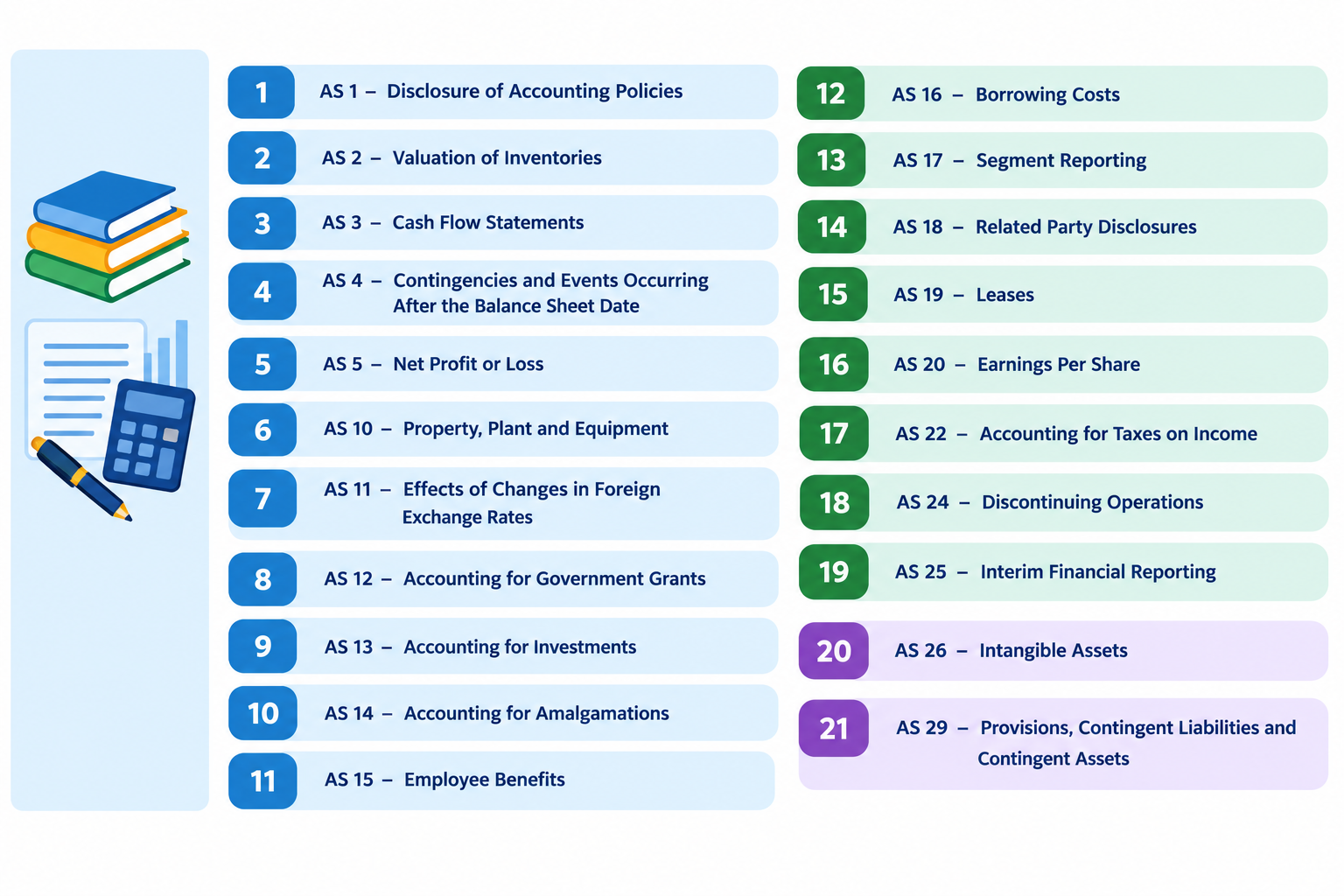
Conceptual Journal Entries Method
Use the following 4-question method to determine the journal entry:
What was received? → Determine the asset, expense, or income.
What was given or paid? → Determine the source, cash, liability, or another asset.
Was there any income? → Determine the income account.
Was there any liability? → Determine the liability account.
Step to Remember
After determining the account: Debit → Asset, Expense, Loss, or account receiving the benefit; Credit → Source, Income, Gain, or Liability
Important: Know what occurred in the transaction before making your debit & credit decisions.
Provision vs. Contingent Liability Example
Think about an instance where a business is involved in a lawsuit. Before making any accounting entry
The student should not immediately pass:
Legal Expense A/c Dr.
To Provision A/c
The following factors need to be considered:
Is there any present obligation?
Does the obligation arise from a prior occurrence?
Is it probable that there will be an outflow of economic benefits?
Is the amount capable of being estimated?
In the event that all these requirements are fulfilled, a provision is made. In case one or more of these factors are not fulfilled, the issue might be recorded as a contingent liability.
This shows why understanding accounting principles matters more than simply memorising entries.
Example: Valuation of Inventory
The key concept behind AS 2 – Valuation of Inventories – must be known by the students:
Inventories should always be written down to the lower of cost and net realisable value.
Instead of trying to remember the rule, it is more important for students to understand the rationale behind the rule:
Why is inventory valued at the lower of cost and NRV?
It is because inventory should not be valued at an amount greater than the economic benefits that will be derived from the sale or use of inventory.
Approach
Cost
↓
Net Realisable Value
↓
Comparison between Cost and NRV
↓
Choose the Lower Amount
↓
Valuation of Inventory
Example: Property, Plant and Equipment
Conceptual knowledge about PPE is very important in order to understand accounting principles well. Main topics are as follows:
Recognition
Measurement
Attributable Costs
Component Accounting
Depreciation
Residual Value and Useful Life
Revaluation
Disposal of Assets
Exchange of Assets
Example on Depreciation
Consider the following assumptions:
Value of asset = Rs.5,00,000
Residual value = Rs.50,000
Depreciable amount = Cost - Residual value
= Rs.5,00,000 - Rs.50,000 = Rs.4,50,000
Depreciation per annum (SLM) = Rs.4,50,000 ÷ 5 = Rs.90,000
Journal Entry
Depreciation A/c Dr. Rs.90,000
To Accumulated Depreciation A/c Rs.90,000
Here, depreciation is not just a calculation or a journal entry — it reflects the economic consumption of the asset's value over time.
Practical Question-Solving Strategy
In lecture viewing, students must learn concepts rather than copying answers. This can be done by dividing notes into four parts:
Concept | Adjustment | Journal Entry | Exam Question |
Depreciation | Depreciation Expense Recognition | Depreciation A/c Dr. To Accumulated Depreciation A/c | Use an appropriate depreciation technique |
Inventory | Write down to NRV if NRV < cost | Inventory write-down A/c Dr. → To Inventory A/c | Value at lower of cost and NRV |
Provision | Probable outflow with a reliable estimate | Expense A/c Dr. To Provision A/c | Apply AS 29 / Ind AS 37 criteria |
Property, Plant & Equipment | Capital Expenditure Identification | PPE A/c Dr. To Bank/Creditor A/c | Identify Qualifying Cost of Asset |
Bullet-Point Revision Method
Section | Points |
1. Concept | • What is the topic all about? • What accounting concept or standard does it cover? |
2. Logic | • Why is this necessary? • What is the logic behind the accounting concept or standard? |
3. Calculation | • What formula, method, or computation is required? • What figures need to be known? |
4. Journal Entries | • What is debited? • What is credited? • When should the entries be recorded? |
5. Impact on Accounts | • In what way does the transaction impact the balance sheet and Income Statement • Are there any special accounting entries? |
6. Exam Tips | • What are the mistakes made by students? • What are the examination points? • Give an easy numeric example for revision. |
Benefit: This format helps students prepare structured lecture notes that are easy to revise and recall during examinations.
How to Watch Advanced Accounting Lectures Effectively
Learning Concept
↓
Short Notes
↓
Journal Writing
↓
Diagram Illustration
↓
ICAI Question
↓
Self-Attempt
↓
Error Checking
↓
Revision
One must attempt questions independently before watching the complete solution to get a better understanding of concepts.
Common Mistakes Students Make
1. Memorizing without Comprehending—Concentration should be given to concepts, rather than journalizing and formulae alone.
2. Ignoring Important Terminologies—Terminologies like "Probable," "Possible," "Capitalized," and "Expensed" may make a difference to accounting.
3. Skipping Working Notes—Always show calculations to support the final answer.
4. Lack of Practice—Regularly solve ICAI and other practical questions to strengthen application skills.
5. Poor Presentation—Use clear headings, working notes, journal entries, and a well-structured final answer.
Benefits of Journal-Entry-Based Lectures
Holistic Approach to Transactions
Construction of a good accounting system involves: Concept → Journal Entry → Impact on Financial Statements
For instance, Expense Incurred
Journal Entry
Expense Account Dr.
To Cash Account/Bank Account/Payables Account
Impact
Expense increased → reduces Profit
Cash account/bank account reduced or payables increased
Students must view each and every transaction from three angles:
Journal Entry + Ledger Impact + Financial Statement Impact
Examination-Oriented Preparation
Strategy of Revision for CA Inter Advanced Accounting
Keep a separate register for revision with:
i) Important definitions & accounting standards
ii) Important formulas and entries
iii) Adjustments and important concepts tested
iv) Errors and ICAI Questions
v) Hard questions for re-revision
3-Round Approach to Revision
First Round: Concept Clarification
Second Round: Working out Illustrations & ICAI Questions
Third Round: Revision of Formulas, Entries, Adjustments, and Errors
Such an approach can help you score better.
Conclusion
CA Inter Advanced Accounting should be studied through concepts and applications and not through memorisation. The approach for the same would be
Understand the Concept → Recognise the Adjustment → Compute the Amount → Prepare the Journal Entry → Understand the Effect on Financial Statements → Practise the Questions
With regular practice, journal entries come out naturally through accounting concepts rather than being something that needs to be memorised.
Visit CAtestseries.org for CA Inter Advanced Accounting study material including structured revision notes, MCQs, and strategy sheets based on these lectures.