
The ICAI has released the dates for the CA Inter exams scheduled for September 2026. Unlike passive study materials, structured test series measure three critical dimensions: conceptual accuracy, professional answer presentation, and time management under exam pressure. This guide explains how to leverage test series strategically across all three CA levels.
Understanding Test Series as a Diagnostic Tool, Not Just Practice
Most students treat test series as repetitive practice. In reality, CA test papers are designed to include 70-80% questions similar to the ones asked in the actual CA exams, making them a diagnostic checkpoint rather than a confidence-building exercise.
The distinction matters. When you attempt a test series, you're not simply solving questions—you're identifying three specific gaps:
- Conceptual gaps: Topics you understand partially or misinterpret under time pressure
- Presentation gaps: How you structure answers according to ICAI's marking rubric
- Time allocation gaps: Which sections consume disproportionate time, leaving other areas rushed
You can better comprehend the exam format, question kinds, and mark distribution by studying previous question papers. This comfort increases confidence and lowers anxiety. However, this benefit only materializes if you analyze performance data after each test, not just complete the test and move forward.
For September 2026, the timing is critical. The September 2026 session serves as an additional opportunity for students who may have missed previous attempts or wish to quickly reattempt unsuccessful groups. This attempt has become increasingly important because it reduces the waiting period between exam cycles and helps students maintain continuity in preparation.
Structured test series differ fundamentally from ICAI's official materials. While ICAI study material provides foundational knowledge, test series embed real exam difficulty, latest amendments, and question patterns that reflect actual examiner expectations. This gap between theory and application is where test series prove invaluable.
Why Third-Party Test Series Outperform Solo Study Material
ICAI study material is comprehensive but static. It doesn't adapt to your weaknesses or provide comparative performance benchmarking. An experienced team of professionals crafts questions that mirror the real exam style, giving you an authentic practice experience.
Third-party test series add three layers ICAI material cannot:
- Amendment integration: Latest syllabus changes are embedded immediately, not released separately
- Comparative analytics: You see how your performance ranks against peer cohorts
- Targeted feedback: Expert evaluators identify specific mistakes, not just mark answers right or wrong
You can determine key regions and themes that are often tested by looking at previous papers. This aids in concentrating your study on subjects with high yield. This prioritization is impossible without structured test series data.
Structural Components of Effective CA Test Series for September 2026
Not all test series are built equally. The market offers multiple formats, each serving different preparation stages. Understanding these components helps you select the right tool for your current phase.
Chapter-Wise Tests: These isolate single topics (e.g., "Accounting Standards" or "Direct Taxes"). They're ideal for early-stage learning when you're building foundational accuracy. Typically 30-45 minutes per test, they measure conceptual clarity without time pressure complications.
Full-Syllabus Mock Tests: These replicate actual exam conditions—same duration, same question mix, same marking pattern. Each paper is three hours long, from 2:00 PM to 5:00 PM. An additional 15 minutes are provided for reading the question paper. These tests measure integrated knowledge and time management simultaneously.
Scheduled vs. Unscheduled Modes: Scheduled tests follow a fixed calendar (e.g., "Test 5 on July 15"), enforcing discipline and peer comparison. Unscheduled tests allow flexibility—you attempt whenever your preparation reaches that stage. For September 2026, scheduled tests create artificial exam-day pressure, while unscheduled tests suit students with irregular schedules.
Test Type | Duration | Best Used When | Key Metric |
| Chapter-wise | 30-45 min | Learning new topics | Conceptual accuracy |
| Full-length mock | 3 hours | 4-6 weeks before exam | Time management + accuracy |
| Scheduled series | Fixed dates | Need external discipline | Peer benchmarking |
| Unscheduled series | Flexible | Irregular study schedule | Self-paced progress |
For September 2026 preparation, the optimal sequence is: complete chapter-wise tests during syllabus coverage (May-July), transition to full-length mocks in August, and finish with scheduled tests in the final 2-3 weeks.
The Role of Expert Evaluation in Test Series Value
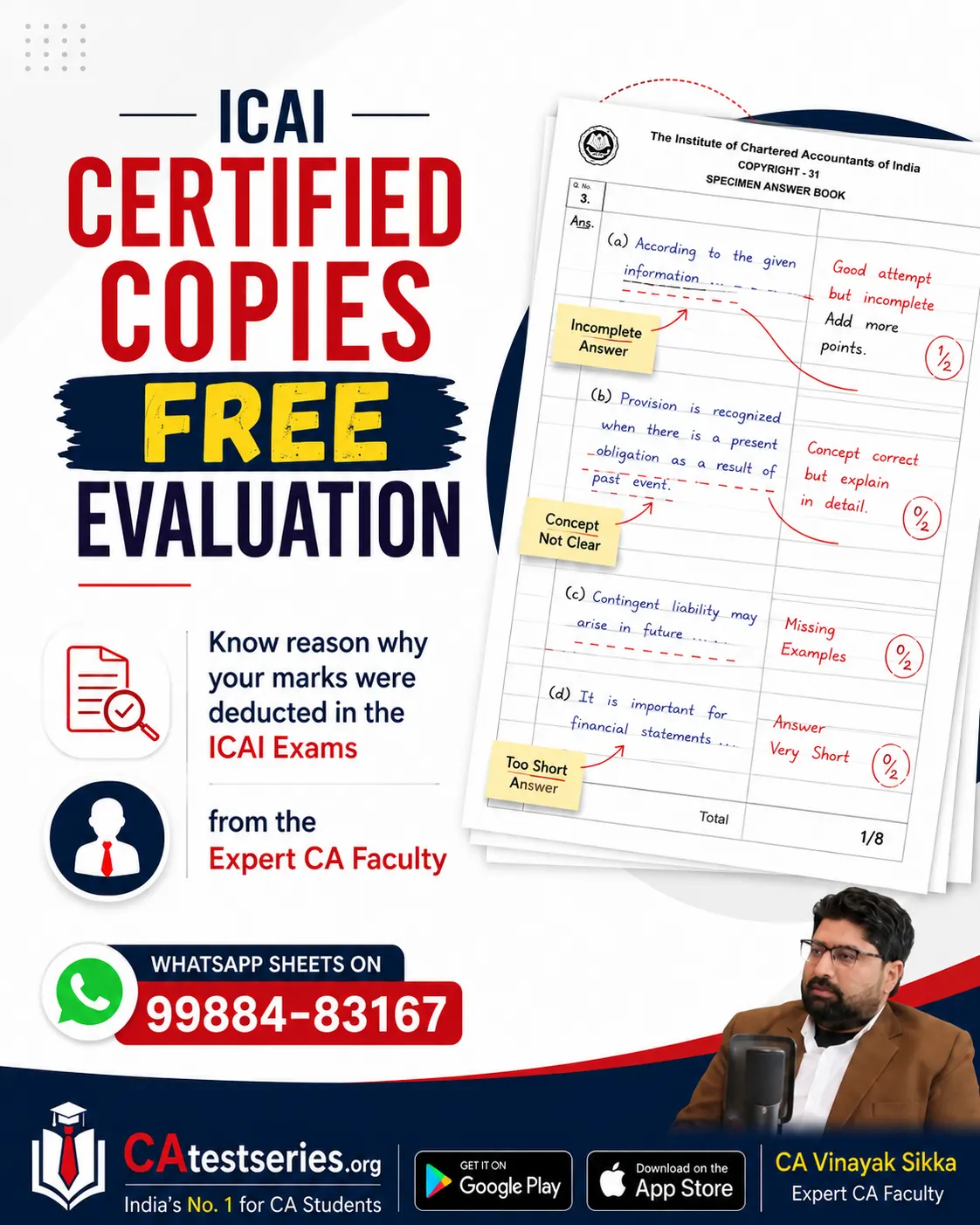
Get detailed feedback and personalized remarks on your answer sheets to enhance your learning and identify areas of improvement. This evaluation step separates premium test series from basic practice platforms.
When an expert evaluates your answer, they assess:
- Step marking accuracy: Did you show working for each calculation step?
- Professional presentation: Is your answer formatted per ICAI conventions?
- Conceptual reasoning: Did you explain the "why" behind your answer, not just the "what"?
- Time efficiency: Did you spend proportionate time on high-mark questions?
Without expert feedback, you repeat the same mistakes across multiple tests. With it, you identify patterns and correct them before the actual exam. Visit Catestseries to see how evaluation platforms provide this layer of analysis.
Extracting Actionable Insights From Test Performance Data
Completing a test series is only 40% of the value. The remaining 60% comes from analyzing your performance data systematically.
After each full-length mock, extract these four metrics:
- Accuracy rate by subject: Which subjects consistently show lower accuracy? These need additional concept review before attempting more tests.
- Time allocation analysis: How many minutes did you spend per question? Compare this to the ideal (total time ÷ total questions). If you're 20% slower than ideal, you need speed drills on that subject.
- Question-type performance: Do you score higher on theory questions vs. numerical problems? This reveals whether your weakness is conceptual or computational.
- Revision gap identification: Which topics appear in tests but weren't in your revision notes? These are high-probability exam topics you've overlooked.
By using actual exam papers for practice, you may improve your time management abilities and make sure you finish the test in the allotted time. Evaluating readiness: Solving practice exams on a regular basis allows you to monitor your progress over time, determine your level of preparedness, and pinpoint your weak areas.
For CA Inter and Final September 2026, this data-driven approach is non-negotiable. The exam window is narrow, and every test must inform your next study block. Students who skip this analysis step typically repeat the same errors in the actual exam.
Create a simple tracking sheet:
- Test date
- Subject-wise scores
- Time taken vs. ideal time
- Topics where you lost marks
- Corrective action for next test
This sheet becomes your revision roadmap in the final 2-3 weeks before September exams.
Integrating Test Series Into Your Broader Preparation Strategy
Test series work best when embedded into a larger study framework, not used in isolation.
Phase 1 (May-June): Concept Building + Chapter TestsDuring this phase, you're learning new topics from ICAI study material. Attempt chapter-wise tests immediately after completing each chapter. This reinforces learning and identifies gaps before moving to the next topic. Don't attempt full-length mocks yet—your syllabus coverage is incomplete.
Phase 2 (July-August): Integrated Learning + Full-Length MocksOnce you've covered 80% of the syllabus, transition to full-length mock tests. These now measure how well you integrate knowledge across topics. Attempt 2-3 full-length mocks per week, analyze performance, and use insights to guide your revision.
Phase 3 (August-September): Revision + Scheduled TestsIn the final 3-4 weeks, use scheduled test series to simulate exam-day conditions. These tests should feel like the actual exam—same timing, same difficulty, same pressure. Categorize your syllabus by using the ABC analytical method. Analyze the syllabus carefully and divide into ABC categories: (A) for high priority chapters, (B) for medium priority chapters, and (C) for low priority chapters.
During revision, prioritize A-category topics (high weightage, frequently tested) and use test series to validate your mastery. B and C categories get less test time but still need coverage.
The Critical Integration Point: RTPs and MTPs reflect current exam patterns and amendment-based questions. They are highly recommended for scoring better marks. Don't treat ICAI's official Mock Test Papers (MTPs) and Revision Test Papers (RTPs) as separate from third-party test series. Instead, use them as validation checkpoints. If you score well on third-party tests but poorly on ICAI's official papers, it signals that your preparation is misaligned with ICAI's actual expectations.
For CA Test Series for 2026, this integration means using third-party tests for frequent practice and ICAI papers for final validation.
Foundation, Inter, and Final: Tailored Test Series Approaches
Each CA level requires a different test series strategy because the exam patterns and difficulty levels differ significantly.
CA Foundation (September 2026)
The CA Foundation Exams for the Institute of Chartered Accountants of India (ICAI) will be 2nd, 5th, 7th & 9th September 2026. Foundation is the entry point, so test series here focus on building speed and accuracy on straightforward conceptual questions.
Foundation test series should emphasize:
- High-frequency topics (accounting principles, basic taxation, business law fundamentals)
- Time management (Foundation papers are shorter, so speed matters more)
- MCQ accuracy (Foundation includes more objective questions than Inter/Final)
Attempt 4-5 full-length mocks in the final month. Foundation students often underestimate this level, leading to preventable failures.
CA Intermediate (September 2026)
The CA Intermediate examination is divided into two groups, Group I and Group II. Each group contains three papers. Inter test series must account for group-wise preparation. Many students prepare both groups simultaneously, while others focus on one group per attempt.
Inter test series strategy:
- Attempt group-specific full-length mocks (Group I papers separately from Group II)
- Practice numerical problems extensively—Inter emphasizes calculations over theory
- Use Syllabus for Test Series to ensure your test papers cover the latest amendments
For September 2026, if you're attempting both groups, use test series to validate that you can manage the combined workload. Attempt at least 2-3 full-length tests covering both groups together.
CA Final (September 2026)
CA Final test series are the most demanding because the exam tests application and judgment, not just knowledge. Test papers should include case studies, scenario-based questions, and integrated problems.
Final test series priorities:
- Application-based questions (not just theory recall)
- Time management under pressure (Final papers are lengthy)
- Integrated knowledge (questions that span multiple subjects)
Attempt 5-6 full-length mocks in the 8 weeks before September exams. Final requires more test attempts than Inter or Foundation because the complexity is higher.
For all three levels, use CA Foundation - Video Lectures & Books as supplementary learning resources when test series reveal conceptual gaps.
Selecting the Right Test Series Platform for September 2026
The market offers multiple test series platforms, each with different strengths. Your choice should align with your preparation stage and learning style.
Evaluation Criteria
When comparing test series platforms, assess these five factors:
- Question quality: Do questions mirror actual ICAI difficulty? Are they application-based or just recall-based?
- Evaluation expertise: Who evaluates your answers? Are they practicing CAs or junior evaluators? What's their average experience?
- Feedback speed: How quickly do you receive evaluation? 24 hours is standard; faster is better.
- Amendment coverage: Are latest syllabus amendments embedded in test papers? Or are they released separately?
- Doubt-solving support: Can you ask questions about test papers? Is there a dedicated doubt panel?
Platform Comparison
Platform Feature | ICAI Official Papers | Third-Party Series | Hybrid Approach |
| Question authenticity | 100% (actual exams) | 70-80% similarity | Both |
| Evaluation quality | Self-evaluation only | Expert feedback | Expert + self |
| Amendment coverage | Delayed | Immediate | Immediate |
| Doubt-solving | Limited | Comprehensive | Comprehensive |
| Cost | Free | Paid | Paid |
For September 2026, use ICAI's official papers (MTPs and RTPs) as validation checkpoints, not as your primary practice tool. Supplement with third-party test series for frequent practice and expert feedback.
When selecting a third-party platform, prioritize evaluation quality over question quantity. A platform with 20 tests and expert evaluation is more valuable than one with 100 tests and no feedback. CS Test Series for Jun 2026 and CMA Test Series for Jun 2026 show how specialized test series can be tailored to specific professional courses—CA test series should offer similar specialization.