
The CA test series for November 2026 represents your most critical preparation tool before the actual ICAI examination. Unlike casual practice, structured test series measure three core dimensions: conceptual accuracy, professional answer presentation, and time management under exam pressure. This guide explores how to leverage test series strategically to maximise your exam readiness.
Understanding the Dual Purpose of CA Test Series: Diagnostic vs. Confidence Building
The CA test series serves two distinct functions that students often conflate. First, they act as diagnostic instruments—revealing knowledge gaps, weak topics, and presentation errors before the actual exam. Second, they build exam confidence by familiarizing you with question patterns, time constraints, and the psychological pressure of timed assessments.
The exam pattern of CA Final Nov 2026 is designed to test not only technical knowledge but also professional application, judgment, and decision-making skills. This means your test series must replicate this complexity. Generic practice papers fall short because they don't embed the application-based reasoning that ICAI examiners expect.
When you attempt a test series, you're not simply checking if you know the answer—you're training your brain to think like an ICAI examiner. Questions are often case-based and analytical. This distinction matters enormously. A student who solves 50 application-based mock tests will outperform a student who solves 200 definition-based practice questions.
The confidence-building function is equally critical. Because of the complexity of papers, proper exam writing practice becomes extremely important at this stage. Sitting through a full 3-hour or 4-hour mock exam trains your stamina, helps you manage anxiety, and teaches you how to allocate time across different question types.
Why Third-Party Test Series Differ From ICAI Official Papers
ICAI releases official Mock Test Papers (MTP) and Revision Test Papers (RTP) at specific intervals. However, third-party test series providers fill a critical gap: they offer unlimited practice with expert evaluation. Application-based unseen questions in CA Final Online Mock Test Series, CA Inter Online Mock Test Series, and CA Foundation Online Mock Test Series as per the latest pattern of the ICAI Exam are designed to stretch your thinking beyond what official papers alone can provide.
Official papers are released close to the exam date and serve as final checkpoints. Third-party series, by contrast, should be attempted throughout your preparation journey—starting 4-5 months before the exam and continuing until exam day. This extended practice window allows you to identify patterns in your mistakes and correct them systematically.
Structural Components of Effective CA Test Series for November 2026
A comprehensive test series for November 2026 must include multiple structural layers. Each layer serves a specific learning objective and builds toward exam readiness.
Chapter-Wise Tests (30-40 marks each)
These are your foundation-building tools. Chapter-wise tests isolate specific topics—say, Financial Reporting standards or Direct Tax provisions—and test your depth in that area. They're ideal for early-stage preparation when you're still building conceptual clarity.
Unit-Wise Tests (50-70 marks)
Unit tests combine 2-3 related chapters and test your ability to integrate concepts. For example, a unit test might combine Accounting Standards with Financial Reporting, forcing you to apply standards within a reporting context.
Full Syllabus Mocks (100 marks)
These replicate the actual exam structure and duration. The ICAI CA Final exams are structured with varying durations depending on the specific paper. While most of the exams are scheduled for three hours, there are a few papers that extend to four hours in each session. Your full mocks must match these exact timings.
Evaluation Quality Matters More Than Quantity
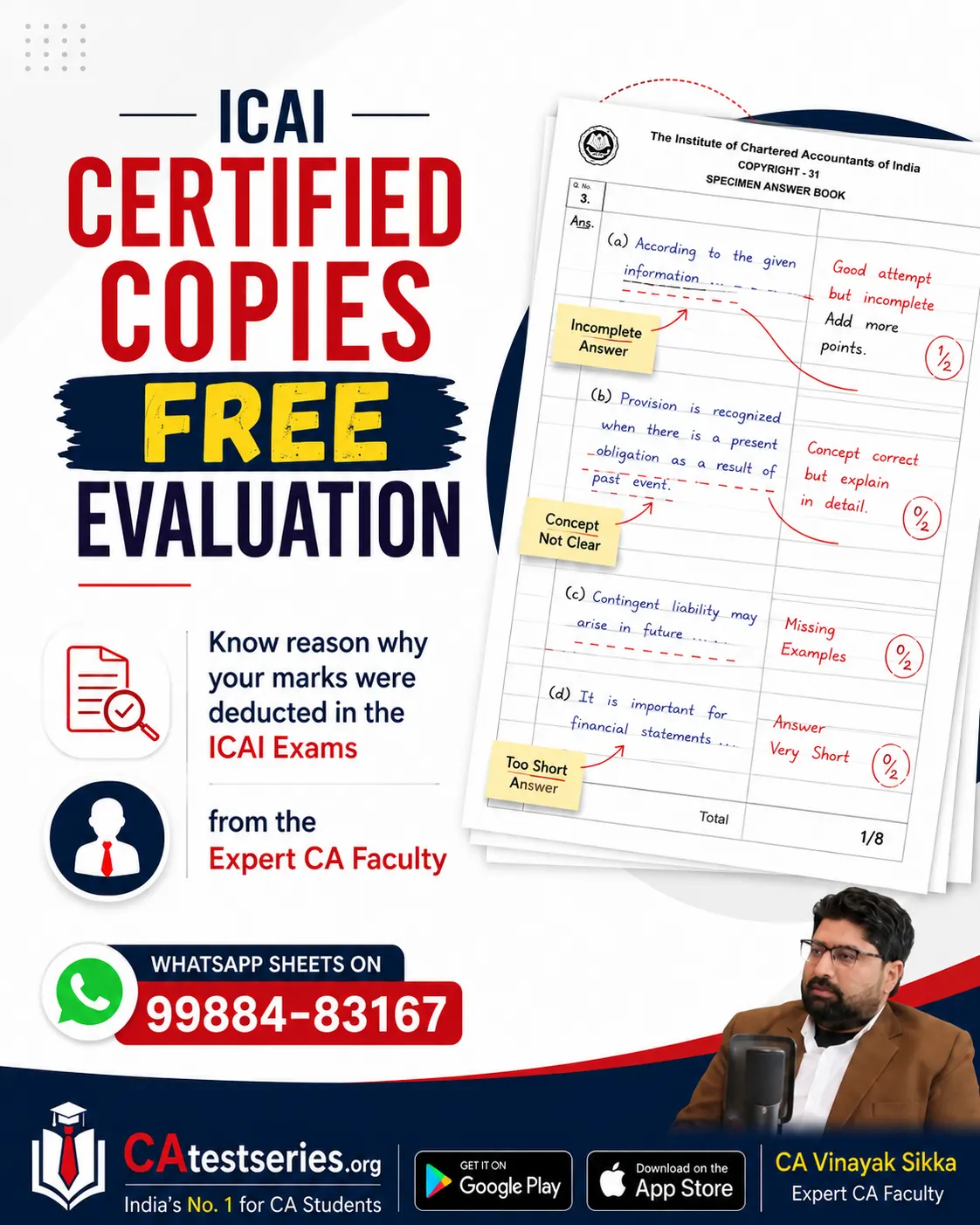
A test series with 50 tests, but generic feedback is less valuable than 15 tests with expert, personalized evaluation. Every CA answer sheet is manually evaluated by a qualified Chartered Accountant with marks, detailed comments, and improvement suggestions within 48 hours. This level of feedback is non-negotiable. Generic feedback like "improve your presentation" doesn't help; specific feedback like "you missed the working notes requirement in step 2, which costs 5 marks" does.
| Test Type | Frequency | Marks | Purpose | Timing |
| Chapter-wise | Weekly | 30-40 | Concept clarity | 45-60 min |
| Unit-wise | Bi-weekly | 50-70 | Integration practice | 75-90 min |
| Full mock | Monthly | 100 | Exam simulation | 3-4 hours |
| Revision tests | Final month | 100 | Last-minute readiness | 3-4 hours |
Evaluating Test Series Providers: What Actually Matters
Not all test series are created equal. When selecting a test series for November 2026, evaluate providers on specific, measurable criteria rather than marketing claims.
Criterion 1: Question Quality and Originality
Do the test papers include original, unseen questions or recycled questions from past exams? Original questions force you to think critically; recycled questions create false confidence. A unique set of questions other than ICAI study material, specific guidance regarding the mistakes, not only general guidance, a topper sheet with complete analysis, step marking, and various unique revision strategies for the ICAI exams makes the CA Test Series one of the most preferred platforms for the CA online test series.
Criterion 2: Evaluator Credentials
Who evaluates your papers? Are they practicing CAs with exam experience, or are they junior staff? Evaluators with 5+ years of CA practice and exam experience provide feedback that junior evaluators cannot. This is non-negotiable.
Criterion 3: Evaluation Turnaround Time
Expert CA evaluation within 48 hours. Faster turnaround is better—you want feedback while the test is fresh in your mind. 48-hour turnaround is the industry standard; anything slower reduces the feedback's value.
Criterion 4: Doubt Support Quality
Can you ask doubts on specific questions? Are doubts answered by qualified CAs or by junior staff? Ask unlimited academic doubts on any CA subject via WhatsApp and email throughout your test series. Answered by qualified CAs. This support should be unlimited and answered by qualified professionals.
Criterion 5: Alignment With Latest ICAI Pattern
All test papers are aligned with the latest ICAI 2026 syllabus and exam pattern. Verify that the provider has updated their papers for the November 2026 exam pattern, not older patterns.
| Evaluation Criterion | What to Look For | Red Flag |
| Question originality | Unseen, application-based questions | Recycled past exam questions |
| Evaluator credentials | 5+ years CA practice | Junior staff or non-CAs |
| Turnaround time | 24-48 hours | 5+ days |
| Doubt support | Unlimited, answered by CAs | Limited or delayed |
| Pattern alignment | Latest ICAI 2026 pattern | Outdated patterns |
Addressing Common Test Series Mistakes and How to Avoid Them
Even with access to quality test series, students make predictable mistakes that undermine their effectiveness.
Mistake 1: Attempting Tests Without Adequate Concept Preparation
Students sometimes jump into full mocks after studying just 2-3 chapters. This creates demoralizingly low scores and wastes the test. Rule: Attempt chapter-wise tests only after completing that chapter's study. Attempt unit tests only after completing all chapters in that unit. Attempt full mocks only after completing 80%+ of the syllabus.
Mistake 2: Not Reviewing Tests Thoroughly
Students check their score, see they got 65/100, and move on. They don't analyze which questions they got wrong or why. This is test series malpractice. Every test must be followed by 2-3 hours of analysis. Without analysis, you're just practicing without learning.
Mistake 3: Ignoring Presentation Feedback
Evaluators often comment on presentation issues: "Missing working notes," "Headings unclear," "Answer structure illogical." Students read these comments and ignore them, assuming they're minor. In reality, presentation issues cost 10-20% of marks in CA exams. If an evaluator flags presentation problems, treat them as seriously as conceptual errors.
Mistake 4: Attempting Too Many Tests Without Spacing
Some students attempt 3-4 full mocks in a single week, thinking more practice = better results. This is counterproductive. You need time between tests to analyze, revise weak areas, and let concepts settle. Optimal spacing: 1 full mock every 7-10 days during intensive preparation.
Mistake 5: Not Simulating Exam Conditions
Students attempt tests in a relaxed home environment, checking their phone, taking breaks whenever they want. Then they're shocked when the actual exam's pressure and time constraints feel overwhelming. Rule: Attempt every full mock in exam-like conditions—no phone, no breaks, strict time limits, quiet environment.
A practical checklist for each test attempt:
- Complete all concept study for that test's topics before attempting
- Attempt in a quiet, distraction-free environment
- Maintain strict time limits (no extensions)
- Submit your answer sheet for expert evaluation
- Spend 2-3 hours analyzing the evaluation
- Identify weak topics and revise them before the next test
- Track your scores across tests to monitor improvement
Leveraging Free Resources and Official ICAI Papers Alongside Paid Test Series
You don't need to rely solely on paid test series. ICAI releases free official papers, and many platforms offer free tests. Strategic use of these free resources alongside paid series maximizes your preparation.
ICAI Official Mock Test Papers (MTP)
ICAI releases official MTPs approximately 1 month before each exam session. For November 2026, official MTPs will be released around October 2026. These papers are invaluable because they reflect the exact exam pattern and difficulty level. Attempt official MTPs in your final month of preparation.
ICAI Revision Test Papers (RTP)
RTPs are released even closer to the exam (typically 2-3 weeks before). These are your final diagnostic tools. If you score well on RTPs, you're exam-ready. If you score poorly, focus your final revision on those weak areas.
Free Test Series From Platforms
CA Test Series also provides a free test series for CA Foundation, CA Intermediate and CA Final on its mobile app CA Test Series which is available on both Android and Apple app stores. Students can attempt free test papers with live results in 5-minute chapter-wise tests for various subjects. Many aspirants find these free tests quite helpful during revision time. Use free tests for quick chapter-wise revision, not as your primary preparation tool.
Strategic Sequencing
- Months 1-4: Use paid test series with expert evaluation as your primary practice tool
- Month 5: Supplement paid series with free chapter-wise tests for quick revision
- Final month: Attempt official ICAI MTPs and RTPs
- Final 2 weeks: Review your performance on official papers and focus revision accordingly
This sequencing ensures you're using each resource type at the optimal time in your preparation journey. Visit Catestseries to explore comprehensive test series options aligned with the November 2026 exam pattern.
Understanding the Difference Between MTP, RTP, and Third-Party Tests
Students often confuse these three test types. Understanding their distinct purposes helps you use each strategically.
MTP (Mock Test Papers): Official ICAI papers released 1 month before exams. They replicate the exact exam pattern and difficulty. Use them as final checkpoints, not as your primary practice tool.
RTP (Revision Test Papers): Official ICAI papers released 2-3 weeks before exams. They're shorter and focus on revision. Use them in your final 2 weeks.
Third-Party Test Series: Unlimited practice papers with expert evaluation. Use them throughout your 5-month preparation journey. CA test Series also evaluates the ICAI MTP (Mock test papers) of Sep 2026 and Nov 2026 for all three levels of ICAI exams at a nominal charge of around Rs 125 to 175 based on the course. Some providers even evaluate official papers for you, providing additional feedback beyond ICAI's suggested answers.
For November 2026, use all three: third-party series for ongoing practice, official MTPs for final-month checkpoints, and official RTPs for last-minute readiness.
Building Your November 2026 Test Series Action Plan
Theory is useful, but execution determines results. Here's a concrete action plan for leveraging test series effectively for November 2026.
Step 1: Select Your Test Series Provider (By June 2026)
Research 3-4 providers using the evaluation criteria outlined above. Compare their question quality, evaluator credentials, turnaround time, and pricing. Select one primary provider for your core test series. Explore CA Test Series for 2026 to understand what comprehensive test series include.
Step 2: Create Your Test Schedule (By June 2026)
Map out when you'll attempt each test. For a 5-month preparation period (June-October 2026):
- June: 4 chapter-wise tests (1 per week)
- July: 8 chapter-wise tests + 2 unit tests
- August: 6 unit tests + 2 full mocks
- September: 4 full mocks + 2 unit tests for weak areas
- October: 2 official MTPs + 2 official RTPs + 1 final full mock
This schedule ensures progressive complexity and adequate spacing between tests.
Step 3: Establish Your Analysis Protocol (Before Starting)
Decide how you'll analyze each test. Create a simple template:
- Test name and date
- Total marks and your score
- Accuracy by chapter (% correct)
- Presentation issues flagged by evaluator
- Time spent on each question
- Topics requiring additional study
- Action items for next test
Use this template consistently for every test. Over time, you'll see patterns in your mistakes and improvements in your scores.
Step 4: Track Your Progress (Ongoing)
Maintain a simple spreadsheet tracking your scores across all tests. Plot your scores on a graph. You should see an upward trend from June to October. If your scores plateau or decline, adjust your study strategy.
Step 5: Adjust Based on Performance (Ongoing)
If you're consistently scoring below 50% on a particular chapter, spend extra time studying that chapter before attempting more tests on it. If you're scoring 80%+ on a chapter, reduce practice on that chapter and focus on weaker areas.
This adaptive approach ensures your test series practice is always targeted toward your actual weaknesses, not generic practice.
For comprehensive guidance on test series structure and syllabus alignment, review the Syllabus for Test Series to understand exactly what topics your tests should cover.