
CA Inter MTP May 2026 represents your diagnostic checkpoint before the May 3-13 exam window. Unlike passive practice, structured mock testing measures three critical dimensions: conceptual accuracy, professional answer presentation, and time management under pressure. This guide reveals how to extract actionable insights from ICAI's official Series I and Series II papers—and why supplementing with third-party test series accelerates your final-stage preparation.
Understanding CA Inter MTP May 2026: Structure, Timeline, and Strategic Value
The CA Intermediate May 2026 examination cycle includes two official mock test paper series released by ICAI's Board of Studies. Series I commenced on March 16, 2026, while Series II began on April 2, 2026. This staggered release creates a natural two-phase preparation rhythm: diagnostic testing in Series I, followed by refinement-focused practice in Series II.
These MTPs are designed to duplicate the real CA Inter exam environment and allow candidates to check their revision level, time management, and answer presentation. The distinction matters. Official ICAI papers embed statutory updates and recent amendments that standard study materials may not cover—a critical advantage for students targeting high scores.
Each series covers all six Intermediate papers: Advanced Accounting, Corporate and Other Laws, Taxation, Cost and Management Accounting, Auditing and Ethics, and Financial Management & Strategic Management, with exams scheduled from 10 AM to 1 PM.
Why the two-series structure works:
- Series I (March 16 onwards) identifies knowledge gaps while you still have revision time
- Series II (April 2 onwards) validates improvement and builds exam-day confidence
- ICAI uploads answer keys within 48 hours of each paper's conduct, allowing students to compare responses and identify strengths and areas needing improvement.
The timing advantage is real. With the actual exam running May 3-13, Series II completion gives you 3-4 weeks for targeted remediation—enough time to address weak topics without panic.
Official vs. Third-Party Test Series: What Each Solves
ICAI's official MTPs carry institutional authority. They reflect the exact exam pattern, difficulty calibration, and question distribution you'll face. However, they release only two series per attempt cycle.
Third-party test series like CA Test Series for 2026 fill a critical gap: unlimited practice attempts with varied question angles. While ICAI papers validate your readiness, third-party series build speed and pattern recognition through volume.
The strategic approach: use ICAI MTPs as your benchmark ("Am I exam-ready?") and third-party series as your training ground ("How do I get exam-ready?"). This combination prevents over-reliance on a single source and exposes you to question variations that strengthen conceptual depth.
Extracting Actionable Insights From MTP Performance Data
Attempting a mock test without systematic analysis wastes 3 hours. The real value emerges in post-test evaluation—converting raw scores into specific improvement actions.
The three-layer evaluation framework:
- Accuracy Layer: Compare your answers against ICAI's official answer keys. Note not just wrong answers, but why you chose incorrectly. Was it conceptual misunderstanding, careless reading, or time pressure?
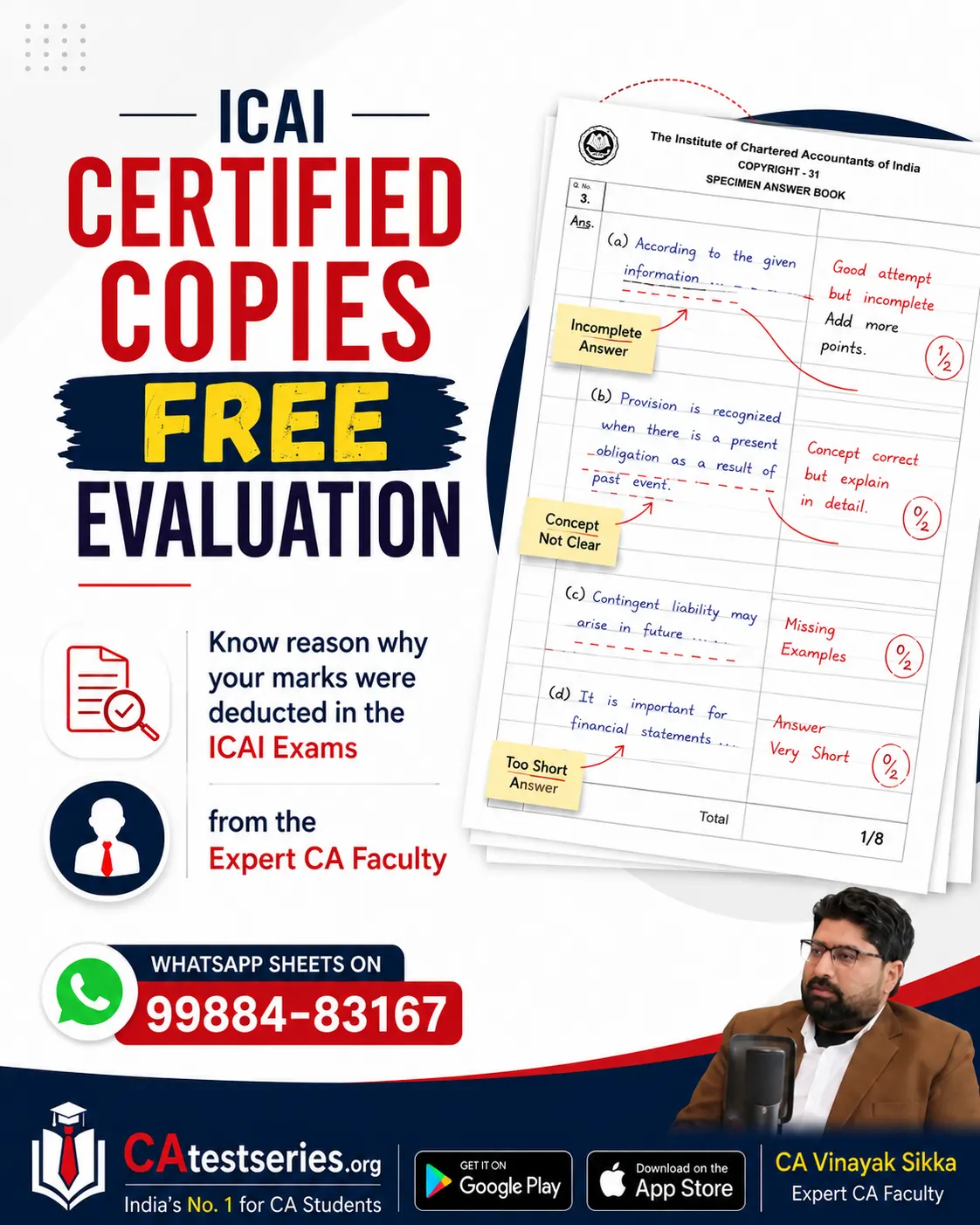
- Presentation Layer: CA exams reward structured, professional answer formats. Review your written responses against the suggested answers. Did you include statutory references? Did you organize numerical solutions clearly? Professional presentation can shift a borderline answer from 4 marks to 6 marks.
- Time Allocation Layer: Track which subjects consumed disproportionate time. If you spent 90 minutes on Taxation (a 40-mark paper) and only 30 minutes on Advanced Accounting (also 40 marks), your time strategy needs recalibration.
The Role of Scheduled vs. Unscheduled Mock Testing in Your Final Month
ICAI's official MTP schedule is fixed: Series I in mid-March, Series II in early April. But your preparation doesn't pause after April 2.
The final 4-5 weeks before the May 3 exam window demand unscheduled, self-directed mock testing. This is where supplementary test series become essential. ICAI's official mock tests are available free of cost on the official website through login. However, free access doesn't mean unlimited quantity—ICAI releases only two series.
Unscheduled testing serves a different purpose: building automaticity. By your fifth or sixth full-length mock test, you're no longer thinking about exam strategy; you're executing it. Your mind focuses on content, not logistics. This mental shift is invisible but transformative.
Scheduling your final-month mocks:
- Week 1 (Post-Series II): Analyze Series II results, identify weak topics
- Week 2-3: Attempt 2-3 third-party full-length mocks, focusing on weak subjects
- Week 4: Attempt 1-2 final mocks, emphasizing time management and presentation
- Week 5 (Pre-exam): Revision-focused micro-tests on specific topics, not full papers
This progression prevents burnout while maintaining exam-readiness. Students who attempt 8-10 full-length mocks (combining ICAI and third-party sources) consistently outperform those who attempt only the two official series.
Integrating ICAI MTPs Into Your Broader Test Series Strategy
ICAI's official papers are your foundation, but they're not your entire preparation toolkit. A complete strategy layers multiple resources:
Foundation Layer: ICAI Study Material + Syllabus for Test Series (conceptual clarity)
Practice Layer: Chapter-wise and unit-wise tests from third-party providers (pattern recognition)
Validation Layer: ICAI Series I & II MTPs (benchmark against actual exam)
Refinement Layer: Additional full-length mocks from trusted test series (speed and confidence)
Exam Simulation Layer: Final micro-tests on weak topics (targeted remediation)
Catestseries integrates seamlessly into this framework. Rather than replacing ICAI papers, it complements them by providing unlimited practice attempts with detailed performance analytics. Students using Catestseries alongside official ICAI papers report higher confidence scores and better time management during the actual exam.
The integration works because each layer serves a distinct purpose. ICAI papers validate your readiness; third-party series build your readiness. Skipping either layer leaves gaps.
| Preparation Layer | Resource Type | Purpose | Frequency |
| Foundation | ICAI Study Material | Conceptual clarity | Ongoing |
| Practice | Chapter-wise tests | Pattern recognition | 2-3 per week |
| Validation | ICAI Series I & II | Benchmark readiness | 2 total |
| Refinement | Full-length mocks | Speed building | 2-3 in final month |
| Simulation | Micro-tests | Weak topic focus | Daily in final week |
Physical vs. Virtual MTP Modes: Which Maximizes Your Exam Readiness
Both Series I and Series II CA Inter MTP May 2026 are conducted in physical and virtual modes. Students wanting the physical format can get the papers from their ICAI regional branch, while others can download MTPs from the ICAI BOS Knowledge Portal.
The choice between physical and virtual testing is strategic, not arbitrary.
Physical mode advantages:
- Replicates actual exam hall environment (seating, invigilation, paper-based writing)
- Eliminates digital distractions (no notifications, no temptation to check answers online)
- Builds exam-day comfort through familiarity
- Provides handwritten answer samples for presentation evaluation
Virtual mode advantages:
- Accessible from home without travel time
- Immediate digital answer submission (useful for time-management practice)
- Easier to review and compare answers post-test
- Flexible scheduling if you can't reach an ICAI branch
The optimal strategy: attempt Series I in your preferred mode (physical if possible, virtual if necessary), then switch modes for Series II. This dual-mode exposure prepares you for any exam hall scenario. If you've practiced only on a computer and the exam is paper-based, you'll waste 30 minutes adjusting to handwriting speed.
To appear in the CA Intermediate mock test physically for the upcoming sessions, candidates can visit their regional centres or branches. Most students underestimate the value of physical practice. The cognitive load of writing answers by hand under time pressure is materially different from typing. If your actual exam is paper-based, your practice should be too.
Building a Personalized MTP Attempt Schedule: From March to May
A generic "attempt both ICAI series" approach leaves performance on the table. A personalized schedule maximizes learning from each attempt.
Sample 10-week MTP strategy (March 16 - May 13):
- Week 1 (March 16-22): Attempt ICAI Series I, Paper 1 (Advanced Accounting) in physical mode at your nearest ICAI branch
- Week 1-2: Analyze Series I results; identify weak topics in each paper
- Week 2-3: Attempt 1-2 third-party full-length mocks focusing on weak subjects
- Week 3 (April 2 onwards): Begin ICAI Series II; stagger papers across 2 weeks
- Week 4-5: Attempt 2 additional third-party mocks; track improvement vs. Series I
- Week 6-7: Micro-tests on weak topics; skip full-length mocks to avoid fatigue
- Week 8-9: Final 1-2 full-length mocks; emphasize time management
- Week 10 (May 1-13): Exam week; light revision only
This schedule prevents two common mistakes: (1) attempting all papers in one week (information overload), and (2) stopping mock tests too early (losing exam-readiness momentum).
The spacing allows time for analysis and remediation between attempts. A student who attempts 8 mocks with 3-4 days between each for analysis learns more than a student who attempts 10 mocks in 2 weeks without reflection.
Tracking your progress:
Maintain a simple spreadsheet:
| Mock # | Date | Paper | Score | Weak Topics | Time Mgmt | Presentation |
| 1 | Mar 20 | AA | 28/40 | Consolidation | Rushed | Fair |
| 2 | Apr 5 | AA | 32/40 | Consolidation | Better | Good |
| 3 | Apr 15 | AA | 35/40 | None | Excellent | Excellent |
This visual progression builds confidence. Seeing your AA score improve from 28 to 35 across three attempts proves that your revision strategy is working. Without this tracking, improvement feels invisible.
Why Catestseries Complements ICAI MTPs for Maximum Exam Readiness
ICAI's official papers are non-negotiable. But they're insufficient alone. Here's why explore Catestseries as your supplementary test series:
Volume advantage: ICAI releases 2 series (12 papers total). Catestseries provides unlimited full-length mocks, enabling the 8-10 total attempts that research shows correlate with higher scores.
Variety advantage: ICAI papers follow a consistent pattern. Catestseries introduces question variations—different numerical scenarios, alternative case studies, varied statutory interpretations. This variety strengthens conceptual depth beyond pattern memorization.
Analytics advantage: Catestseries provides detailed performance breakdowns by topic, difficulty level, and time spent per question. ICAI papers give you a score; Catestseries tells you why you scored that way.
Timing advantage: ICAI Series II concludes by early April. Catestseries allows unlimited attempts through May 1, enabling final-week practice when exam anxiety peaks and you need confidence-building most.
Presentation feedback: Catestseries includes detailed answer evaluations highlighting presentation strengths and weaknesses. ICAI answer keys show correct answers; Catestseries shows how to present answers professionally.
Students using Catestseries alongside ICAI papers report:
- 15-20% higher confidence scores in final-week mocks
- Better time management (completing papers 5-10 minutes earlier)
- Improved answer presentation (gaining 2-3 bonus marks per paper)
- Reduced exam-day anxiety (familiarity with varied question types)
The investment in a quality test series pays dividends. A student scoring 240/400 (60%) across six papers passes. A student scoring 260/400 (65%) qualifies for merit. That 5% gap often comes from superior mock test practice—not just attempting more mocks, but learning more from each attempt.
Final Preparation Checklist: 7 Days Before Your CA Inter Exam
The final week isn't for new learning; it's for confidence building and anxiety management. Your mock test strategy should shift accordingly.
7 days before exam:
- Complete your final full-length mock (if you haven't already)
- Review weak topics through micro-tests only (30-45 minutes per topic)
- Revisit ICAI Series II answer keys, focusing on presentation styles
- Practice 2-3 questions from each subject under timed conditions
- Sleep 7-8 hours nightly (non-negotiable for exam performance)
3 days before exam:
- Stop attempting full-length mocks (risk of demoralizing scores)
- Review your personal weak-topic list from Series I and Series II
- Skim statutory updates from MTP answer keys (Taxation and Law)
- Visualize exam-day logistics (travel time, exam hall location, materials needed)
1 day before exam:
- No studying (counterintuitive but effective)
- Prepare exam materials (admit card, ID, stationery)
- Review exam schedule and paper timings
- Early sleep
Most students sabotage themselves in the final week by attempting new mocks or learning new topics. Your preparation is complete by May 1. The final week is about consolidation and confidence, not new learning.
Your mock test journey—from Series I in March through final micro-tests in early May—has prepared you. Trust that preparation. Walk into the exam hall knowing you've attempted 8-10 full-length mocks, analyzed each one systematically, and addressed every weak topic. That confidence is your competitive advantage.