CA Tanvi Singla Law Classes Review: Concepts, Case Studies and Revision
Corporate & other laws might seem straightforward in theory, but students often find them difficult in practice—the length of the exam, the volume of topics to cover in limited time, sourcing reliable data, and weaving in case-study examples all make it hard to prepare within a short timeframe.
Who is CA Tanvi Singla
CA Tanvi Singla is a well-known practicing chartered accountant with eight years of teaching experience who is mentoring many students through her lectures, concepts, and revisions to make it easy to crack CA Corporate & other laws. She is also available 24/7, so students can reach out with questions on any topic or provision and understand it quickly and easily.

Her approach to teaching corporate & other laws
Corporate law is a very essential subject to study for CA aspirants for their analytical approach towards any circumstances that arise in the future, as it deals with the relationships between the company and its customers, shareholders, creditors, employees, and all related parties. However, its concepts can feel difficult to grasp with theory alone—which is why a case-based approach is necessary for students to apply provisions effectively in real life.
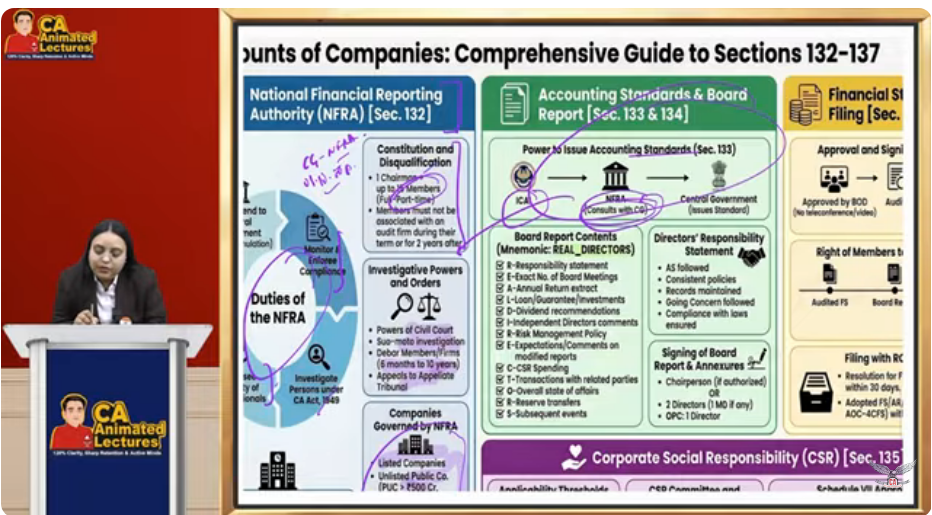
Thus, CA Tanvi Singla makes very relevant approaches for studying corporate law as follows:
1. Case Law Approach
CA Tanvi Singla believes that understanding through examples rather than theoretical learning is more convenient for students to go through every law and its meanings. Therefore, she makes 1000+ solved case studies mapped to sections in every concept.
As such, here's a useful understanding method:
Step | What the student does |
Problem | Read the facts. |
Issue | Identify the legal question. |
Rule | Find the applicable provision. |
Application | Apply the provision. |
Conclusion | State the result. |
2. Practical Approach
Corporate law is connected with business practices where a CA student understands how to deal with any conflict through legal provisions and attempts in a real-life environment.
They can gain an understanding that is practical in nature by reviewing:
Articles of Association &
Memorandum and Board resolutions,
Shareholders' resolutions,
Minutes & notices of meetings,
Company filings,
Annual reports,
Shareholders' agreements,
Corporate contracts, and
Compliance
The above-mentioned documents provide students with the link between theoretical education and practical knowledge.
3. Approach to Analysis
Students should therefore learn to analyze legal problems from different perspectives. When presented with a problem, they should identify the relevant facts, determine the legal issues, locate the applicable law, consider possible arguments, and reach a reasoned conclusion.
4. Comparative approach
In an interview, CA Tanvi says that a comparative approach can help students understand why different legal systems adopt different rules concerning company formation, directors' duties, shareholder protection, corporate governance, mergers, and insolvency.
Thus, corporate activities frequently cross national boundaries. Students can therefore benefit from comparing corporate law principles across different jurisdictions. It can be easily achieved through CA Tanvi’s lectures.
However, a comparative study should supplement—not replace—the detailed study of the student's own jurisdiction's law.
5. Current-Affairs Approach
The current affairs approach deals with all changes and circumstances that happen every day. CA Tanvi Singla updates her material to reflect recent amendments and case law and provides these updates to students so they can implement them in their answers and improve their exam marks.
Concept-based learning
CA Tanvi Singla makes it easier for students to learn concepts through her revision, books, notes, lectures, and thoughts. The revisions provide various conceptual understandings. A bunch of mock tests is also available for students to better understand corporate law.
Here lies the importance of practice, homework, mentoring & tests. The student might feel that the topic is easy while attending a lecture, but while trying the questions themselves without any help from the faculty member, their shortcomings can be identified:
Stage | Student's Focus | Expected Outcome |
Understanding | Learn the concept. | Conceptual clarity |
Visualization | Connect concepts. | Better retention |
Practice | Solve examples. | Application ability |
Homework | Attempt independently | Identify weak areas. |
Mentoring | Correct mistakes | Direction and improvement |
Test | Perform under exam conditions. | Exam readiness |
Revision | Revisit concepts. | Long-term retention |
Importance of case studies in law
Practical understanding—Case studies help students understand how corporate law is applied in real-life situations.
Understanding legal principles—They make concepts such as company formation, directors’ duties, shareholders’ rights, and corporate governance easier to understand.
Analysis of court decisions—Case studies help in understanding how courts interpret and apply provisions of corporate law.
Problem-solving skills—They develop the ability to identify legal issues and find appropriate solutions.
Understanding corporate disputes—They provide knowledge about common disputes involving companies, directors, shareholders, and creditors.
Knowledge of precedents—Important judgments become legal precedents that guide future cases.
Decision-making skills—They help managers, directors, and legal professionals make better decisions while complying with the law.
Awareness of legal consequences—Case studies show the consequences of violating corporate laws and directors’ duties.
Why is CA Tanvi Singla the best for law
CA Tanvi Singla is a strong choice for law because her conceptual clarity, practical approach, case-study-based teaching, and professional perspective can make a difficult subject easier and more understandable.
Strong knowledge of law—She has a good understanding of legal concepts and corporate laws.
Clear explanation—Complex legal topics can be explained in a simple and easy-to-understand manner.
Practical approach—She can connect legal concepts with real-life corporate situations and case studies.
Focus on concepts—Instead of only memorizing provisions, she helps students understand the reasoning behind the law.
Case-law-based learning—Important judgments and examples make the subject more interesting and practical.
Exam-oriented preparation—Her teaching can help students understand how to structure answers and present legal provisions effectively.
Updated knowledge—Corporate and company laws keep changing, so staying updated with amendments and judicial decisions is important.
Interactive learning—Discussion and examples can make difficult legal topics easier to remember.
Professional perspective—A CA’s understanding of business, taxation, finance, and corporate matters can provide an additional practical perspective on law.
Builds confidence—Good guidance helps students approach difficult legal questions with greater confidence.
Exam-oriented Practices
CA Tanvi Singla gives all her theories in an exam-friendly format. As given below:
1. Meaning / Definition: Legal concepts are explained briefly.
2. Relevant provision / Section: The section is mentioned with the section number and the Companies Act, 2013 provision.
3. Legal rule / Provisions: All important requirements, conditions, exceptions, and limitations are given in separate points.
4. Application / Analysis
Use phrases like
“In the present case…”
“According to the above provision…”
“Therefore, the company/director/member is…”
If the question gives a case/problem, apply the law to the facts.
5. Conclusion: One- or two-line conclusion at the end.
For instance:
Question: What is a Director Identification Number (DIN)?
Answer:
Meaning of DIN: Individuals who intend to be a director of a company must have an identification number called a Director Identification Number (DIN).
Relevant Provision: Section 153 of the Companies Act, 2013
Provisions:
Every person intending to be a director must apply for a DIN.
A person cannot hold more than one DIN.
An individual has a unique identification number.
The DIN must be quoted in documents where required under the Act.
Conclusion:
Thus, a DIN is a unique statutory identification number necessary for an individual to act as a director of a company.
Resources | Links |
Concepts Notes | |
Question Bank | |
Strategy | |
Chartbook |
Benefits of choosing her as a mentor
She believes concept-first teaching reduces the burden of memorization.
She has real-world business context through professional experience
Her mentoring provides a structure-based improvement.
Personalized doubt support for students who struggle with theory or case-based questions
Specific strength in corporate & other laws
Students’ review
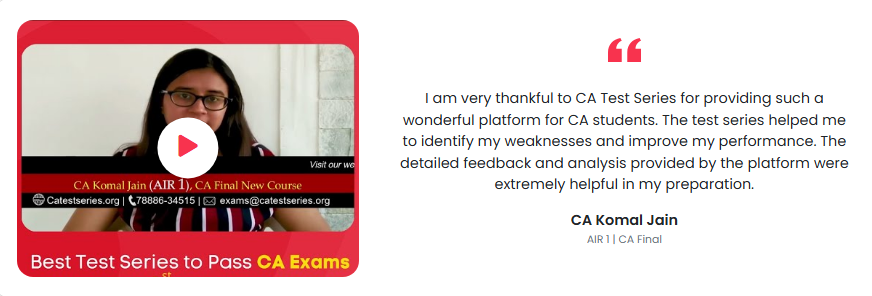
Rajesh Kumar (CA Inter)
The CA test series really helped me build up my confidence in corporate laws before appearing for the exam. The questions were highly similar to the pattern, and the comments were highly explanatory in nature, showing what exactly needs to be improved and how to do it.
Komal Praneeth (CA Final)
The evaluation was quite personal in nature. The comments were clear and motivating. Helped me focus on my weak areas. CA Tanvi Singla always helps me out when I face problems.
Batch: Pricing, Format, and Duration
Students having concerns about enrolling can directly check on catestseries.org, as their plan and fee structure are:
Detail | What to Confirm |
Course fee | Free course |
Validity | 12 months |
Format | Live and recorded |
Language | Hindi and English |
Doubt-solving mode | WhatsApp, forum, live Q&A, one-on-one calls |
App/platform access | Website: catestseries.org |
Batch Timing & Availability
Detail | Status |
Course Format | Recorded video lectures (also offered in a newer 3D-animated format across CAtestseries.org) |
Latest Batch (3D Animated Series) | Batch 1 — Registrations Full |
Next Batch | Batch 2—Yet to be launched (Stay tuned for Batch 2 launch) |
Access Mode | Streamable on Android, iOS, laptop, and tablet |
Validity | Typically tied to the applicable exam attempt—confirm the validity period at checkout. |
Conclusion
The revisions by CA Tanvi Singla are suitable for all aspects of mentoring students for CA corporate & other laws and for practicing different models with her. Her parameters are enough to give all relevant theories for CA aspirants.