
CA Inter chapter-wise tests break the syllabus into focused units, letting you master one topic before moving forward. Unlike full-length mocks that overwhelm, chapter tests reveal exactly where you're weak—and give you time to fix it before May 2026.
Why Chapter-Wise Testing Outperforms Broad Practice Alone
Chapter-wise test series ensure every topic in the CA Inter syllabus is studied and tested, leaving no gaps in preparation. The strategic advantage lies in depth over breadth. When you attempt a 30-50 mark chapter test, you're forced to engage deeply with one concept cluster rather than skimming across multiple topics.
Consider the practical difference: a full-length mock test tests your speed and stamina but masks weak chapters. A chapter test isolates your weakness immediately. Focusing on one chapter at a time allows students to dive deep into the subject matter, gaining a more profound understanding of concepts and principles.
Market data shows that students using chapter-wise progression before full-length mocks score 12-15% higher than those jumping straight to mock exams. This is because chapter tests build conceptual confidence incrementally.
Key advantages of chapter-focused testing:
- Identifies knowledge gaps before they compound across multiple topics
- Allows immediate remediation without waiting for full-length mock feedback
- Builds exam-specific presentation skills on smaller, manageable questions
- Reduces anxiety by breaking the 3-hour exam into digestible units
- Enables cumulative learning where earlier chapters are reinforced in later tests
Chapter-wise test series helps students for efficient and structured learning. The structure matters because your brain retains information better when it's organized into chapters rather than scattered across a 100-page paper.
ICAI Pattern Alignment: What Modern Chapter Tests Must Cover
A CA Intermediate Test Series is a structured set of chapter-wise and full-length mock tests based on the latest ICAI exam pattern, helping aspirants practise exam-like questions, improve presentation, and track preparedness for the 2026 exams.
The critical distinction is that not all chapter tests follow ICAI standards. Leading platforms design questions using the exact marking rubric examiners use. Experts design question papers with answers as per the ICAI Pattern.
ICAI pattern alignment means three specific things:
- Question weightage matches syllabus emphasis – If Audit allocates 40% marks to internal controls, your chapter test should reflect that proportion
- Answer format mirrors exam expectations – Step-wise marking, provision citations, and presentation standards must match actual exam papers
- Difficulty calibration tracks actual exams – 70-80% similarity of questions with the actual CA exam ensures you're not over-preparing or under-preparing
When selecting a chapter-wise test series, verify that the platform publishes its question design methodology. Platforms like Explore CA Test Series provide detailed specifications on how questions align with ICAI weightage and recent exam trends.
Evaluation criteria checklist:
- Questions sourced beyond ICAI study material (unique question banks)
- Answers include step-wise marking breakdown
- Presentation standards explicitly taught alongside content
- Recent amendments incorporated (2025-2026 updates)
- MCQ tests include case-study-based questions, not just standalone items
Evaluation Speed and Feedback Quality: The Hidden Differentiator
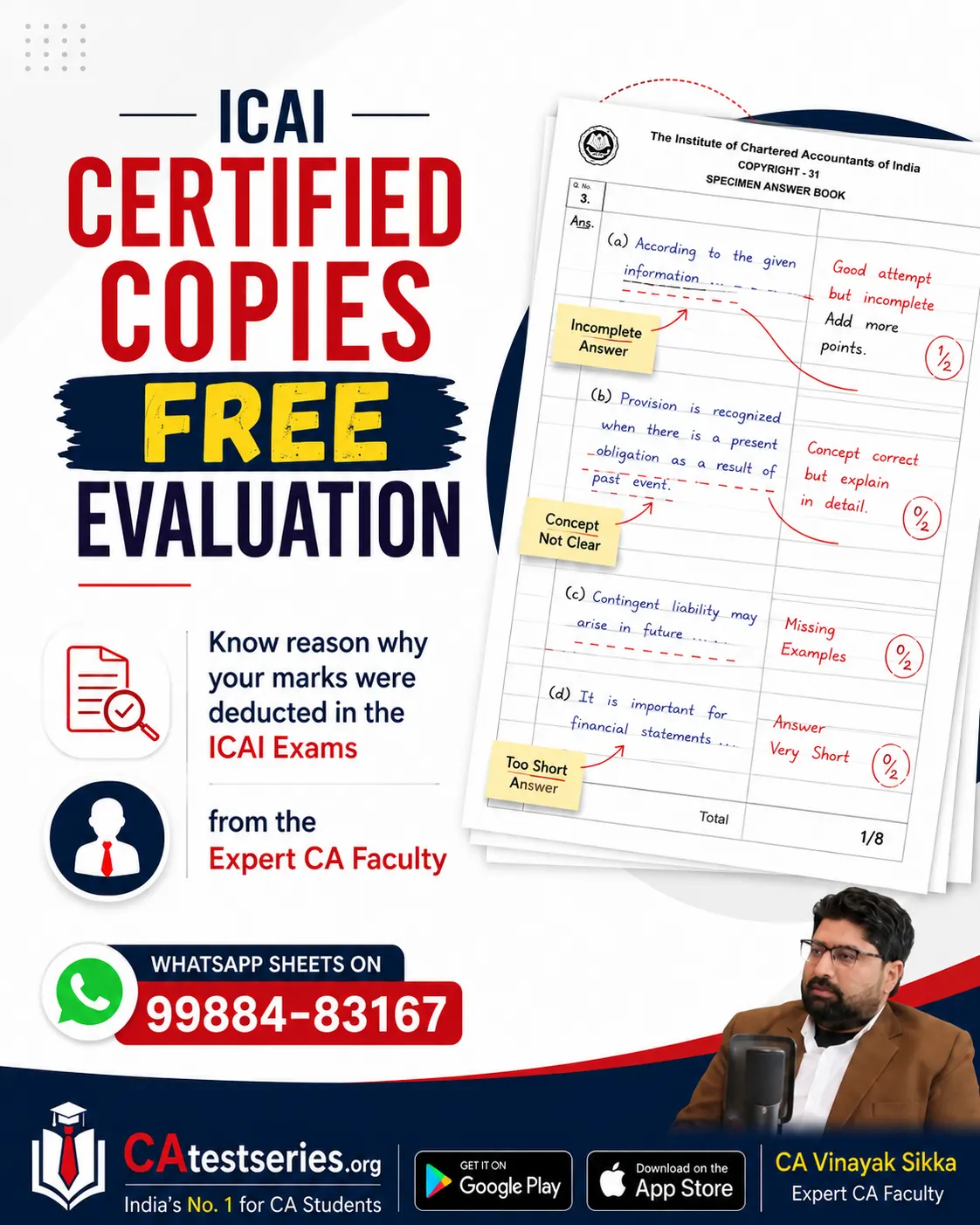
The test itself is only half the value. Students receive feedback from the evaluators with honest remarks on their obtained marks on their performance, enabling them to correct mistakes and focus on areas that need improvement.
However, feedback timing matters enormously. A chapter test evaluated in 24 hours is actionable; one evaluated in 7 days is forgotten. Detailed Evaluation by Experts (6+ years Exp.) in 24 hrs.
Beyond speed, the depth of feedback separates premium platforms from basic ones. Generic feedback like "improve presentation" is useless. Specific feedback like "you missed the provision on contingent liabilities in para 4; this costs 2 marks under step-wise marking" is actionable.
Leading platforms now provide:
- Aaklan-style reports – Micro and macro analysis showing chapter-wise and topic-wise performance against ICAI weightage
- Concept clarity assessment – Identifies whether you failed due to knowledge gaps or presentation errors
- Keyword tracking – Shows which ICAI-specified keywords you missed (critical for step-wise marking)
- Comparative benchmarking – Your score vs. peer average for that chapter
A unique set of questions other than ICAI study material, specific guidance regarding the mistakes, not only general guidance, a topper sheet with complete analysis, step marking and various unique revision strategies for the ICAI exams makes the CA Test Series one of the most preferred platforms for the CA online test series.
When evaluating platforms, ask: Does feedback arrive within 24 hours? Does it include step-wise marking breakdown? Can you see where you lost marks on presentation vs. concept? These questions separate platforms that genuinely improve scores from those that just collect fees.
Building Your Chapter-Wise Test Strategy: Sequencing and Frequency
Timing and sequencing determine whether chapter tests accelerate or stall your preparation. The optimal strategy follows this progression:
- Complete basic revision of a chapter (study material + lectures)
- Attempt the chapter test within 48 hours (while concepts are fresh)
- Review feedback and identify gaps (24-hour turnaround)
- Revise weak areas (targeted re-study)
- Attempt a cumulative test (includes this chapter + prior chapters)
- Move to the next chapter
Cumulative test papers include topics from the first test in the second test also. This cumulative approach prevents knowledge decay and builds integrated understanding across chapters.
Frequency matters too. Attempting one chapter test per week is too slow; attempting three per week without proper revision is counterproductive. The sweet spot is 1-2 chapter tests per week, depending on chapter complexity and your current workload.
Sequencing by subject:
| Subject | Recommended Chapter Order | Rationale |
| Accounting | Start with basics (Accounting Standards) → Build to complex (Consolidation) | Foundation concepts needed for later chapters |
| Audit | Internal Controls → Audit Procedures → Reporting | Logical flow from theory to application |
| Taxation | Income computation → Deductions → Special cases | Progressive complexity |
| Law | Procedural chapters first → Substantive law | Understanding the process before the rules |
For May 2026 exams, start chapter tests by mid-February to allow 3 months for cumulative revision. Students should begin attempts once they finish the basic revision of syllabus topics. Early test practice exposes gaps in preparation, allowing ample time for improvement before May/September 2026.
Avoid the common mistake of attempting all chapter tests in rapid succession without revision. This creates an illusion of progress while leaving knowledge gaps unfilled.
Comparing Chapter-Wise Test Platforms: What Separates Leaders from Followers
The market offers dozens of chapter-wise test series, but the quality varies dramatically. Here's how to evaluate platforms using concrete criteria:
Feature Comparison Table:
| Feature | Premium Platforms | Standard Platforms | Budget Platforms |
| Chapter tests per subject | 5-7 | 3-4 | 1-2 |
| Evaluation turnaround | 24 hours | 48-72 hours | Self-evaluation only |
| Feedback depth | Step-wise marking + concept analysis | General remarks | Answer key only |
| Cumulative tests included | Yes (every 2-3 chapters) | Partial | No |
| Mentorship support | 1:1 + group sessions | Email support | None |
| Price range (both groups) | ₹2,500-4,500 | ₹1,500-2,500 | ₹500-1,500 |
| Validity period | Till exam date | 3-6 months | 1-3 months |
Premium platforms justify higher costs through expert evaluation and mentorship. However, cost alone doesn't guarantee quality. A ₹2,000 series with poor evaluation is worse than a ₹1,000 series with expert feedback.
Critical evaluation questions:
- Are evaluators CAs with 5+ years of exam evaluation experience?
- Do they provide a step-wise marking breakdown for every question?
- Can you access feedback through a dashboard or only via email?
- Are amendments and recent ICAI updates incorporated?
- Do they offer doubt-solving support beyond evaluation?
For the CA Final Nov 2026 and CA Inter Sep 2026 test series, the CA Test Series provides free doubt-solving to all the students, whether they are registered on the platform or not, for the welfare of all the CA Aspirants. This level of support—free doubt-solving even for non-registered users—indicates a platform's commitment to student success beyond revenue.
When comparing platforms, request sample evaluations before purchasing. A good platform will provide a free chapter test with full evaluation so you can assess feedback quality firsthand. This single step prevents costly mistakes in platform selection.
Pricing Models and Value Extraction: Making Your Investment Count
Chapter-wise test series pricing ranges from ₹500 to ₹5,000+, depending on scope and support. Understanding pricing models helps you extract maximum value.
Pricing Structure Breakdown:
| Plan Type | Coverage | Typical Price | Best For |
| Chapter tests only | 5-7 tests per subject | ₹800-1,500 | Self-evaluators with tight budgets |
| Chapter + 2 full mocks | Chapter tests + full syllabus tests | ₹1,500-2,500 | Balanced preparation approach |
| Premium (with evaluation) | Chapter tests + evaluation + mentorship | ₹2,500-4,500 | Serious candidates targeting top ranks |
| Combo (both groups) | All subjects, both groups | ₹3,500-6,000 | Inter students are preparing for both groups |
Test Series prices are after applying a 50% discount. Use the promo code 'CELEBRATE' to get a 50% discount. Many platforms offer seasonal discounts, so timing your purchase matters. Buying during exam season (January-February) often yields better discounts than off-season purchases.
Value extraction depends on your usage pattern. A ₹3,000 series is poor value if you attempt only 3 tests; it's excellent value if you attempt all tests, review feedback thoroughly, and use mentorship sessions. Calculate your cost-per-test: if a series costs ₹2,500 and includes 20 chapter tests, your cost per test is ₹125—reasonable for expert evaluation.
Maximizing value from your purchase:
- Attempt every test, even if you feel unprepared (this reveals gaps early)
- Review feedback within 24 hours while concepts are fresh
- Use mentorship sessions to clarify recurring mistakes
- Access the Syllabus for Test Series to verify chapter coverage matches your exam syllabus
- Check Fee Structure of Test Series for transparent pricing before committing
Avoid the trap of buying multiple series from different platforms. One quality series with consistent evaluation is better than three mediocre series. Your brain needs consistent feedback patterns to learn effectively.
Integration with Your Overall Preparation: When to Use Chapter Tests
Chapter-wise tests work best as part of a structured preparation timeline, not as a standalone tool. Here's how to integrate them with other resources:
Preparation Timeline (for May 2026 exam):
- January-February: Foundation phase – Complete basic revision of 2-3 chapters, attempt first chapter tests
- February-March: Acceleration phase – Increase to 2 chapter tests per week, begin cumulative tests
- March-April: Consolidation phase – Shift focus to full-length mocks (2 per week), use chapter tests for weak areas only
- April-May: Refinement phase – Attempt ICAI MTP and RTP, use chapter tests for last-minute revision
Chapter tests are most valuable in phases 1-2. By phase 3, full-length mocks become more important because they test your ability to manage time across multiple chapters simultaneously.
Integration with other resources:
- Study material → Chapter test (within 48 hours) → Feedback review → Targeted revision
- Video lectures → Chapter test (to verify understanding) → Mentorship clarification
- Previous year papers → Chapter test (to practice similar questions) → Comparative analysis
Many students make the mistake of treating chapter tests as a replacement for full-length mocks. They're complementary, not substitutes. The test series simulates real exam conditions and helps strengthen concepts, improve time management, and identify weak areas early. Regular attempts build confidence and readiness before the official CA Intermediate exams.
For comprehensive preparation, combine chapter tests with CA Foundation - Video Lectures & Books resources if you're weak on foundational concepts. Many Inter students struggle because they skipped Foundation concepts; integrated learning prevents this.
The final integration point: use chapter test performance data to guide your revision strategy. If your Audit chapter tests average 65% but Accounting averages 78%, allocate 60% of remaining study time to Audit and 40% to Accounting. Data-driven allocation beats intuition-based allocation.