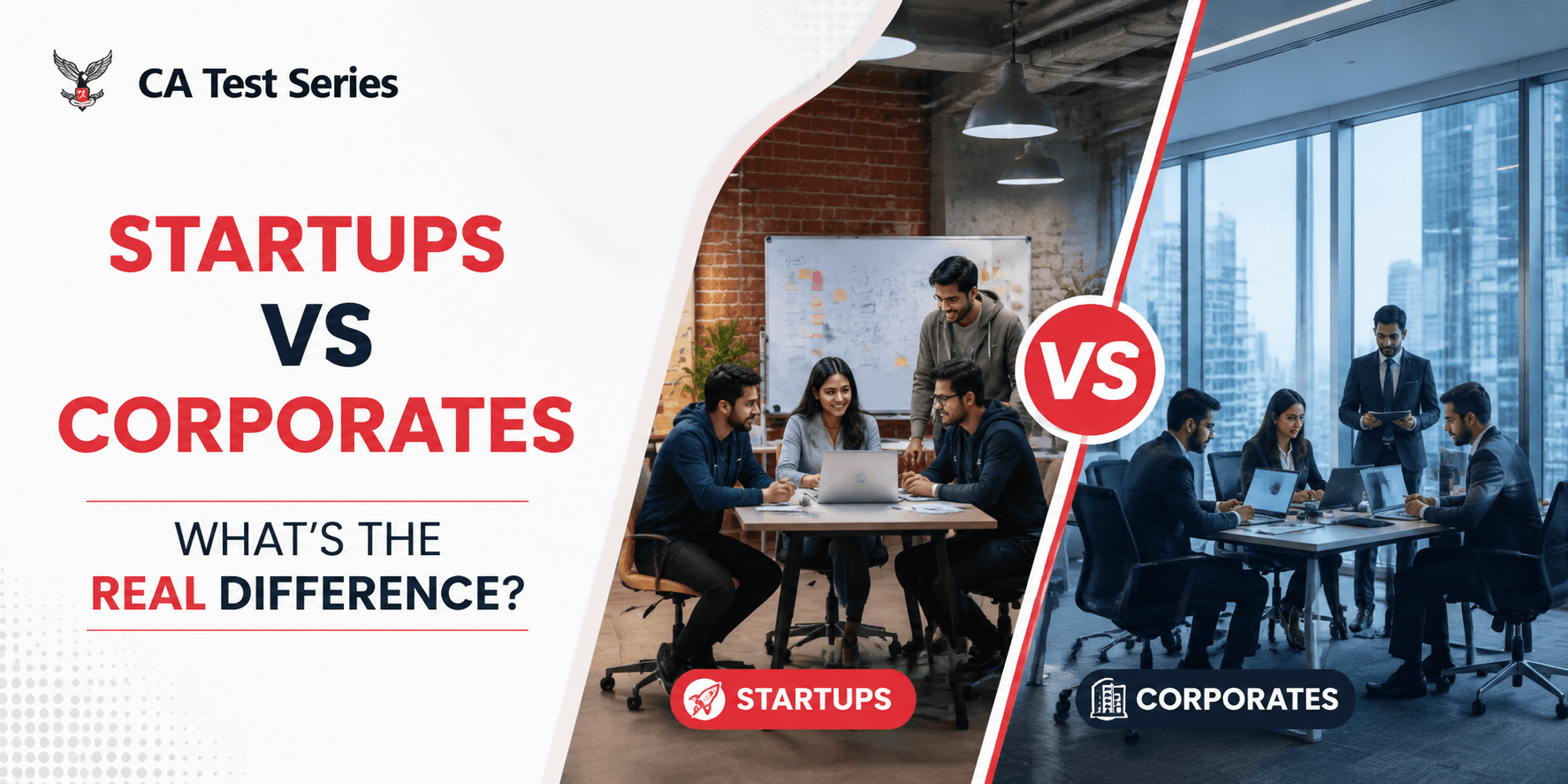
Choosing between a startup and a corporate company is an important career decision for a Chartered Accountant. Both environments can offer strong learning, professional growth, and long-term career opportunities, but the actual experience can be very different. A startup may give a CA broader responsibilities, closer access to founders, and exposure to multiple business functions, while a corporate company generally offers specialised roles, established systems, defined reporting structures, and a more predictable career path. Understanding CA in Startups vs Corporates can therefore help freshers and experienced professionals compare salary structure, learning opportunities, job security, work culture, career growth, and overall suitability before accepting a role.
CA in Startups vs Corporates: Quick Comparison
The main difference between working as a CA in a startup and working in a corporate company usually comes down to role breadth and organisational structure. Startups often rely on smaller teams, which means a CA may work across several financial areas, while larger corporate organisations typically divide responsibilities among dedicated teams and specialists. Neither model is automatically better, so the right choice depends on your career stage, learning goals, preferred working style, and tolerance for uncertainty.
Factor | Startup | Corporate |
Job Role | Broad and flexible | More specialised |
Learning | Cross-functional | Function-specific and deeper |
Job Security | Depends heavily on company growth | Usually more predictable |
Decision-Making | Often faster and direct | Usually more structured |
Career Growth | Can be fast but less predictable | More defined progression |
Team Structure | Smaller teams | Larger specialised teams |
Business Exposure | Multiple departments | Focused functions |
Work Culture | Dynamic and adaptable | Structured and process-driven |
Risk Level | Generally higher | Usually lower in mature firms |
Best For | Adaptable, entrepreneurial CAs | CAs seeking structure and specialisation |
What Does a CA Do in a Startup?
A Chartered Accountant in a startup often becomes involved in both financial management and broader business decisions because growing companies may not yet have large finance departments. Depending on the startup’s size and stage, a CA may work on budgeting, forecasting, taxation, compliance, cash-flow management, financial reporting, internal controls, investor reporting, due diligence, fundraising support, and management decision-making. This broader role can be attractive to professionals who want to understand how finance connects with the entire business.
Common Responsibilities of a CA in Startups: Typical responsibilities may include preparing budgets and forecasts, tracking cash flow, improving financial controls, managing tax and compliance requirements, preparing management reports, coordinating with auditors, supporting fundraising activities, assisting during due diligence, and helping founders understand the financial impact of business decisions. Because teams are often smaller, a startup CA may also work closely with operations, sales, legal, HR, and other departments.
Skills You Can Develop in a Startup: A startup environment can help a CA develop financial modelling, budgeting, forecasting, commercial thinking, problem-solving, communication, negotiation, business partnering, process development, and decision-making skills. The need to work across multiple functions can also strengthen adaptability and provide a practical understanding of how financial decisions affect revenue, operations, growth, and long-term business sustainability.
What Does a CA Do in a Corporate Company?
In a corporate organisation, Chartered Accountants generally work within established finance structures where responsibilities are divided among departments such as financial reporting, taxation, treasury, internal audit, compliance, risk management, FP&A, controllership, or corporate finance. This structure allows professionals to focus more deeply on a specific area and gain experience working with formal systems, larger teams, defined policies, established governance processes, and complex business operations.
Common Responsibilities of CAs in Corporates: A corporate CA may prepare financial statements, support audits, monitor budgets, analyse business performance, manage taxation, strengthen internal controls, support treasury activities, prepare management reports, review compliance requirements, assess financial risks, or contribute to strategic planning. The exact role depends on the organisation, industry, seniority level, and finance function in which the professional works.
Skills You Can Develop in a Corporate Environment: Corporate roles can help CAs strengthen financial reporting, governance, compliance, enterprise systems, internal controls, stakeholder management, risk analysis, leadership, and structured decision-making skills. Professionals may also gain exposure to large-scale operations, multiple business units, formal review processes, complex transactions, and specialist financial functions that can support long-term expertise in a particular field.
Startup vs Corporate Salary for Chartered Accountants
There is no universal rule that startups or corporates always pay Chartered Accountants more because compensation varies according to experience, location, industry, company size, responsibilities, seniority, financial performance, and the overall employment package. Startups may sometimes combine fixed pay with performance incentives or equity, while larger corporate organisations often use more structured salary bands, bonuses, and employee benefits. A candidate should therefore compare the complete compensation package rather than focusing only on the monthly or annual fixed salary.
Compensation Factor | Startup | Corporate |
Fixed Salary | Can vary significantly | Usually more structured |
Performance Bonus | Common in growth-focused firms | Often policy-based |
ESOPs/Equity | May be available | Less common in many roles |
Employee Benefits | Depends on company maturity | Usually more established |
Salary Predictability | Can vary | Generally more predictable |
Long-Term Value | Depends strongly on company growth | Often linked to structured progression |
Fixed Salary vs ESOPs and Incentives: Startup compensation may sometimes look attractive because of Employee Stock Ownership Plans, bonuses, or performance-linked incentives, but these components should be evaluated carefully. Equity is not the same as guaranteed cash income because its future value depends on company performance, valuation, liquidity, and the terms of the plan. Corporate packages may be easier to compare because they generally use more formal compensation structures, although benefits and incentives can still vary significantly between employers.
Learning Opportunities: Startup vs Corporate
Both environments can offer valuable learning, but the type of learning is different. A startup can give CAs wider exposure because they may need to work across accounting, compliance, cash flow, planning, fundraising, and business strategy, while a corporate role may allow deeper development in one particular finance function. The better choice depends on whether you currently need breadth of experience or deeper specialisation.
Learning in a Startup Environment: Learning in a startup is often practical and cross-functional because professionals may need to solve problems with smaller teams and fewer established systems. A CA may work on financial planning, review compliance requirements, prepare investor information, support management decisions, and improve internal processes within the same role, creating broad exposure to how a growing business operates.
Learning in a Corporate Environment: Corporate learning is generally more structured because large organisations usually have established reporting systems, formal processes, experienced managers, specialised departments, review procedures, and documented policies. This can be particularly useful for CAs who want to understand how sophisticated finance functions operate at scale and develop expertise in areas such as taxation, FP&A, audit, treasury, risk, or controllership.
Career Growth for CAs in Startups vs Corporates
Career progression can happen in both startups and corporates, but the route may look very different. A CA in a growing startup may gain responsibility quickly as the business expands, while a corporate employee generally moves through more clearly defined levels based on performance, experience, organisational requirements, and available positions. Startup growth can be faster but less predictable, whereas corporate progression is usually more structured.
Possible Startup Path | Possible Corporate Path |
Chartered Accountant | CA / Finance Executive |
Finance Manager | Assistant Manager |
Head of Finance | Manager |
Finance Director | Senior Manager |
CFO | Financial Controller / Director / CFO |
Opportunities to Move Into Leadership Roles: Startups may provide earlier leadership opportunities because smaller finance teams can require capable professionals to take ownership of important functions sooner. In corporate organisations, leadership responsibilities may come through a more formal progression process, but the scale of responsibility can eventually include larger teams, complex operations, multiple business units, and significant financial decision-making.
Job Security: Startup vs Corporate for CAs
Job security depends on the financial condition and management quality of the individual organisation rather than the startup or corporate label alone. Early-stage startups may face greater uncertainty because of changing business models, limited resources, funding requirements, or fluctuating revenue, while mature corporations generally have more established operations. However, corporations can also experience restructuring, acquisitions, cost reductions, or changes in business strategy, so no role should be considered completely risk-free.
Job Security Factor | Startup | Corporate |
Revenue Stability | Can be uncertain | Usually more established |
Funding Dependency | May be significant | Usually lower |
Role Changes | Can happen quickly | Often more structured |
Restructuring Risk | Depends on growth stage | Still possible |
Business Predictability | Lower in early stages | Usually higher |
Work Culture and Decision-Making
Startup work culture is often associated with smaller teams, flexible responsibilities, direct communication, and faster decision-making, while corporate culture generally involves clearer hierarchies, formal policies, approval processes, and defined responsibilities. These are broad patterns rather than fixed rules because actual work culture depends heavily on leadership, management style, industry, team structure, and the organisation itself.
Startup Work Culture: A startup CA may work directly with founders or senior leaders and participate in decisions that extend beyond traditional accounting responsibilities. This can create a strong sense of ownership and provide valuable business exposure, but it can also require flexibility because job responsibilities, priorities, systems, and processes may change as the organisation grows.
Corporate Work Culture: A corporate CA generally works within established reporting lines and defined responsibilities, which can make expectations clearer and processes more predictable. However, decisions may require input or approval from several stakeholders, meaning the pace can sometimes be slower compared with a smaller startup where fewer people are involved.
Work-Life Balance for CAs: Startup vs Corporate
Neither startups nor corporate companies can guarantee better work-life balance because working hours depend on the specific role, employer, team size, management style, and reporting requirements. Startup workloads may become unpredictable during fundraising, expansion, audits, or major business changes, while corporate finance teams can become extremely busy during month-end closing, year-end reporting, audits, tax deadlines, budgeting, and major transactions.
Pros and Cons of Working as a CA in a Startup
Working in a startup can be attractive for CAs who want broad responsibility, entrepreneurial exposure, direct access to leadership, and the opportunity to understand several parts of a business. However, these advantages can come with challenges such as changing priorities, less-developed systems, smaller support teams, and greater business uncertainty.
Advantages | Challenges |
Broad business exposure | Higher business uncertainty |
Direct access to leadership | Less clearly defined roles |
Early responsibility | Smaller support teams |
Cross-functional learning | Rapidly changing priorities |
Entrepreneurial exposure | Developing processes |
Potential leadership growth | Growth depends on company success |
Pros and Cons of Working as a CA in a Corporate
Corporate employment can suit CAs who prefer structured career progression, established processes, specialist expertise, larger professional teams, and formal systems. However, professionals may have less exposure to areas outside their specific function, and responsibilities may expand more gradually because large organisations usually have multiple management and approval levels.
Advantages | Challenges |
Structured career framework | Roles may become highly specialised |
Established processes | More approval levels |
Larger finance teams | Less direct access to senior leadership |
Formal training | Responsibility may grow gradually |
Mature systems | Processes can be complex |
Large-scale exposure | Cross-functional exposure varies |
Which Environment Is Better for a Fresher CA?
A fresher CA should focus less on whether a company is labelled a startup or corporate and more on the quality of the role, manager, mentorship, practical exposure, and skills they will develop. A startup can provide broad responsibilities and early ownership, while a corporate role may offer structured training, established systems, specialised learning, and experience working with larger professional teams. The stronger first job is generally the one that creates useful skills and supports your long-term career direction.
How to Decide Between a Startup and Corporate Career
The right decision becomes easier when you compare actual job opportunities rather than general assumptions. Review the responsibilities, salary structure, manager, company financial health, learning opportunities, workload, culture, team quality, promotion possibilities, and skills you expect to develop before choosing between a startup and corporate position.
Ask Yourself | Why It Matters |
Do I want broad or specialised work? | Helps identify your preferred role type |
How important is stability? | Reveals your risk tolerance |
Do I enjoy fast-changing environments? | Important when considering startups |
Do I prefer formal progression? | Often relevant in corporate careers |
Do I want early responsibility? | Smaller teams may offer more ownership |
Do I value structured training? | Larger firms may provide more formal learning |
Where do I want to be in five years? | Keeps the decision aligned with career goals |
Quick Decision Tip: If you enjoy variety, direct responsibility, fast decisions, and entrepreneurial environments, a startup may be a stronger fit. If you prefer structured systems, defined responsibilities, specialist expertise, and formal career progression, a corporate organisation may suit you better. However, always judge the actual company and position rather than making a decision based only on the employer category.
Conclusion
When comparing CA in Startups vs Corporates, there is no single career path that is best for every Chartered Accountant. Startups can provide broad responsibilities, cross-functional learning, entrepreneurial exposure, and early involvement in important business decisions, while corporate organisations generally provide structured progression, specialist expertise, established systems, and greater organisational predictability. The best choice depends on your career goals, preferred work style, learning priorities, financial expectations, and comfort with risk. After a demanding period of professional work or study, taking time to recharge can also help you return with better focus, and the peaceful coffee plantations and natural surroundings of Inika Resort in Coorg offer a relaxing setting for a refreshing break.