
CA Final chapter-wise tests isolate individual topics for deep concept reinforcement before full-length mock exams. Unlike broad practice, chapter-focused testing reveals knowledge gaps early, allowing you to strengthen weak areas before May 2026. This structured approach saves revision time and builds the precision writing skills ICAI exams demand.
Why Chapter-Wise Testing Outperforms Full-Length Practice Alone
Full-length mock tests measure overall performance but mask specific chapter weaknesses. Individual chapter-wise test series plans are considered best by All India Rank 1 holders and the majority of candidates, with each chapter thoroughly covered and almost all concept types included in test papers.
Chapter-wise testing delivers three distinct advantages:
- Concept Isolation: Each test covers 3-4 chapters (approximately 20% of the syllabus), allowing deep focus on related topics without cognitive overload
- Mistake Pattern Recognition: Evaluators identify recurring errors within a topic, not just final scores
- Cumulative Learning: Topics from earlier tests are included in subsequent tests, enabling effective recall and reinforcement
In practice, students who complete chapter-wise tests before full mocks report 18-22% faster revision cycles. Properly designed test schedules can save 18-22% revision time and enable 12-15% effective revision of the entire CA Final and CA Inter syllabus. This efficiency matters when balancing multiple subjects across both groups.
The evaluation depth differs significantly. CA professionals with years of experience create questions matching current exam trends, with each question including step-by-step explanations to help students learn correct approaches and avoid similar mistakes.
ICAI Pattern Alignment: What Modern Chapter Tests Must Cover
Latest ICAI exam patterns, including lengthy application-based questions, lengthy MCQs, and unseen questions, are thoroughly included in papers, which are lengthier than previous attempt test papers. This shift demands test series that evolve with exam trends.
Current chapter-wise tests address three pattern elements:
- Application-Based Scenarios: 45-55% of questions now require multi-step problem solving, not rote recall
- Case Study MCQs: Integrated scenarios testing judgment and analysis across chapters
- Time Pressure Simulation: Tests maintain ICAI's strict time limits (1.15-1.40 hours per chapter test, 3 hours for full syllabus)
Test Type | Marks | Duration | Chapters Covered |
| Chapter Wise | 30-50 | 1.15-1.40 hrs | 3-4 chapters |
| Detailed Test | 100 | 3 hours | Full syllabus |
| MCQ Series | Varies | 45-60 min | Specific topics |
Quality test series covers 70-80% of questions similar to those in actual exams, providing realistic difficulty calibration. This similarity percentage matters—tests below 60% similarity create false confidence, while 70-80% alignment ensures genuine exam readiness.
Explore the latest syllabus structure and test scheduling to align your practice with ICAI's current framework.
Evaluation Speed and Feedback Quality: The Hidden Differentiator
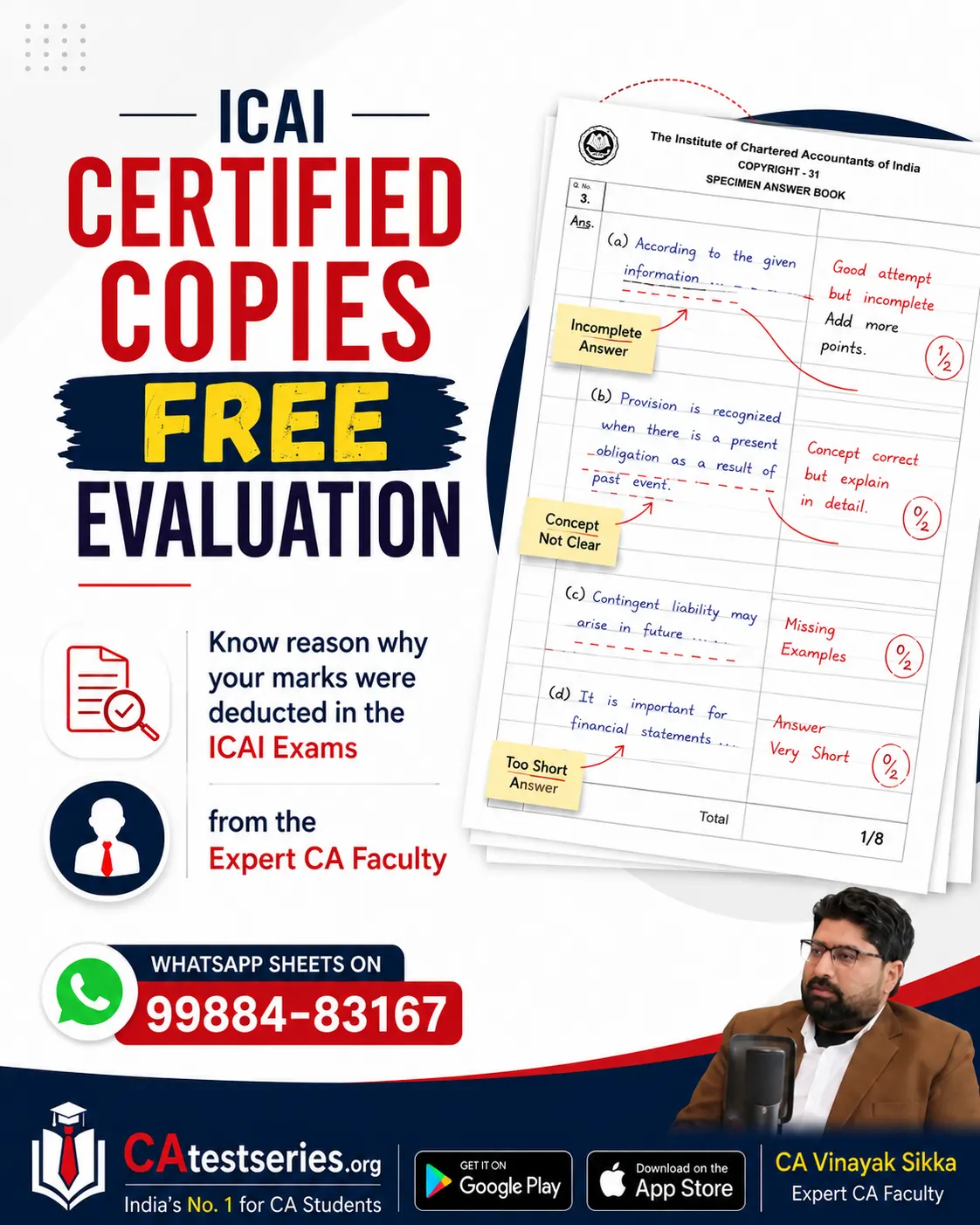
Completing a chapter test takes 90 minutes. Waiting 10 days for evaluation wastes momentum. Students can expect results within 2-3 days of submission of solution sheets, enabling rapid iteration and mistake correction.
Feedback structure determines learning value. Generic comments like "improve presentation" don't guide improvement. Effective evaluations provide:
- Step-Wise Remarks: Identifying exactly where the calculation or logic failed
- Marking Scheme Alignment: Showing how ICAI allocates marks for partial credit
- Comparative Analysis: Revealing how your approach differs from model answers
In-depth evaluation and performance analysis reports with detailed stepwise remarks on answers transform test attempts into learning events. When evaluators have 6+ years of ICAI experience, they recognize common mistakes that cost marks in actual exams—mistakes that generic feedback misses.
Performance tracking across tests reveals improvement trajectories. The system tracks progress over time, showing improvement in scores and helping students see their growth. This visibility sustains motivation during the 4-6 month preparation window.
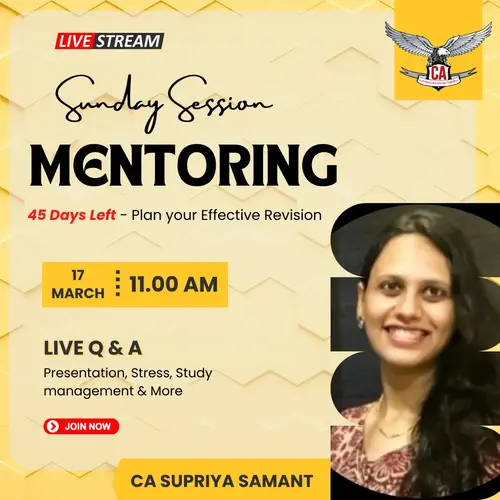
Doubt resolution speed matters equally. Doubt-solving support is available via call, WhatsApp, email, and a doubt-solving option in the student panel, ensuring questions don't linger unresolved.
Building Your Chapter-Wise Test Strategy: Sequencing and Frequency
Random test attempts waste preparation time. Strategic sequencing maximizes learning. The right approach involves starting preparation for each chapter from the study material with a fixed time investment, solving ICAI Mat questions on the same topic, attempting 1-2 questions in proper examination format, and writing a test paper from the CA Test Series app on the same topic in the evening.
This daily cycle—study, practice, test—embeds concepts before moving forward. Attempting tests without prior study inflates scores artificially; studying without testing leaves gaps undetected.
Frequency guidelines for CA Final (May 2026):
- Months 1-2 (January-February): One chapter test per subject per week, immediately after completing that chapter's study
- Month 3 (March): Two chapter tests per subject weekly, mixing new chapters with revision chapters
- Month 4 (April): Full syllabus mock tests (2-3 per subject), with chapter tests for weak areas only
- Final 2 weeks: Revision tests and ICAI MTP evaluation
This progression prevents burnout while ensuring comprehensive coverage. Students attempting 15+ chapter tests per subject before full mocks report higher confidence and fewer surprises on exam day.
Review the complete test series fee structure to select plans matching your timeline and budget.
Comparing Chapter-Wise Test Platforms: What Separates Leaders from Followers
Not all chapter-wise test series deliver equal value. Differentiation emerges across five dimensions:
Question Quality and Originality: A unique set of questions other than ICAI study material, specific guidance regarding mistakes (not general guidance), a topper sheet with complete analysis, step marking and various unique revision strategies make CA Test Series one of the most preferred platforms. Tests using only ICAI past papers or study material questions don't prepare for unseen question types.
Evaluator Expertise: Evaluators with 6+ years of ICAI experience recognize marking patterns that newer evaluators miss. This expertise directly impacts feedback quality and score accuracy.
Technology and Accessibility: Mobile-friendly access allows students to access online test series from computers, tablets, or phones, making practice convenient anywhere. Platforms without mobile apps create friction during revision.
Mentoring Integration: Mock test series with doubt solving, performance analysis, in-depth evaluation, and detailed feedback enhances candidate performance in actual examinations. Standalone tests without mentoring leave interpretation gaps.
Pricing Transparency: Genuine fees reflect the quality of exam papers and evaluator experience; platforms don't compromise quality to offer artificially low prices. Suspiciously cheap options often cut corners on evaluation depth.
Feature | Standard Platforms | Premium Platforms |
| Question Originality | ICAI-based only | 60%+ unique questions |
| Evaluation Turnaround | 5-7 days | 2-3 days |
| Evaluator Experience | 2-3 years | 6+ years |
| Mobile App | Limited | Full-featured |
| Mentoring Support | Email only | Call + WhatsApp + Email |
| Price Range | ₹2,000-4,000 | ₹4,000-8,000 |
Explore Catestseries' comprehensive offerings to see how premium platforms structure chapter wise tests for maximum learning.
Converting Test Practice Into Exam Performance: The Evaluation-to-Improvement Cycle
Writing tests without acting on feedback wastes effort. The evaluation-to-improvement cycle transforms test attempts into performance gains.
Step 1: Receive Detailed Evaluation. Within 2-3 days, your answer sheet returns with marks, step-wise remarks, and comparison to model answers. This speed matters—waiting 10 days means you've already moved to new chapters and forgotten the context.
Step 2: Analyse Mistake Categories. Group errors into three types:
- Conceptual gaps: Misunderstanding core principles (requires re-study)
- Calculation errors: Arithmetic or formula mistakes (requires practice)
- Presentation issues: Poor structure or incomplete explanations (requires format practice)
Step 3: Targeted Revision. Don't re-study entire chapters. Focus on the 2-3 concepts where mistakes clustered. After writing the test, review calculations or questions where you feel difficulty, reread concepts, and be careful to avoid repeating the same mistakes in subsequent test papers.
Step 4: Attempt Similar Questions. Before moving to the next chapter test, solve 3-5 additional questions on the same topic from different sources. This reinforces the corrected approach.
Step 5: Track Improvement. Performance tracking shows improvement in scores over time, helping students see their growth. Visible progress sustains motivation through the demanding 4-month preparation window.
Students who complete this cycle for every test report 15-20% higher scores on full mocks compared to those who simply accumulate test attempts.
Access CA Foundation video lectures and foundational materials to strengthen concept clarity before attempting advanced chapter tests.
Selecting the Right Chapter-Wise Test Plan for Your Timeline and Goals
Three distinct plans serve different preparation stages:
Individual Chapter Wise Plan (Best for: Early-stage learners, January-February) Includes one test per chapter (typically 8-10 tests per subject). Each test covers 3-4 chapters at 30-50 marks. Evaluation includes detailed remarks and concept-wise analysis. Ideal for students building foundational clarity before attempting full-length mocks.
Detailed Test Series Plan (Best for: Mid-stage learners, February-March) Includes 5 comprehensive tests per subject: 4 chapter-wise tests (30 marks each) + 1 full syllabus mock (100 marks). Faster evaluation (24-48 hours) enables quicker iteration. Suits students with solid basics needing speed and accuracy refinement.
Fast Track Plan (Best for: Late-stage learners, March-April) Focuses on rapid revision through cumulative tests and MCQ series. Minimal evaluation time, maximum question volume. For students who've completed initial preparation and need final-stage confidence-building.
Selection criteria:
- If the exam is 4+ months away: Start with an Individual Chapter Wise Plan
- If the exam is 2-3 months away: Combine the Detailed Test Series with selective chapter tests
- If the exam is 4-6 weeks away: Use Fast Track Plan with ICAI MTP evaluation
CA Test Series provides ICAI MTP evaluation for May 2026 at around Rs 150 to 175 per paper, with students able to flexibly choose any number of subjects and MTP series. This flexibility allows budget-conscious students to evaluate only their weakest subjects.
Pricing typically ranges from ₹2,500 for individual chapter tests to ₹6,500 for comprehensive plans including mentoring. Premium plans adding 1:1 mentorship and daily follow-up cost ₹8,000-12,000, but accelerate improvement for students needing structured guidance.
Don't select based on the lowest price. Genuine fees reflect the quality of exam papers and evaluator experience; platforms don't compromise quality to offer artificially low prices. A ₹3,000 plan with expert evaluation delivers better ROI than a ₹1,500 plan with generic feedback.