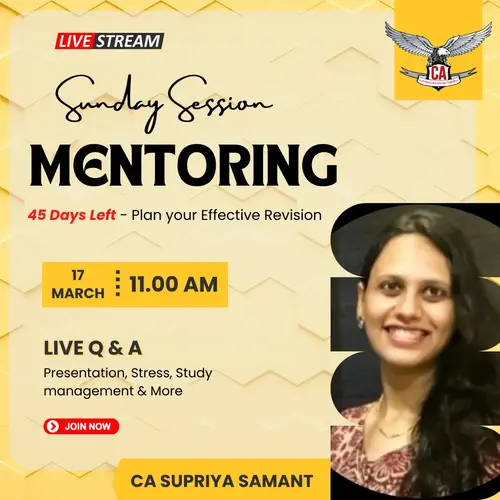

“Smart CA Foundation preparation is not about spending more; it is about choosing the right lectures, notes, practice, and guidance at the right price.”
Preparation for the CA Foundation exam does not necessarily require spending a huge amount of money on coaching. Students can find many affordable lecture courses that include video lectures, notes, practice questions, assignments, revisions, tests, and mentoring.
Affordable CA Foundation Lectures with Notes: A Budget-Friendly Guide
But the most affordable course is not necessarily the best choice. A course may be very cheap but contain only lectures, leaving students with no choice but to buy notes, test series, and other materials individually.
What Are CA Foundation Lectures With Notes?
CA Foundation lectures are lectures conducted systematically to help the students cover their syllabus. Lectures are live or recorded and are usually taken according to different subjects and chapters.
In case of notes along with the lectures, students need not waste much time on lengthy notes.
Full syllabus coverage
Skilled faculty
Notes provided by the faculty members
Visualisation of concepts
Questions for practice
Assignment homework
Revisions
Mock or Practice tests
Doubt-solving session and Mentorship
Why Choose Affordable CA Foundation Lectures?
Preparing for CA Foundation comes with many costs, including lectures, books, notes, and test series. If you have a tight budget, then an affordable course will help you save on your preparation costs.
The advantage of online lectures is that they help you prepare according to your convenience.
Low cost of preparation
Flexible timetable of studying
Learning from lectures at home
Revisiting difficult lessons
Organised materials for study
Practice chances
Less requirement for several sources
The fact that something is inexpensive does not mean it is of low quality. What really matters is whether there are sufficient resources for thorough preparation.
What Should Be Included in an Affordable CA Foundation Course?
When buying the most affordable CA Foundation classes, one must examine in detail what is included in this package.
The lowest price may sometimes leave out notes, quizzes, revision sessions, or doubt-solving services, and will add up to your total cost significantly.
Four subjects lecture videos
Updated notes
Practice questions
Homework
Revisions classes
Test series
Doubt clearing
Mentoring
Validity of course
Thus, the actual cost would be decided after factoring in all the resources that you may require. Compare CA Foundation course packages to see what is actually included before you buy.
Minimum vs Better vs Ideal: Feature Comparison
Many students overlook the cost of extra resources in lectures purchased. At times, a course that provides more resources may prove more beneficial, despite the slightly increased initial cost.
Feature | Minimum to Look For | Better Option | Ideal Option |
Subjects Covered | 4 | 4 | 4 |
Lecture Access | 3–6 months | 6–12 months | 12+ months |
Practice Questions | 500+ | 1,000+ | 1,500+ |
Mock Tests | 4–8 | 8–15 | 15+ |
Revision Sessions | 1 | 2 | 3+ |
Doubt Support | Basic | Regular | Dedicated |
Notes | Digital | Digital + Printed | Comprehensive |
The table above will assist the students in identifying what to look for while choosing budget courses.
How Concept Visualisation Improves CA Foundation Preparation?
Another learning method which is frequently ignored is concept visualisation. It is often easier to understand concepts when you visualise them instead of reading or listening to them because visualisation enables you to understand different aspects of the subject matter.
Some ways of visualising concepts could be:
Flow charts
Diagrams
Tables
Concept mapping
Case study

This will help to keep the students engaged throughout the lecture.
How Many Hours Should You Spend Preparing for CA Foundation?
Time varies from person to person. The students having good fundamentals will need fewer hours than those who are just starters.
The time spent by a student should not be based on the mere number of hours; rather, the student must have a balanced approach in all aspects.
Preparation Activity | Daily Time | Weekly Time |
Lectures | 2–3 hours | 14–21 hours |
Self-Study | 2–3 hours | 14–21 hours |
Question Practice | 1–2 hours | 7–14 hours |
Revision | 30–60 minutes | 3.5–7 hours |
Tests & Analysis | 30–60 minutes | 3.5–7 hours |
Total | 6–9 hours | 42–63 hours |
This is just an estimate, and you must adjust it as per your convenience.
Full-Subject Breakdown (Full Syllabus, All Subjects)
Every subject of CA Foundation has its own way of preparation. For numerical subjects, question solving is required more, while theory subjects need revision.
Subject | Lecture Time | Practice Time | Revision Time | Test Focus |
Accounting | 80–100 hrs | 40–50 hrs | 15–20 hrs | High |
Business Laws | 60–80 hrs | 20–30 hrs | 20–25 hrs | High |
Quantitative Aptitude | 70–90 hrs | 40–50 hrs | 15–20 hrs | High |
Economics | 50–70 hrs | 20–30 hrs | 15–20 hrs | Moderate–High |
Total (full syllabus, all subjects) | 260–340 hrs | |||
So, it is not advisable to divide time equally for all the subjects.
30 Days CA Foundation Lectures & Practice Schedule
For students who prefer a planned method, their study period can be divided into weekly goals as follows:
Week | Lecture Target | Practice Target | Revision | Tests |
Week 1 | 15–20 hrs | 8–10 hrs | 3 hrs | 1 |
Week 2 | 15–20 hrs | 8–10 hrs | 3 hrs | 1 |
Week 3 | 15–20 hrs | 10–12 hrs | 4 hrs | 2 |
Week 4 | 10–15 hrs | 12–15 hrs | 5–6 hrs | 2–3 |
Total | 55–75 hrs | 38–47 hrs | 15–16 hrs | 6–7 |
This serves as an example for a 30-day plan and needs to be changed according to the syllabus of the student. It is important to note that the last few weeks rely more on practice and exams than lectures since the students move from a learning stage to an exam stage.
How to Balance Lectures, Self-Study, Practice & Revision?
A very typical flaw committed by students is devoting most of the preparation time to watching lectures. Watching lectures gives a feeling of having done something, but it does not always equate to understanding the concept.
Preparation must be a mixture of solving problems and self-testing.
Activity | Approx. Share of Preparation | Main Purpose |
Watching Lectures | 30–35% | Understanding concepts |
Reading Notes | 15–20% | Reinforcing concepts |
Practice Questions | 25–30% | Applying concepts |
Revision | 10–15% | Improving retention |
Tests & Analysis | 10–15% | Measuring performance |
Why Mentoring Can Make an Affordable Course More Valuable
Mentoring can help students maintain consistency and identify weaknesses in their preparation process. With lectures being affordable, there may still be difficulties with planning, revising, time management, or choosing topics to pay more attention to.
The mentoring approach can transform a bunch of lectures into a more structured preparation process.
Study planning
Progress tracking
Identification of weak topics
Revision planning
Exam strategies
Motivation and consistency
For students who are preparing without the assistance of classroom mentoring, such assistance can be really helpful.
How Mock Tests Help You Assess
Sometimes students may feel that they are well-prepared just because they have done all their classes. But the mock tests enable them to gauge themselves on how really prepared they are by seeing whether they can remember the stuff and apply it in limited time frames.
Test Series | Cost |
Individual Test Series | ₹ 625 Per Subject |
Detailed Test Series (Full-length real exam condition) | ₹ 425 Per Subject |
Pass Guarantee Add-on (with Individual Test Series, all 4 subjects) | ₹ 4000 |

How to Spend Less While Preparing for CA Foundation?
There are several ways to make students less dependent on expenditure while preparing for CA Foundation.
The first rule is not to duplicate your sources, which means that purchasing many lecture packages will confuse you and cost more money.
The better way is to purchase one good source and utilise others when it is needed.
Some ways to lower your spending are the following:
Compare all packages
See if notes are provided
See how many tests are included
Do not purchase books that duplicate each other
Combine ICAI materials with lectures
Find helpful demo lectures before making purchases
Check course duration
Calculate total cost
What is important, you should not try to spend less money at all costs.
CA Foundation Lectures along with Practice, Homework, Mentoring and Tests
CA Foundation courses should not limit themselves to video lectures. In order to gain proper knowledge and accuracy, along with keeping track of one’s preparation, students should be given practice, homework, mentoring, and tests.
By adopting a balanced 1:1:1 technique, students will be able to balance their preparation time among learning, practising, and evaluating.

Practice: Practising questions to gain knowledge.
Homework: Completing homework after attending lectures to learn.
Mentoring: Being mentored for planning, weaknesses, revising, and taking exams.
Tests: Taking regular tests for speed and accuracy.
1:1:1 Technique: Having an equal balance among learning, practising, and evaluating, rather than watching lectures.
Conclusion
Finding the most economical CA Foundation lectures with notes does not mean choosing a course based on its cheapest lecture price. An economical course should offer adequate academic materials for students starting with their first lecture and ending with revision and tests.
Quality faculty members, concept visualisation, notes, assignments, practice, mentoring, revision, and tests all determine the value of a course.
Therefore, students with an economic budget should look into the overall cost of preparation rather than only considering the price of lectures. A course which offers students notes, practice, revision, and tests is likely to be more cost-effective than another cheap course where all the resources have to be bought separately.