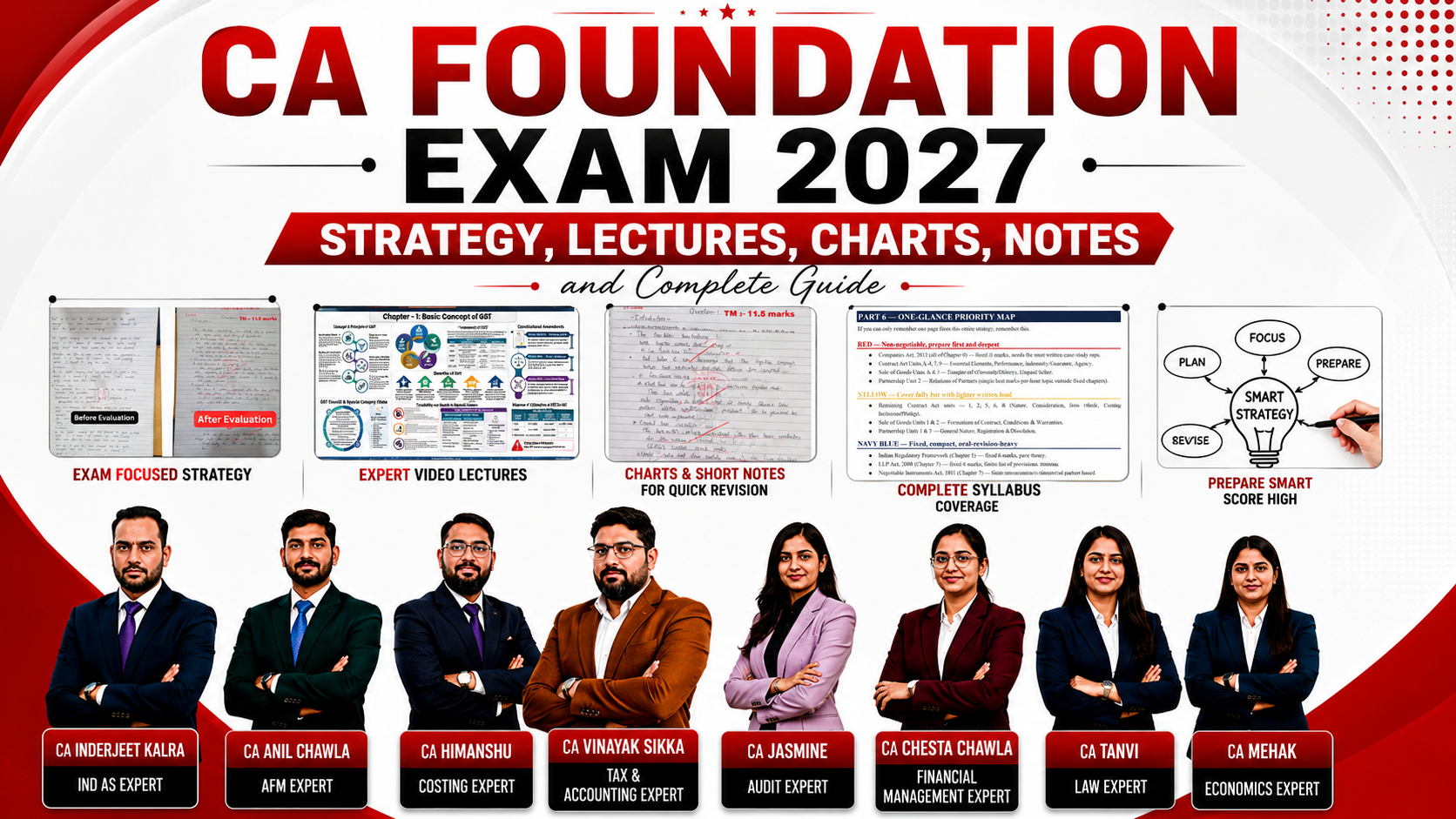
CA Foundation Exam Preparation: Complete Strategy, Lectures & Chart Notes Guide
"Exams are not about studying more—it is always about studying smartly with Concept Visualisation to keep active throughout the lectures”
The CA Foundation exam is the entry route in the Chartered Accountancy Career. This exam is followed by the Intermediate and Final Level Exams. The CA Foundation exam is going to be held in September 2026.
In this guide, students will come to know about the CA Foundation syllabus, subject-wise strategy, Visualisation, Notes, charts, and every concept that is important to score well in the CA exam.
CA Foundation Exam: Strategy, Lectures, Charts, Notes and Complete Guide
Preparing for the CA Foundation 2026 exam gets much simpler if students watch lectures and short and clear notes for each chapter. It also helps to practice. Instead of wasting a lot of time looking for study materials, students should pay attention to teachers who explain things in a way that is easy to understand. These teachers also ensure that the study material is up to date and aligns with the latest ICAI syllabus.
CA Foundation Syllabus: Complete overview
Before starting to prepare for the CA exam, one has to check the syllabus first for better understanding. The CA Foundation consists of four papers, which consist of Accounting, Business Laws, Quantitative Aptitude, and Business Economics.
Papers | Subjects | Type | Marks | Timining |
Paper 1 | Accounting | Subjective | 100 | 3 hours |
Paper 2 | Business Laws | Subjective | 100 | 3 hours |
Paper 3 | Quantitative Aptitude | Objective | 100 | 2 hours |
Paper 4 | Business Economics | Objective | 100 | 2 hours |
The above table helps the students to understand the CA Foundation pattern according to the latest ICAI pattern.
The Importance of Teachers & Live Lectures for CA Foundation Preparation
Reading textbooks will not give an idea. The real thing that will help you build your fundamentals will be listening to a skilled teacher explaining a concept and its significance and relating it to exam-type questions. This is the sole reason why students prefer going for a lecture-based CA Foundation course instead of self-preparation.
Here is how we have designed this at CAtestseries:
Live Interactive Classes: In live classes, students get to study from experienced CA faculty who will help them understand the concept as toppers actually do.
Recorded Lectures: Along with live classes, lectures will be provided on-demand. It means that a student can listen to lectures regarding a concept multiple times, say partnership accounting or sections of the Companies Act.
Live Doubt Solving: Faculty will be available for doubt-solving during the course, which means students will not have doubts piled chapter after chapter.
Bilingual Teaching: Live classes will be available in both languages.
Good teaching not only helps with imparting knowledge but also helps gain confidence enough to write the 3-hour paper.
Course Highlights: What You Get When You Join CAtestseries
The CA Foundation exam is one of the major exams in the chartered accountant career. Every year, many students take this exam. The CA test series provides digital learning that combines concept building, practice and revision through animated lectures and chart notes.
Particulars | Details |
Course Name | CA Foundation |
Course type | Online |
Language | Bilingual(English and Hindi) |
Study Resources | PDF, Video Lectures & Chart Notes |
Learning Support | Live Faculty Interaction and Doubt Solving |
Test Platform | Subject Test, Topic Test & Full Length Mock |
For this kind of daily study notes, video lectures, and chart notes, go to CAtestseries.
Features of the Course For Foundation Exam
CAtestseries is designed as an all-encompassing preparation process. It is much more than a series of lectures. Here is what you get on joining the course:
This course includes everything you need to crack the CA Foundation exam: conceptual learning, test series, revision resources, and expert guidance, all in one place.
Features | Student Benefit |
Live Interactive Classes | Learn from experienced CA faculty |
Recorded Lectures | Unlimited revision anytime |
Structured Study Plan | Complete syllabus coverage |
Digital Study Material | Easy chapter-wise revision |
PDF Notes & Chart Notes | Quick learning support |
Topic Tests | Evaluate chapter-wise understanding |
Sectional Tests | Improve subject-wise performance |
Full-Length Mock Tests | Experience the actual exam environment |
Revision Sessions | Improve retention before examination |
Reasons Why Students Prefer CAtestseries to Self-Study?
CA Foundation consists of some theory-based papers (Laws, Economics) along with numerically based papers (Accounting, Quantitative Aptitude). The combination is quite tough to prepare on one's own. Here's why it is different for those preparing with CAtestseries:
Teachers who teach for the exams, not for the syllabus – lectures focus on the way in which the topics are tested by the ICAI.
A study plan without the guessing game – rather than trying to guess what to prepare next, students get a well-defined path to follow chapter by chapter.
Chart Notes to convert tough chapters into revision charts – Ideal for last-minute revisions before exams.
A full-fledged testing system – topic tests, sectional tests and mock tests ensure that students practice the test environment many times before the actual exam.
Doubt-solving facility – no chapter is left halfway.
Why Are Chart Notes Helpful?
Chart notes are very helpful for students to understand a concept visually and remember it for a time. Since the CA Foundation syllabus includes a mix of theory (Laws, Economics) and numerical practice (Accounting, Quantitative Aptitude), charts will help to turn chapters into quick, easy-to-review formats.
They take a lot of information. Make it short and simple to remember.
They are great to look at before a test, like a day or two before.
Chart notes help connect related ideas; for example, they show how Journal, Ledger, Trial Balance and Final Accounts are all connected.
They save a lot of time because you do not have to read the textbook again.
They point out the things that you need to know for the test, like formulas and definitions.
Chart notes help you remember things better because you see them, and that is better than reading about them.
They make it easier to study with friends and go over things quickly.
Chart notes help you figure out what is most important to study so you can use your time wisely.
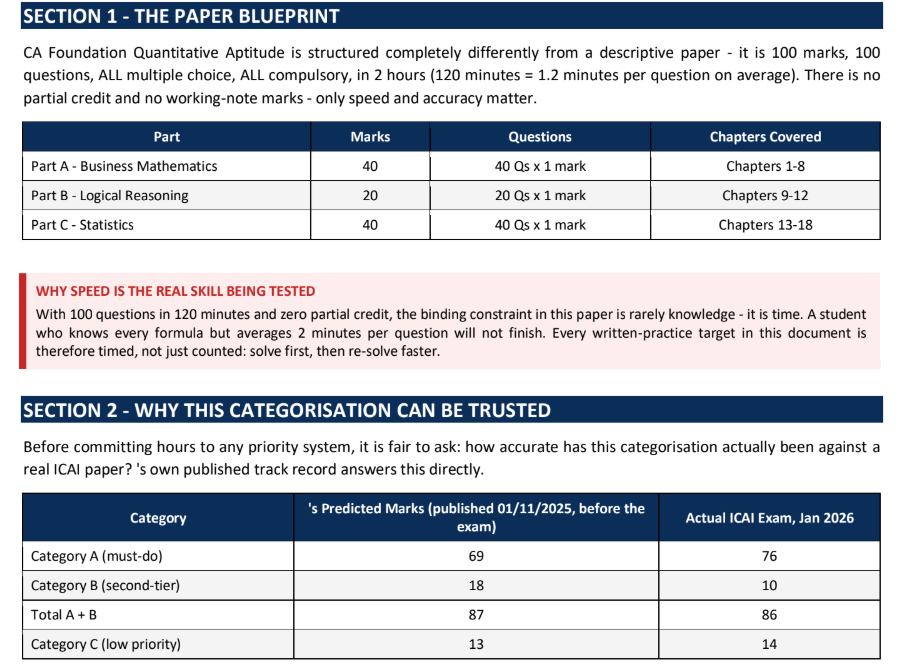
Students can take these chart notes for quick revision. These notes help to save a lot of time before the exam.
Chapter Flow Visualisation Accounting Example
A simple concept flow chart helps students see how Accounting topics are connected when studying each chapter on its own.
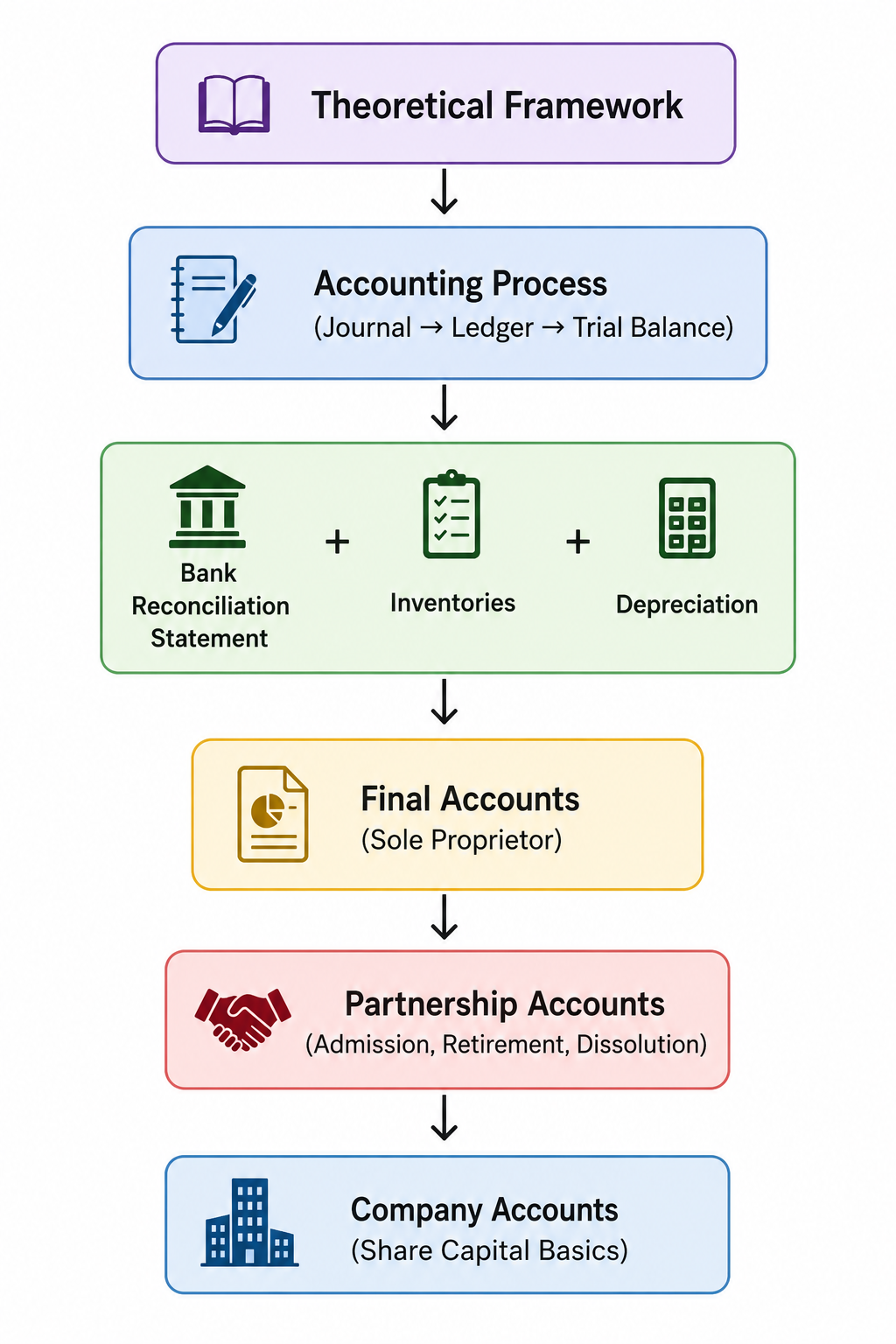
This type of flow chart helps students see why the order of study matters. Each topic relies on the one that comes before it. If you skip the accounting steps, the later chapters are really tough to figure out. The order of study is important because each topic is connected to the accounting process.
Subject-Wise Preparation Strategy
1. The Accounting: Faculty stresses practical numericals every day rather than theoretical reading. The accounting process section comes first and foremost because it is the basis of final accounts and partnership accounts. It is advised to keep a formula-and-format notebook for adjustments such as closing stock, outstanding expenses, and depreciation.
2. Business Laws: Lectures revolve around the reading of Acts as well as the practical application through case studies. Professors encourage students to make one-page charts on definitions, exceptions, and important sections,s with particular emphasis on the Contract Act and Companies Act.
3. Quantitative Aptitude: In this case, since the paper contains objective-type questions with negative marking, greater emphasis is placed on correctness than on speed. Teachers pay extra attention to teaching Statistics and Time value of money due to their high weightage.
4. Business Economics: Diagrams are widely used in lectures when teaching this topic, as this is a very diagrammatic topic. Lectures also draw upon examples from life in relation to economic theories, thus making it easy to solve MCQs and revision classes are held specifically for the Indian Economy.

Common Mistakes to Avoid
When it comes to studying, students often make mistakes. One big mistake is relying on what the teacher says in class. Students should not do this. They should solve a lot of practice questions.
Ignoring some subjects like Quantitative Aptitude and Business Economics is a mistake. Students do this when they focus too much on Accounting and Law.
Students also make a mistake when they do not think about the marking strategy in Paper 3. This paper has choice questions
It is also a mistake to start making charts late. Students should make these charts as they read the material for the time.
Not taking full-length mock tests before the actual exam is another mistake. Students should take many of these tests to be ready for the exam.
Conclusion
The CA Foundation exam in September 2026 will be a lot easier to pass if students have a plan. You need to study each subject one by one and make notes for each chapter. It is also a good idea to make charts to help you remember things and to practice with mock tests all the time. If you watch video lessons, take notes, and then test yourself, you will do well in all four subjects of the CA Foundation exam. The CA Foundation exam is very important. You should study for it smartly.
Begin your CA Foundation preparation with CAtestseries – get access to faculty lectures, note-making, and complete test series.