
Financial Management (FM) is one of the few CA Inter papers where marks are almost entirely in your own hands. There is no subjectivity, no examiner mood, no lengthy theory to memorise — just formulas, logic, and numbers. Yet every attempt, thousands of otherwise hardworking students lose marks in FM, not because the subject is impossible, but because they picked a faculty whose teaching style didn't match how they actually learn.
Ask ten toppers how they chose their CA Inter FM faculty, and you'll hear three different answers: "I needed someone fast," "I needed someone who built my concepts from zero," and "I needed someone who made me solve hundreds of questions." All three are valid — but only if they match your starting point. This guide breaks down the three teaching approaches faculty use for FM, helps you identify which one you actually need, and explains why CA Chesta Chawla has become one of the most recommended names for CA Inter FM on CA Test Series.
Why the Right CA Inter FM Faculty Choice Matters So Much
FM is a scoring paper only when the foundation is solid. Unlike theory subjects where partial answers still fetch marks, FM numericals are largely right-or-wrong. A single conceptual gap in areas like leverage, capital budgeting, or working capital management can cascade into wrong answers across an entire question. This is exactly why faculty selection carries more weight in FM than in most other CA Inter papers — the wrong teaching style doesn't just slow you down; it can quietly build bad habits that surface only in the exam hall.
Students preparing for CA Inter Costing or Law face a similar dilemma, but FM's practical, calculation-heavy nature makes the speed-versus-concept-versus-practice question especially important.
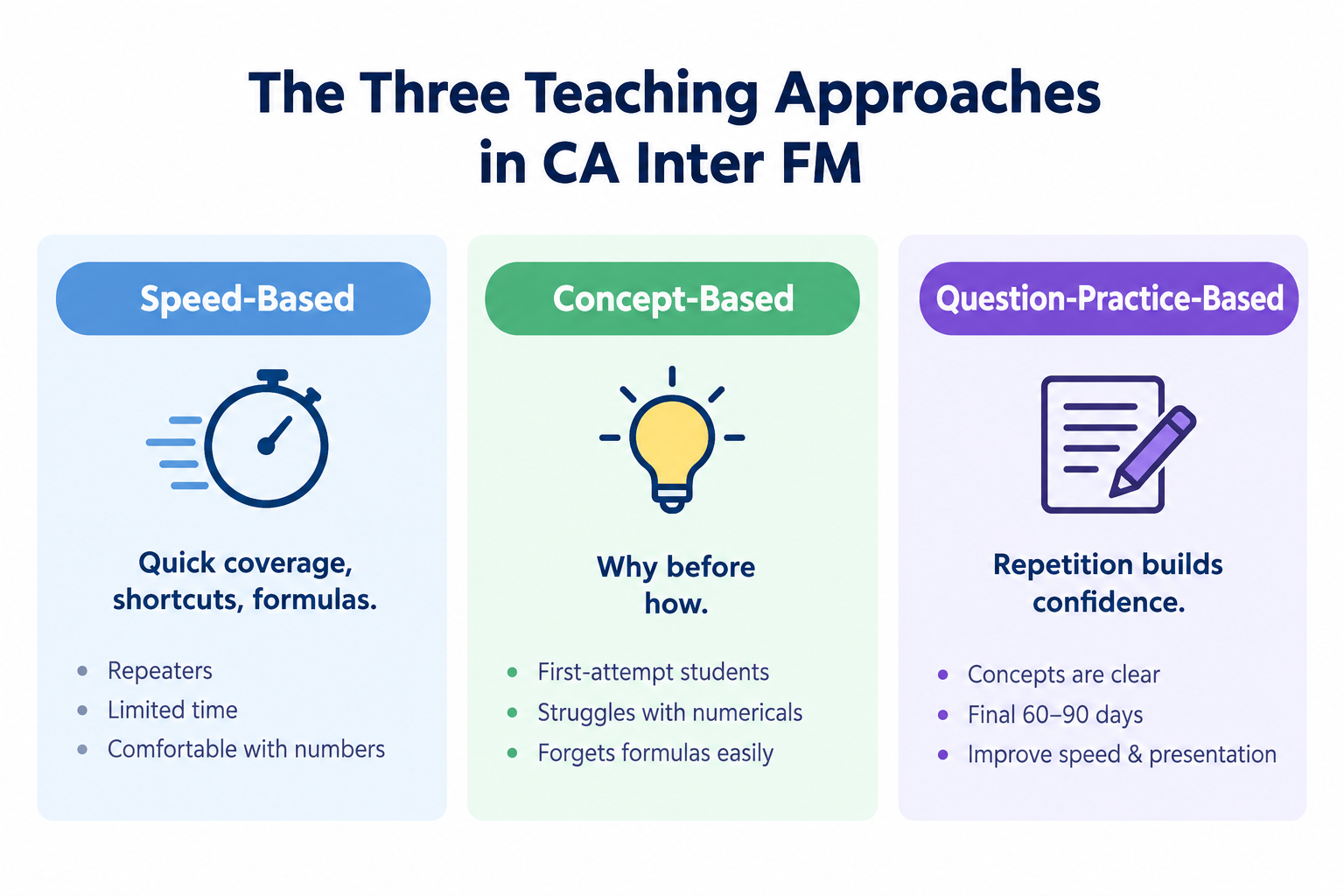
The Three Teaching Approaches in CA Inter FM
Before comparing faculty, it helps to understand what "speed," "concept," and "practice" actually mean in a CA Inter FM classroom.
1. Speed-Based Teaching
Speed-focused faculty prioritise covering the syllabus quickly, using shortcuts, direct formulas, and compressed explanations. This works well for:
Repeaters who already understand the basics and need a quick refresher
Students with limited time before the exam
Learners who are already comfortable with numbers and finance logic
The risk: if your basics aren't strong, a fast-paced class can leave gaps that only show up when you attempt a slightly twisted question in the actual paper.
2. Concept-Based Teaching
Concept-first faculty spend more time on the "why" before the "how." They connect formulas to real business logic — for example, explaining why the cost of equity is higher than the cost of debt before jumping into the CAPM formula. This approach benefits:
First-attempt students building FM from scratch
Students who have historically struggled with numerical subjects
Learners who forget formulas easily because they never understood the logic behind them
The trade-off is pace — concept-heavy classes can take longer to complete the syllabus, which is why revision batches exist.
3. Question-Practice-Based Teaching
Practice-driven faculty believe FM is won in the exam hall through repetition. Their classes are built around solving large volumes of questions — past papers, RTPs, MTPs, and faculty-curated problem sets — so that pattern recognition becomes second nature. This suits:
Students who already have conceptual clarity but freeze under time pressure
Learners preparing for the final 60–90 days before the exam
Anyone whose weak point is presentation and speed in the exam, not understanding
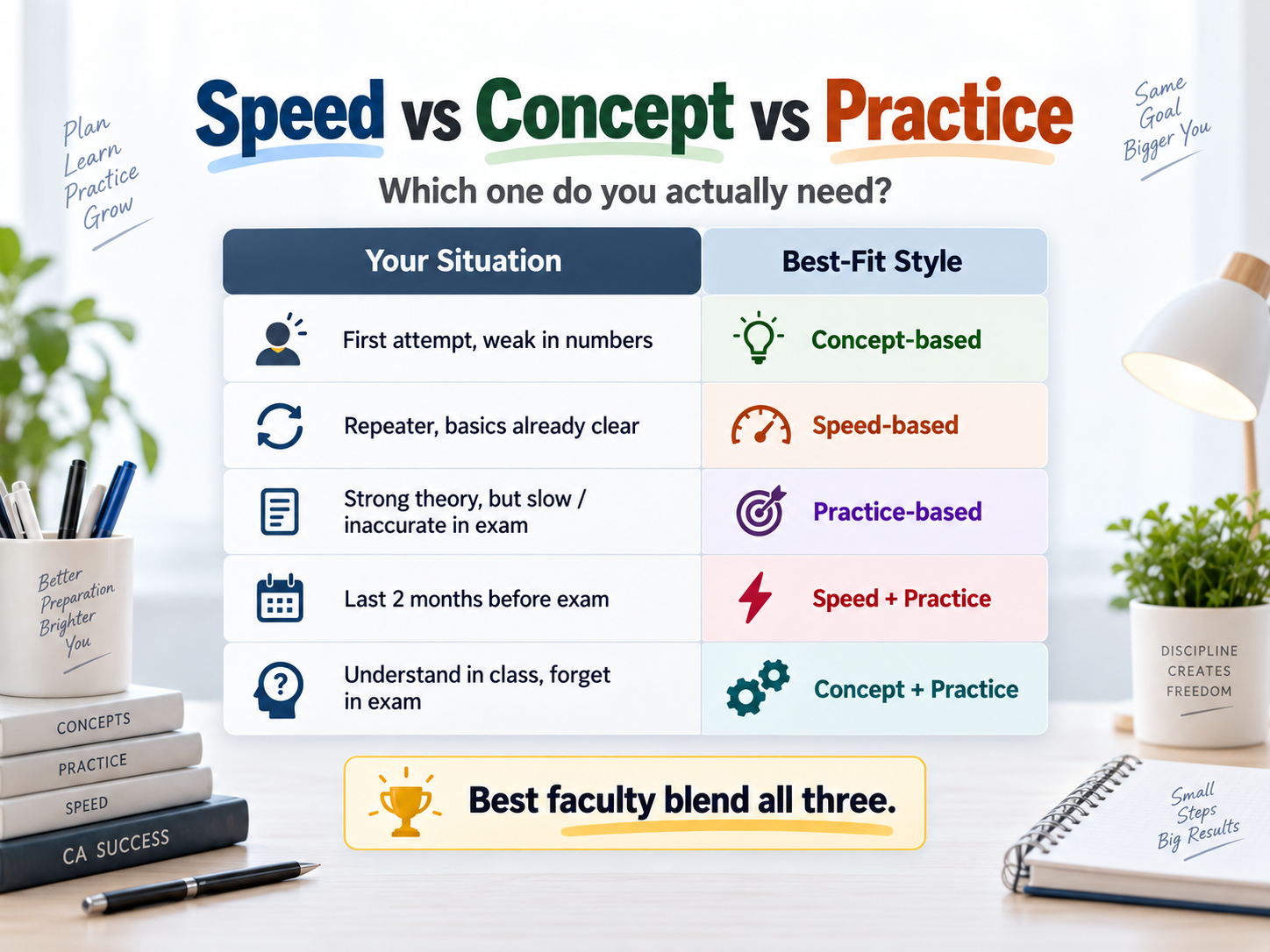
Speed vs Concept vs Practice: Which One Do You Actually Need?
Your Situation | Best-Fit Teaching Style |
First attempt, weak in numbers | Concept-based |
Repeater with basics already clear | Speed-based |
Strong theory but slow/inaccurate in the exam | Practice-based |
Limited time before exam (last 2 months) | Speed + Practice combined |
History of "understanding in class, forgetting in exam" | Concept + Practice combined |
Most students don't fit neatly into one box — which is why the strongest CA Inter FM faculty are the ones who blend all three approaches into a single, structured course rather than forcing students to choose.
Why CA Chesta Chawla Balances All Three for CA Inter FM
This is exactly the gap CA Chesta Chawla's FM course is designed to close. Rather than picking one teaching philosophy at the cost of the others, her CA Inter FM lectures are structured to move students through concept clarity first, followed by speed-building drills and extensive question practice — so students aren't forced to enrol in three different courses to cover three different needs.
Conceptual grounding first. Every topic — from ratio analysis to capital budgeting to leverage — is built from the underlying business logic before the formula is introduced. This matters most for students who have historically found FM intimidating, because a formula learnt without context is a formula that's forgotten under exam pressure.
Speed without skipping steps. Once concepts are clear, the pace picks up with structured problem-solving techniques and shortcuts that don't compromise on presentation — a balance that matters heavily in FM, where step-marking rewards clear working, not just the final answer.
High-volume, exam-pattern practice. The course is backed by a dedicated question bank covering ICAI past papers, RTPs, MTPs, and faculty-curated problems, so students move from "I understand this" to "I can solve this in under 90 seconds" — the actual skill tested on exam day.
Structured notes and doubt support. Systematic notes reduce the time spent making sense of scattered classroom material during revision, while consistent doubt-resolution ensures conceptual gaps don't carry forward untreated into the next chapter.
This combination is a large part of why she is frequently featured in faculty reviews on CA Test Series as a strong pick for CA Inter FM, particularly for students who have found the subject difficult in the past.
CA Chesta Chawla FM: Regular vs Revision Lectures
Understanding the difference between her regular and revision batches helps you pick the right one for your attempt stage:
Regular Lectures — Designed for first-time learners building FM from the ground up. These cover the full syllabus with detailed conceptual explanations, moderate pacing, and chapter-wise practice, making them ideal for students with 4–6 months of preparation time remaining.
Revision Lectures — Built for students who have already completed a first round of FM and need fast-paced reinforcement. These focus on high-weightage topics, formula recall, commonly tested question patterns, and speed — ideal in the final 30–45 days before the exam.
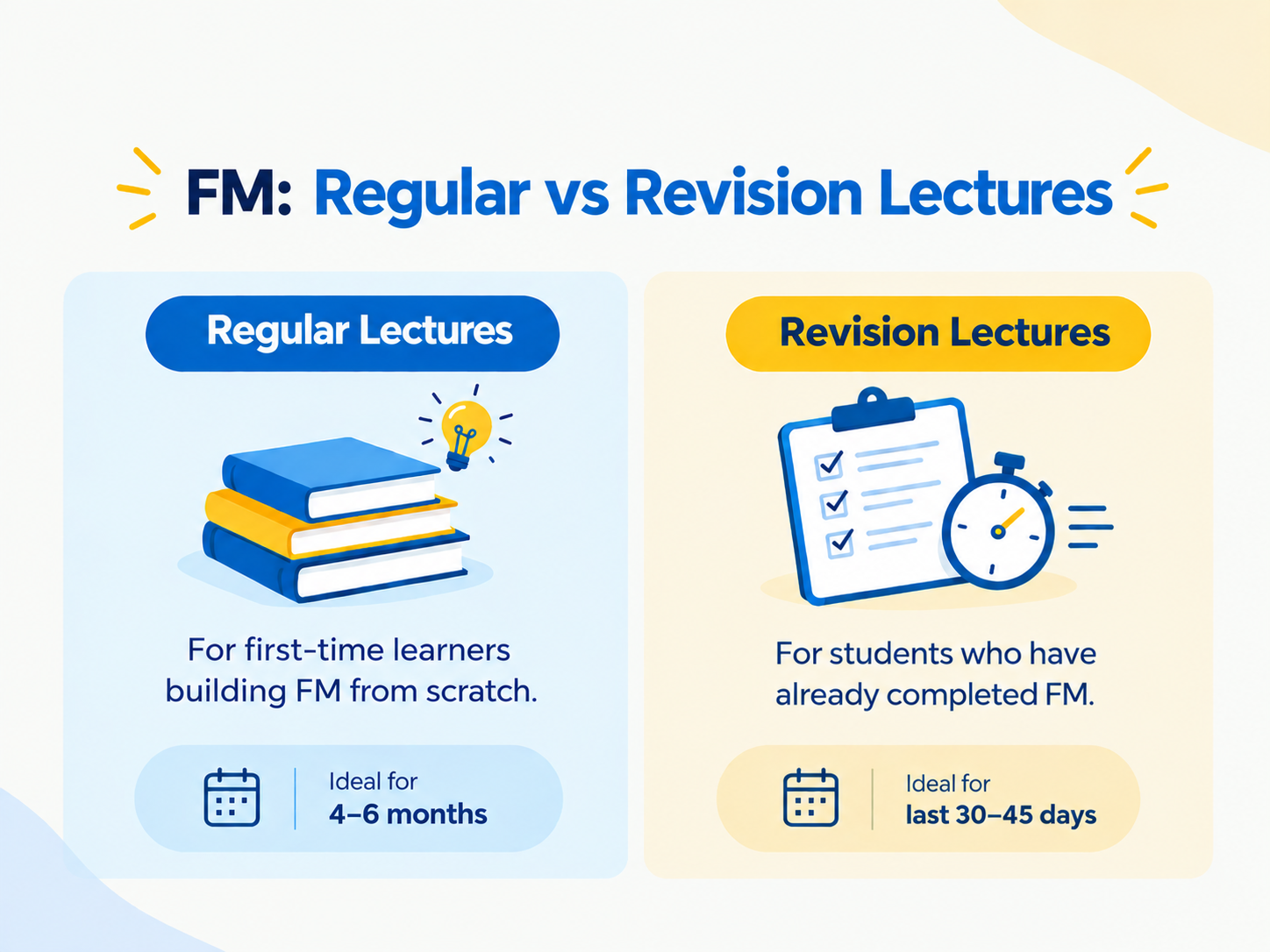
Choosing between the two isn't about which is "better" — it's about which matches where you currently stand in your FM preparation journey.
How to Evaluate Any CA Inter FM Faculty Before Enrolling
Whether you eventually choose CA Chesta Chawla or another faculty, use this checklist before paying for any course:
Watch a demo lecture first. Does the pacing match how you personally learn — or does it feel too fast or too slow within the first 15 minutes?
Check the notes quality. Are they structured enough to revise from independently, without re-watching the full lecture?
Confirm syllabus and amendment coverage. Ensure the batch is updated for your specific attempt, not recycled from a previous cycle.
Look at the question bank depth. A faculty who only explains but doesn't provide enough practice material will leave you under-prepared for the actual paper.
Verify doubt-solving support. FM numericals generate a lot of doubts — confirm there's a reliable channel to get them resolved quickly.
Match the batch type to your timeline. Regular for building from scratch, revision for reinforcement closer to the exam.
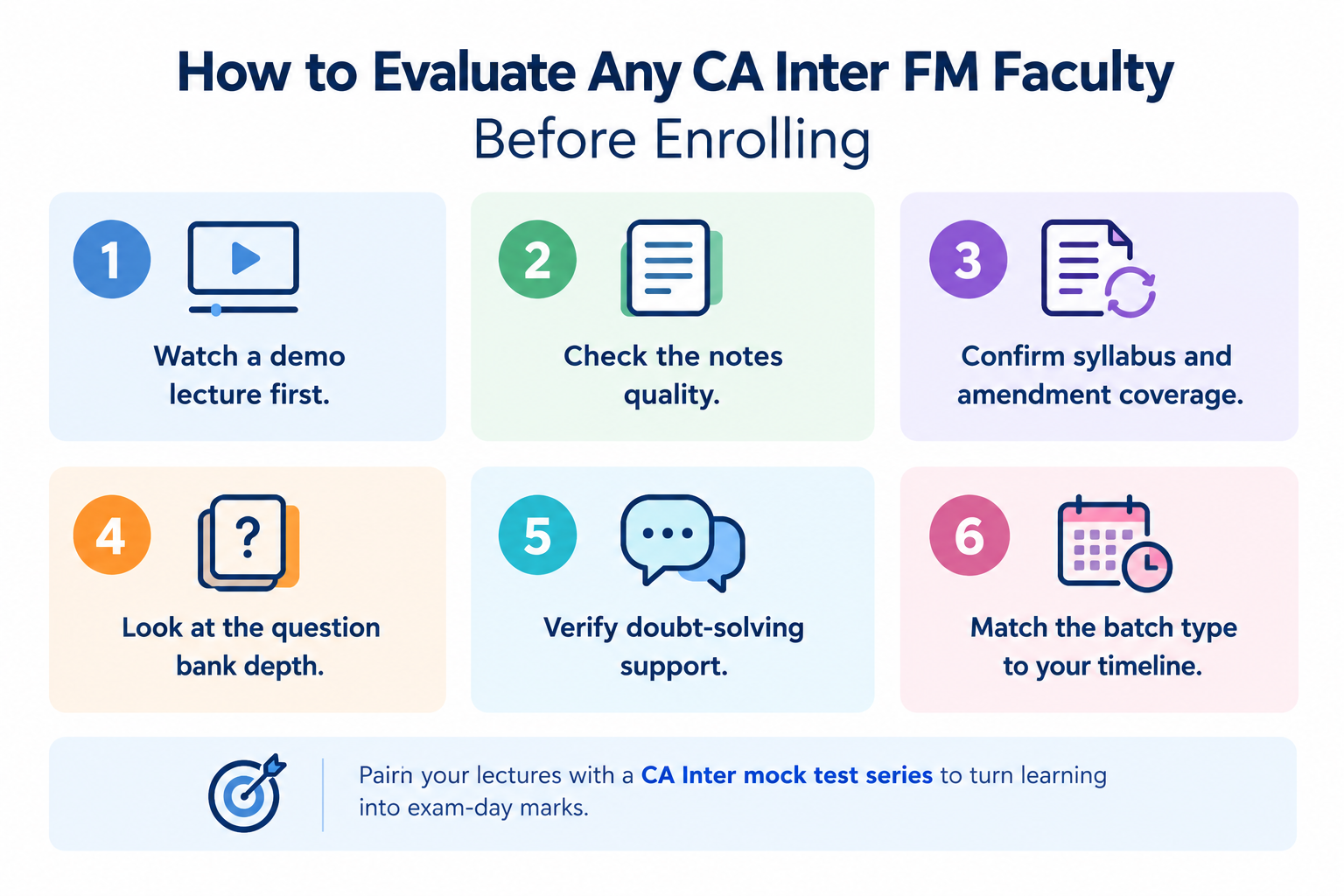
Pairing your chosen lectures with a disciplined CA Inter mock test series is what actually converts classroom learning into exam-day marks — watching lectures alone rarely moves the needle without structured, evaluated practice.
Common Mistakes Students Make While Choosing FM Faculty
Choosing based on brand name alone, without checking if the teaching pace suits their own learning speed.
Picking a revision batch too early, before concepts are even clear, which leaves permanent gaps.
Ignoring practice volume and assuming that watching enough lectures is the same as being exam-ready.
Switching faculty mid-syllabus, which usually causes more confusion than it solves — different faculty use different formula notations and problem-solving sequences.
Not attempting mock tests alongside lectures, which means the first real test of speed and accuracy happens on the actual exam day instead of in a safe practice environment.
Conclusion
There is no universally "best" CA Inter FM faculty — only the faculty best suited to where you currently stand: whether you need speed, concept clarity, or sheer question practice. What makes a course genuinely worth your time is when it doesn't force that trade-off at all. That's the strongest case for CA Chesta Chawla's CA Inter FM lectures — conceptual grounding, speed-building, and high-volume practice, structured into one course instead of three separate ones.
Once your lectures are covered, the next step is disciplined, evaluated practice. Explore the CA Inter FM mock test series on CAtestseries.org to convert classroom concepts into exam-day marks.