How CA Vinayak Sikka Teaches Accounting Standards Through Logic – CA Inter
Accounting Standards have been seen as challenging for many students because they simply memorise the rules, terms, and disclosures without understanding the reason behind them — a habit that breaks down the moment ICAI changes the facts of a question.
According to CA Vinayak Sikka, accounting standards become easy to understand if a student understands the logic and concept behind them. He doesn’t make students mug up rules and terms but instead helps them understand why these standards are there in the first place.
Understanding the concept and purpose of an accounting standard makes solving new questions very easy.

The Problem with Memorising Accounting Standards
A lot of students use memorisation techniques to learn about accounting standards, such as rules, definitions, and journal entries. Although this is helpful during revision, it can be challenging, especially when new information is presented within the question.
Students who understand the principles behind an accounting standard will be able to apply it confidently despite any changes.
The Logic-First Philosophy
The teaching method employed by CA Vinayak Sikka relies more on concepts than memorisation. The tutor starts by providing students with information about the nature of the business transaction and the impact that the transaction will have on the books of accounts before introducing the accounting standard. The student is expected to comprehend the objective of the accounting standard, determine the proper accounting treatment of the transaction, and subsequently prepare the journal entry.
Connecting Standards with Basic Accounting Concepts
A unique aspect of logical teaching is the fact that every accounting standard is related to the core principles of accounting upon which the practice of accounting is based.
Initially, the basic principles such as
Accrual Principle
Matching Principle
Prudence
Substance over Form
Materiality
Consistency
Going Concern
After understanding these principles, accounting standards are taught to the students as an application of the accounting principles in accounting practice.
It assists one in comprehending the principle that the accounting standards are not just principles but there is logic behind them and they are utilized to ensure that the financial statements are an accurate and true representation of the financial standing of the organization.
In other words, instead of just learning accounting standards, students learn the reason for the rules, thus making the learning process easier.
Use of Conceptual Journal Entries
Conceiving the conceptual approach to journal entries will assist students in knowing why an account is debited or credited rather than memorising the entry.
Students need to look into:
Reason for passing the entry.
Effects on the financial statements.
Concept that justifies the treatment.
Example - Provision for Bad Debts:
The first thing students need to know about is the possibility of non-payment and the concept of prudence. The entry follows.
Explaining the Purpose Behind Every Standard
The logical process starts with one important question:
"Why was this accounting standard written?"
It is only after understanding what the problem is that students can understand the requirements.
For instance: AS 2: Inventory valuation
The valuation of inventory influences COGS and profit:
1. Inventory is a current asset.
2. Greater closing inventory = Lower COGS = Higher Profit.
3. Low inventory valuation means low profitability.
Therefore, the principle "cost or NRV, whichever is lower" makes sense instead of being a mere formula to be learned.
Real-Life Business Examples
Logical teaching gains strength when linked to practical applications in the business world.
AS 10 Example: Property, Plant, and Equipment
Instead of learning how to capitalize, the students concentrate more on:
1. The cost to purchase the machinery
2. Transportation cost
3. Installation cost
4. Costs for trial and error
The most important question becomes:
“What costs are required to make the asset ready for use?”
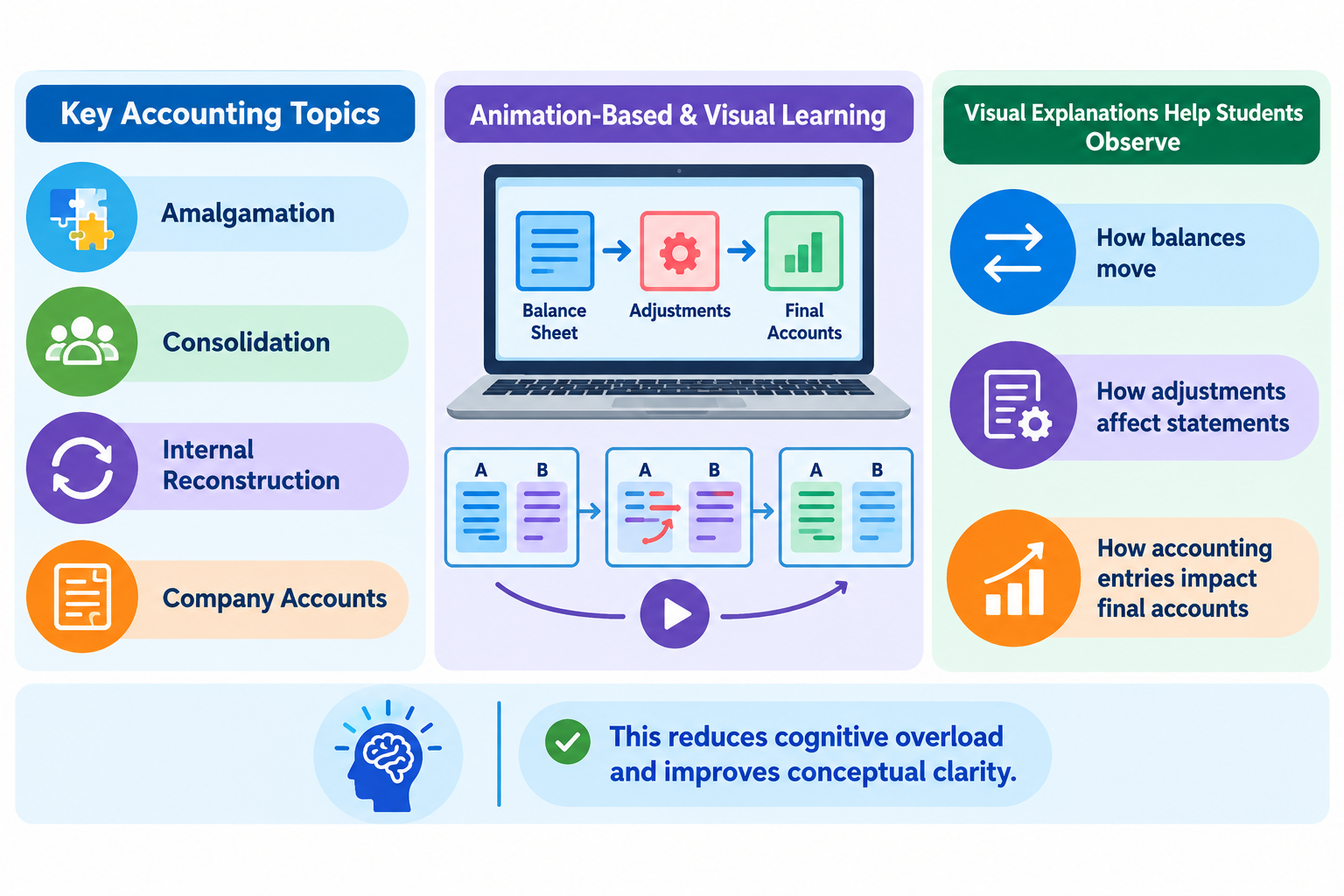
Visual Learning and Animation-Based Teaching
Simplifying Complex Language
Technical terminology is used in accounting standards, which may be difficult to comprehend.
The logic approach first explains such terms as “fair value", “impairment loss", “present obligation", and “contingent liability” in layman’s terms.
First, students understand the business aspect of the terms before learning their technical meanings.
Question-Based Learning
Logical teaching motivates the students to question everything.
Asking questions such as why this particular asset should be recognised or why this particular provision should be made would enable students to comprehend the accounting entries and also the reasoning behind them.
This approach would make learning active and conceptually clear. This would benefit students appearing for ICAI examinations.
Application-Based Practice
Conceptual understanding must be followed by practical application under exam conditions. Students should practice:
Practical questions
Concept-based adjustments
Mixed problems
ICAI illustrations
RTPs and MTPs
This converts conceptual clarity into examination performance.
Handling Modified ICAI Questions
Learning by logic will help students deal with problems that have new facts.
ICAI can change dates, amounts, terms, adjustments, and more.
Conceptually strong students can do without memorising formats because they can:
Analyse the new facts.
Recognise the applicable standard.
Ascertain the correct treatment.
Make the proper entry.
Long-Term Benefits for CA Students
Learning accounting standards through logic pays off beyond the exam hall. Students gain:
Analytical and problem-solving skills
Knowledge of financial statements
Professional judgment
Accounting knowledge
These skills carry into articleship, audit, financial reporting, and corporate finance.
Conclusion
Accounting standards will be easily comprehended by students when they pay attention to the comprehension of concepts rather than rules. Through his explanation of accounting standards in relation to principles, practical examples, and theoretical journal entries, CA Vinayak Sikka assists students in building sound conceptual understanding. The students will be able to answer ICAI exam questions with ease.