Best Faculty for CA Inter Costing: A Complete Study Guide
Most of the students who clear the CA Inter exam agree that Cost and Management Accounting is, ironically, one of the highest-scoring papers in the entire CA Inter curriculum. It rewards students who understand logic over students who memorize steps. The gap between a student who scores 35 and one who scores 75 is rarely about talent — it almost always comes down to the quality of teaching, the structure of the revision material, and how much real practice a student has put in under exam-like conditions.
If you are a candidate who is preparing for the CA Inter costing exam and looking for the best faculty for CA Intermediate costing, the one name that stands out in the industry is CA Himanshu Singla. He is known for his unique teaching style, with the help of animation in his lectures, so that students understand the core principles and concepts visually.
CA Inter Costing Syllabus & Chapter-Wise Weightage
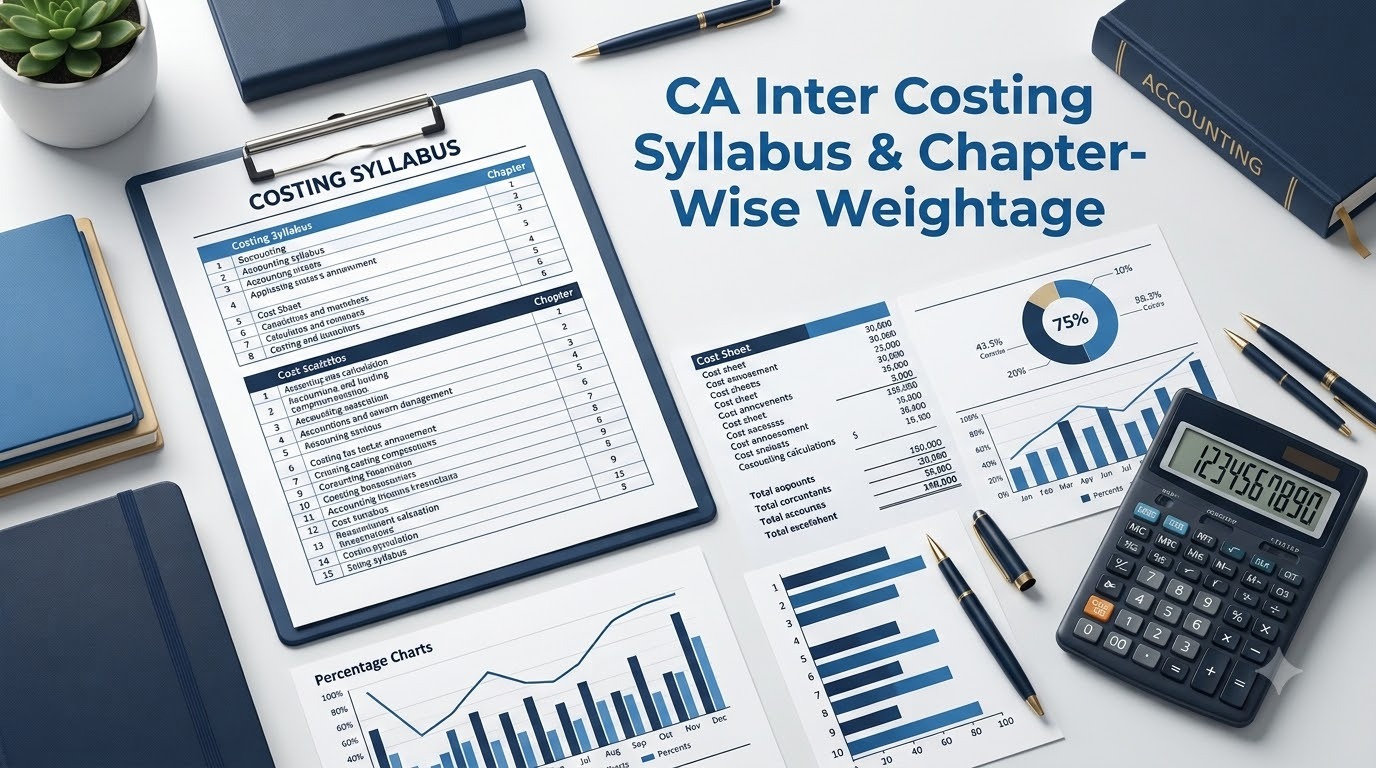
Section I – Overview of Cost and Management Accounting (10%–15%) | Objectives and Scope of CMA, Users of Cost and Management Accounting Information, Functions of Management Accounting, Role of Cost Accounting Department, Installation of Costing System, Cost Terms and Concepts, Cost Reduction and Cost Control, Elements of Costs, Cost Behavior Pattern, Methods and Techniques of Costing, Digital Costing, Preparation of Cost Sheets |
Section II – Ascertainment of Cost (35%–40%) | Material Cost – Procurement, Valuation, Stock Verification, Material Requirement Analysis through Digital Costing, Government e-Marketplace (GeM), Costing through Enterprise Resource Planning (ERP), Inventory Control Techniques – EOQ, ABC, FSN, HML, VED, Treatment of Normal/Abnormal Losses, Employee Cost – Attendance, Payroll, Elements of Wages, Employee Turnover, Remuneration Systems – Halsey Plan, Rowan Plan, Direct Expenses, Overheads – Factory, Administration, Selling, Distribution, R&D, Allocation and Apportionment of Overheads, Activity Based Costing (ABC), Integration of Cost and Financial Data, Reconciliation of Profit |
Section III – Methods of Costing (20%–25%) | Output/Unit Costing, Batch Costing – Optimum Batch Quantity, Job Costing, Process/Operation Costing, Joint Products – Apportionment of Joint Costs, By-Products, Costing of Service Sectors |
Section IV – Cost Control and Analysis (25%–30%) | Standard Costing – Setting Standards, Types of Standards, Variance Analysis – Material, Labour, Overhead Variances, Marginal Costing – Contribution Margin, Break-Even Analysis, CVP Analysis, Comparison of Marginal Costing with Absorption Costing, Short-Term Decision Making – Make or Buy, Discontinuation, Limiting Factor Analysis, Budget and Budgetary Control, Flexible Budget, Functional Budgets, Cash Budget, Zero-Based Budgeting (ZBB), Performance Budget |
Meet CA Himanshu Sir — Best Faculty for CA Inter Costing

A practicing Chartered Accountant and one of the core academic mentors at CATestSeries.org, CA Himanshu Singla combines practical experience with teaching, bringing both hands-on costing knowledge and classroom expertise to every session. He has been mentoring CA aspirants with a practical, concept-driven, and examination-focused teaching methodology, helping thousands of students simplify Cost & Management Accounting through logical explanations, practical illustrations, and structured learning techniques.
His classes emphasize conceptual clarity, answer-writing presentation, and strategic preparation as expected by ICAI. Apart from classroom teaching, he personally contributes to the preparation of comprehensive notes, question banks, mock tests, revision resources, and personalized study plans tailored to each student's pace of learning. What sets him apart is his continuous availability for doubt-solving — students often mention that his after-class support and one-on-one guidance are what helped them push through Cost & Management Accounting, a subject many find intimidating.
Highlights:
Professional Chartered Accountant who operates independently
Prepares questions, revision sheets, and notes for CA Inter Costing exams
Renowned for providing round-the-clock solutions to any query
Has mentored thousands of students via performance monitoring since becoming associated with CATestSeries.org
Costing Video Lectures — What His Online Classes Cover
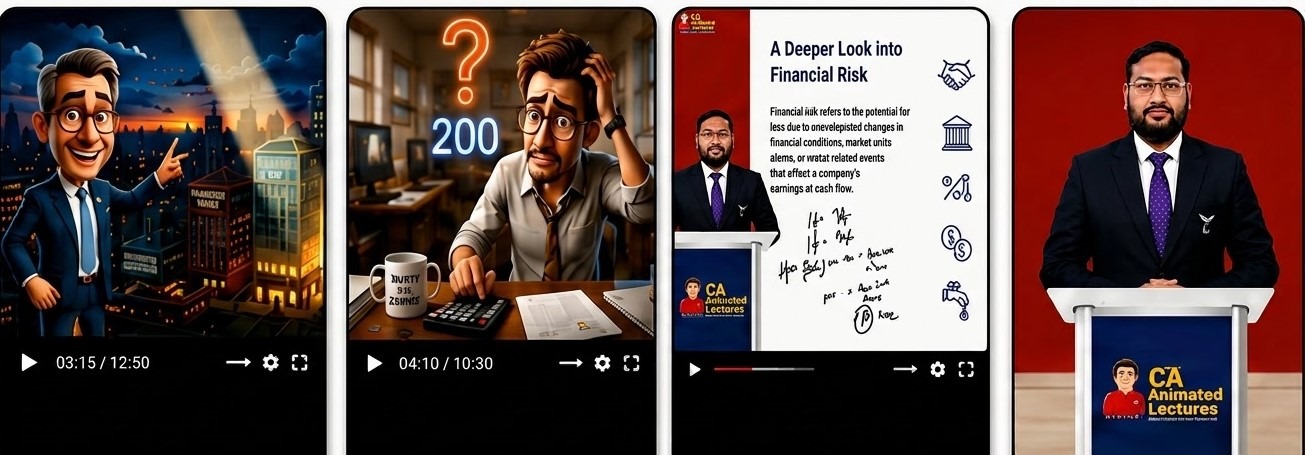
The CA Inter Costing video lectures cover the complete syllabus in a structured, chapter-wise manner—from Material Cost and Overheads to Process Costing, Standard Costing, Marginal Costing, and Budgetary Control. Each concept is introduced by first building a clear understanding of the underlying logic and reasoning behind the formulas, followed by step-by-step illustrations, practical applications, and exam-oriented problem-solving. This approach helps students move beyond formula-based learning and develop a strong conceptual foundation with the confidence to tackle exam-level questions
Animation-Based Learning: Making Complex Costing Concepts Easier
Visual Understanding: Animation helps students see how a concept works instead of relying only on lengthy theoretical explanations.
Process Costing: Process flows, units, normal/abnormal losses, and movement of costs can be visually demonstrated for easier understanding.
Marginal Costing: Animation can simplify concepts such as cost behaviour, contribution, break-even analysis, and decision-making.
Overheads & ABC: Visual representation makes overhead allocation, activities, and cost drivers easier to understand.
Better Concept Retention: When students see and understand a process, they are more likely to remember the concept during revision and exams.
Simplifies Difficult Chapters: Animation breaks complex, process-oriented topics into simple and easy-to-follow visual explanations.
A More Engaging Learning Experience: Instead of passive learning through paragraphs and formulas, students can visualize, understand, and apply the concepts.
Distinctive Teaching Approach: The combination of animation + explanation + storytelling gives students a more intuitive way to learn CA Inter Costing.
Himanshu Sir vs Other Faculty: A Better Way to Understand CA Costing
Topics | CA Himanshu Singla | Other Faculty |
Standard Costing | Animation makes variance concepts visual and easier to understand, while storytelling helps students remember the logic. | Concepts are generally explained through theory, formulas, and numerical examples. |
Marginal Costing & Decision Making | Stories and practical situations make decision-making concepts easier to relate to and understand. | The focus is mainly on concept explanation, formulas, and question-solving. |
Process Costing | Animation helps students visualize the movement of units, processes,s and losses, making the flow easier to grasp. | The process is explained mainly through diagrams, formats,ts and numerical questions. |
Overheads & Activity-Based Costing | Animation simplifies cost allocation and cost-driver concepts by giving students a visual understanding. | Concepts are generally covered through theoretical explanation and numerical application. |
More Than Lectures — Your Complete CA Learning Partner
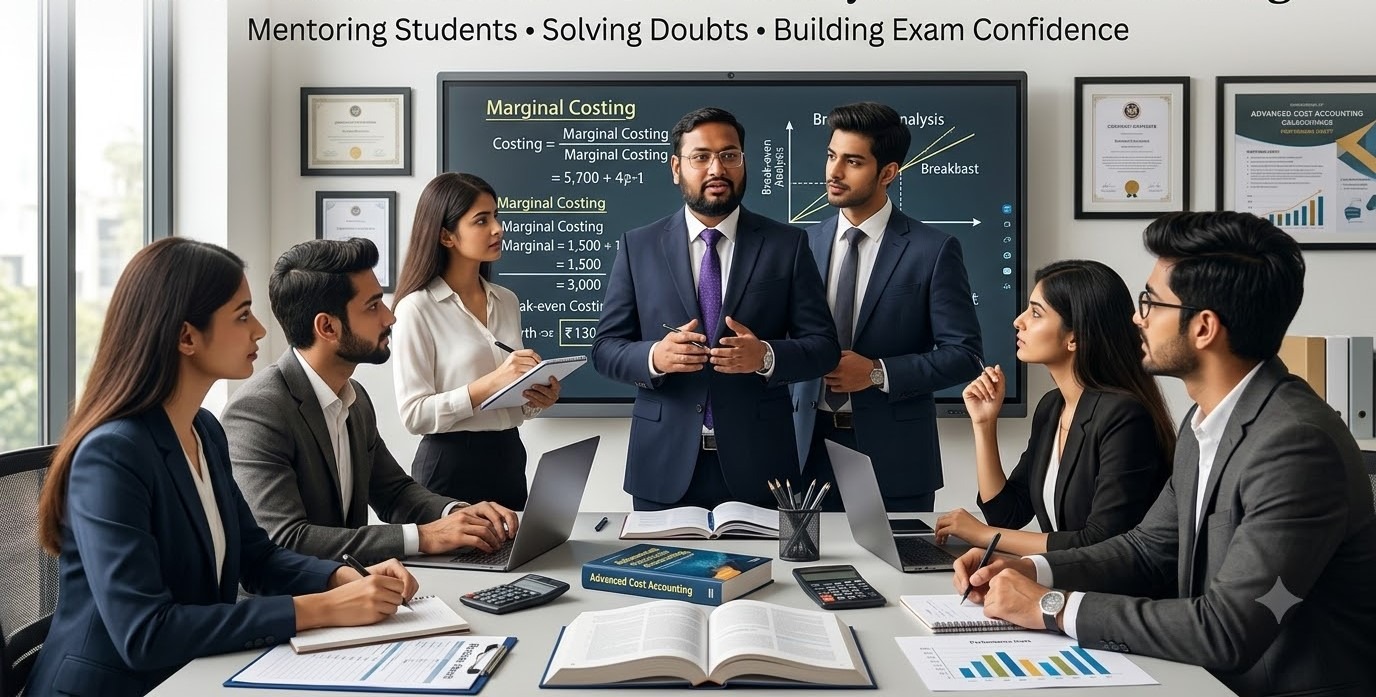
Lectures build understanding, but exam success comes from effective revision, consistent practice, and the right guidance. Our complete learning support is designed to take students from understanding concepts to becoming fully exam-ready.
Study Material & Revision Notes — Concise, structured resources designed for quick and effective revision.
Free MCQ Test Series — Regular MCQ practice to strengthen conceptual understanding and exam readiness.
Mock Test Series — Both scheduled and Unscheduled tests to help students practice with flexibility while maintaining exam discipline.
Mentorship & Study Planner — Personal guidance and structured study planning to help students stay consistent and on track.
Explore the complete CA Inter Costing course — video lectures, handwritten notes, and the mock test series, all structured around the study plan above
Watch CA Himanshu Sir’s Free Demo Lecture
How to Study CA Inter Costing the Right Way — A Step-by-Step Preparation Guide
A better result does not require more hours. It requires a better sequence.
Build the concept first—before touching a numerical problem, understand why the formula exists and what real-world costing situation it is solving.
Solve the illustration immediately—do not let a gap form between learning a concept and applying it. Practice right after you learn.
Maintain a formula and logic notebook. This becomes your fastest revision tool in the final weeks before the exam.
Revise using structured notes, not the full textbook. When a concept is well understood, the revision process is supposed to be swift and specific.
Take timed mock tests regularly—this is how understanding is converted into exam speed.
Review every mistake properly- A wrong answer analyzed carefully is often worth more than three new problems solved without reflection.
Common Mistakes in CA Inter Costing Preparation
Almost every student who struggles with Costing is making one or more of these mistakes, often without realizing it.
Learning formulas before understanding logic—a formula memorized without knowing why it works — falls apart the moment ICAI frames a question slightly differently from the textbook.
Treating Costing as a purely numerical subject—theory- and definition-based questions appear regularly, and students who skip theory portions lose easy marks.
Solving a problem once and moving on—costing is a practice-heavy subject. One-time exposure to a sum rarely translates into exam-day speed.
Getting sign conventions wrong in variance analysis—a single sign error in Standard Costing can cascade through an entire answer and cost several marks in one question.
Never practicing under time pressure—this is one of the most common gaps. Students who skip timed practice are often caught off guard by how different real exam conditions feel compared to solving the same problem untimed at home.
Relying on scattered resources—jumping between random YouTube videos, borrowed notes, and outdated PDFs — creates gaps instead of a complete picture.
CA Inter Costing 60-Day Study Plan
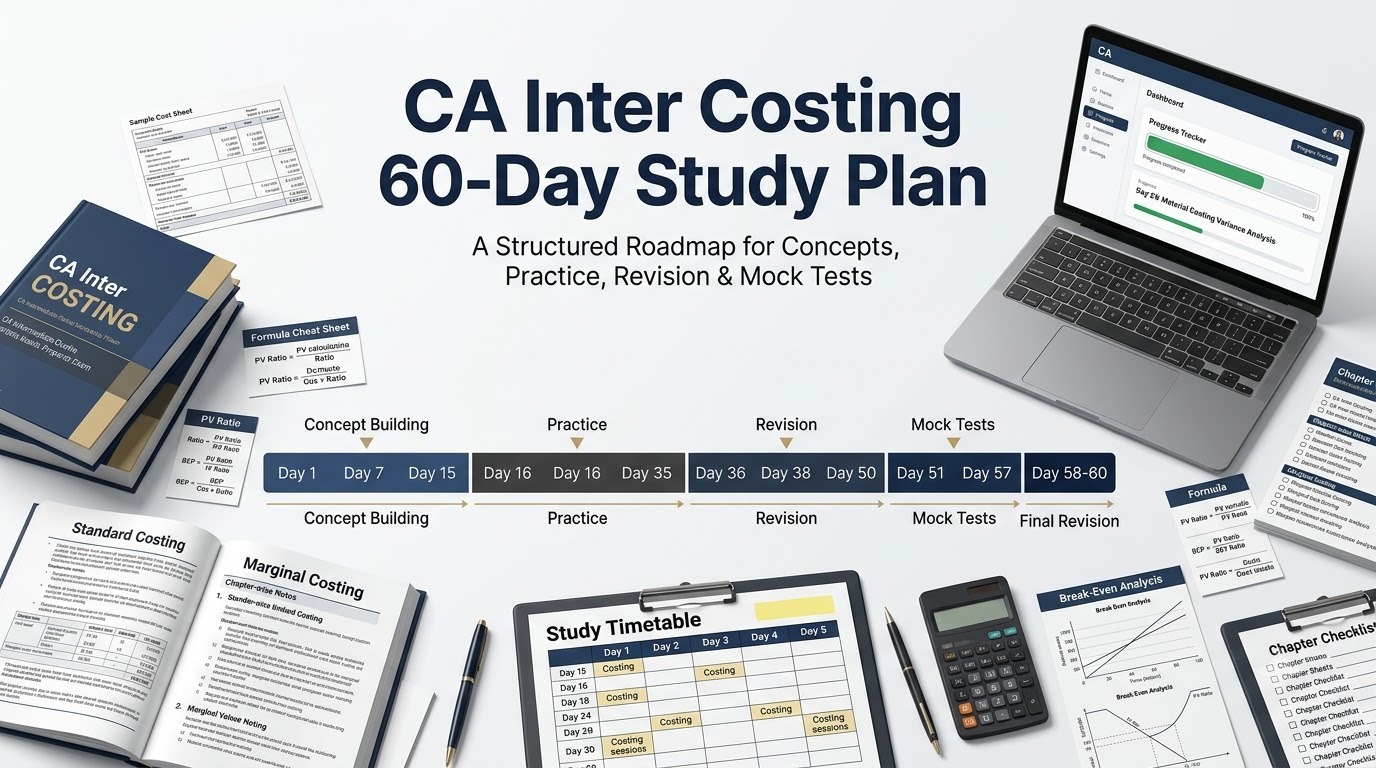
Phase | Days | Focus |
Phase 1 | Day 1–25 | Concept building through video lectures, chapter by chapter, starting with Material Cost through to Overheads and Cost Sheets |
Phase 2 | Day 26–40 | Deep focus on high-weightage chapters — Process Costing, Standard Costing, and Marginal Costing — supported by handwritten notes |
Phase 3 | Day 41–55 | Timed mock tests, one every two to three days, covering both chapter-wise and full-syllabus patterns |
Phase 4 | Day 56–60 | Reviewing mock test mistakes, final formula revision, and a last pass through the handwritten notes |
This structure is not rigid. It can be compressed or extended based on how much time you have before your attempt, but the sequence — concept, focused revision, timed practice, review — should stay the same regardless of your timeline.
Conclusion
Scoring good marks in costing is not a difficult task if you have good conceptual clarity. The right teaching does not just explain a topic once. It builds the concept properly, backs it up with structured notes and study material for revision, and pushes you to practice under real exam conditions through mock tests. CA Himanshu Sir’s approach at CATestSeries.org is built around exactly this cycle, giving CA Inter students a complete, structured path through one of the most important papers in the exam.