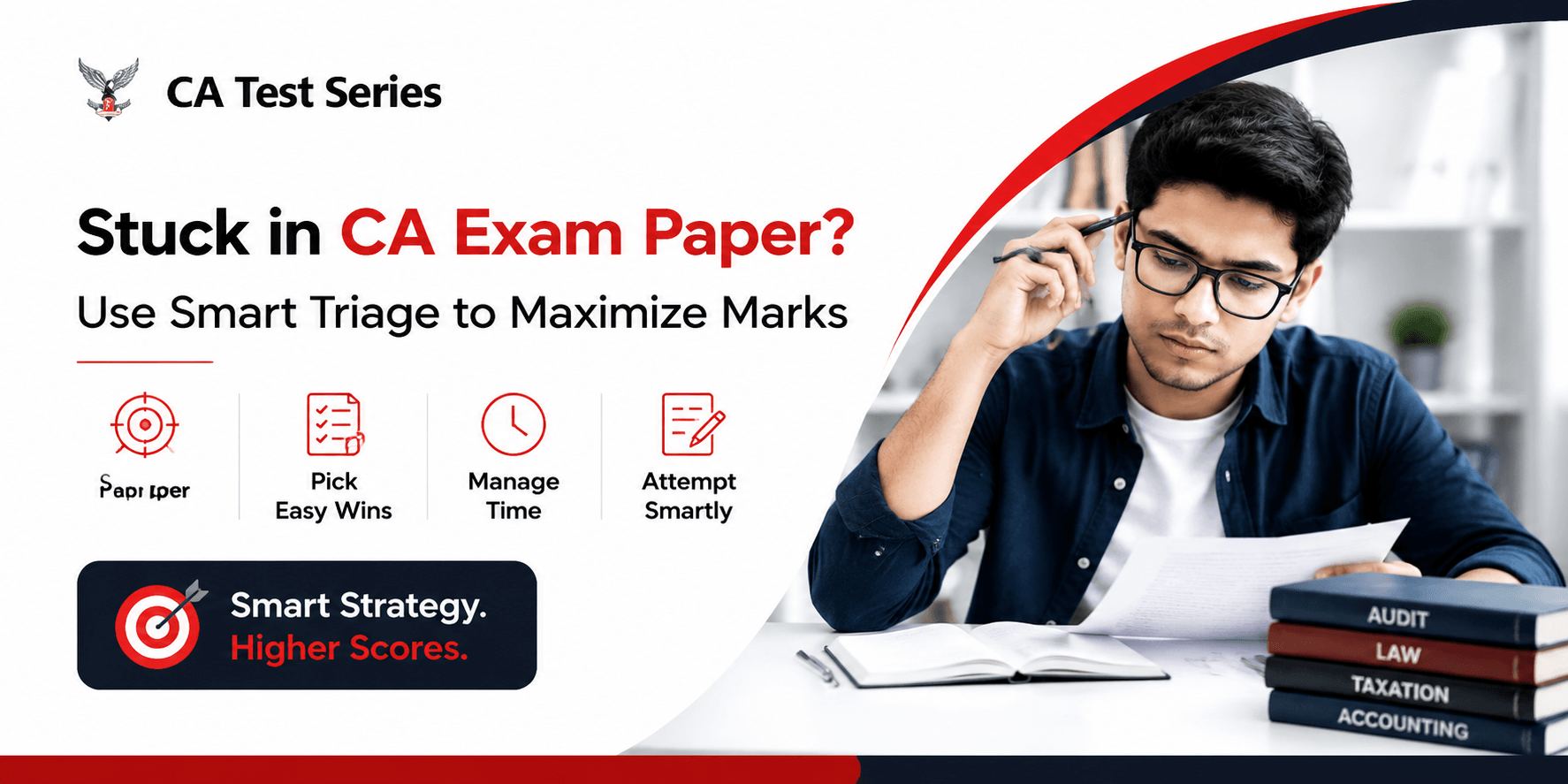
CA exams are not only a test of knowledge, concepts, and preparation but also a test of decision-making ability under pressure. Many students prepare seriously for months, revise multiple times, and practice questions regularly. However, during the actual examination, they often face unexpected situations such as forgetting a concept, getting confused about a question, or spending too much time on a single problem. Getting stuck in a CA exam paper is a common challenge among students. It does not always mean that you do not know the answer. Sometimes, exam pressure, anxiety, or overthinking can create a temporary mental block that prevents you from recalling information. The way you respond at that moment can have a major impact on your overall performance. A smart triage strategy helps CA students stay calm, prioritize questions, manage time effectively, and recover marks even when they face difficult questions. Instead of allowing one challenging question to affect the entire paper, students can use practical techniques to maintain control and maximize their scoring opportunities.
What Does It Mean to Get Stuck in a CA Exam Paper?
Getting stuck in a CA exam paper means reaching a point where you are unable to proceed confidently with a particular question. This situation can happen because of different reasons, including lack of clarity, memory failure, confusion between concepts, or shortage of time. Sometimes students know the topic but cannot remember the exact provision, formula, or explanation. In other cases, they may understand the question but struggle to decide the correct approach. Recognizing the reason behind getting stuck is important because the solution depends on the actual problem. For example, a memory recall issue requires a different approach compared to a complete knowledge gap. Similarly, spending too much time on a question requires better time management rather than additional thinking.
Common Situations Where CA Students Get Stuck
CA students usually face difficulties in exams in the following situations:
Situation | Reason Behind the Problem |
Forgetting an answer despite preparation | Exam pressure affects memory recall |
Unable to understand the question requirement | Lack of careful reading |
Confusion between multiple options | Weak conceptual clarity |
Spending too much time on one question | Poor time allocation |
Feeling nervous after seeing an unexpected question | Exam anxiety |
These situations are normal in professional exams like CA. The important factor is not whether you face difficulties, but how effectively you handle them.
Why Do Students Freeze During CA Exams?
Students often experience a mental block during CA exams because of pressure and fear of losing marks. When a difficult question appears, many students immediately start worrying about the consequences. This creates stress, which makes it even harder to recall information. Another major reason is insufficient exam practice. Students who only study concepts but do not practice full-length papers may struggle to manage real exam pressure. CA exams require not only knowledge but also speed, accuracy, and decision-making skills. Overthinking a question, trying to write a perfect answer, or repeatedly attempting the same problem can waste valuable time and reduce confidence.
The First 60 Seconds: What to Do When You Are Stuck
The first few moments after getting stuck are extremely important. Your reaction can either help you recover quickly or cause unnecessary time loss. Instead of panicking, follow a structured approach.
Step 1: Stay Calm and Reset Your Mind: The first step is to control your emotions. Take a few seconds, breathe normally, and remind yourself that one difficult question does not decide your entire exam. A calm mind works more effectively than a stressed mind. Once you relax, your brain has a better chance of recalling information that you have already studied.
Step 2: Identify the Real Problem
Ask yourself why you are unable to continue.
The problem may be:
You do not know the concept.
You know the concept but cannot remember details.
You misunderstood the question.
You are under time pressure.
Identifying the reason helps you choose the correct solution instead of wasting time unnecessarily.
Step 3: Move Forward Strategically: One of the biggest mistakes students make is fighting with one difficult question for too long. If you are unable to make progress after a reasonable attempt, leave it temporarily and move to the next question. Completing easier questions first helps you secure marks, increase confidence, and return to the difficult question later with a fresh mind.
CA Exam Paper Triage Strategy
A CA exam paper triage strategy means deciding which questions deserve your attention first based on difficulty, marks, and confidence level.
Instead of attempting questions randomly, divide them into three categories.
Category | Type of Question | Strategy |
Category 1 | Questions you know well | Attempt immediately and secure marks |
Category 2 | Questions you partially know | Write relevant points and concepts |
Category 3 | Questions you cannot solve | Leave temporarily and return later |
Questions You Can Answer Immediately: These questions should always receive priority. They provide the safest opportunity to score marks and help create a positive flow during the exam. Starting with familiar questions also improves confidence and reduces exam pressure.
Questions You Partially Know
Many students make the mistake of leaving questions because they cannot remember the complete answer. However, partial knowledge can still earn marks.
Write:
Relevant concepts
Important keywords
Formulas
Provisions
Logical explanations
A meaningful partial answer is always better than leaving the answer sheet blank.
Questions You Cannot Solve: If a question is completely unfamiliar, do not spend excessive time trying to force a solution. Mark it, move ahead, and return later if time permits. Sometimes after completing other questions, your mind becomes more relaxed and you can identify the correct approach.
What to Do When You Cannot Remember an Answer?
Forgetting an answer during a CA exam does not mean you have lost all marks. Many students try to recall the entire answer word-by-word, which creates additional pressure.
Instead, use keyword recall.
Remember:
Main concepts
Headings
Important terms
Basic principles
Once you remember the core idea, you can create a structured answer using your understanding.
Write Whatever Relevant Knowledge You Have
Never leave a question completely blank if you have some understanding of the topic. Even incomplete but relevant information can help demonstrate your knowledge. Examiners look for conceptual understanding, logical presentation, and correct points.
Follow Proper Answer Writing Technique
A well-presented answer improves readability. Use:
Proper headings
Clear explanations
Relevant keywords
Logical structure
Appropriate conclusions
A good presentation helps the examiner understand your answer more effectively.
Time Management When You Get Stuck
Time management is one of the most important skills in CA exams. A difficult question should not consume the time required for multiple other questions.
Follow the Marks-to-Time Rule
Always allocate time according to marks. Higher-mark questions deserve more time, while smaller questions should be completed quickly. Avoid spending twenty minutes on a question that carries only a few marks.
Keep Buffer Time for Revision
Try to complete the paper before the final minutes. Extra time allows you to:
Check calculations
Complete unanswered questions
Correct mistakes
Improve presentation
Subject-Wise Strategy
Different CA subjects require different approaches.
Subject Type | Strategy When Stuck |
Theory Subjects | Write keywords, concepts, and structured explanations |
Practical Subjects | Show working notes and calculation steps |
Case Studies | Identify issues and apply relevant concepts |
In theory papers, focus on presentation and important points. In practical papers, show your method clearly because step-wise working can help earn partial marks.
Common Mistakes Students Make
Mistake | Better Approach |
Spending too much time on one question | Move ahead and return later |
Leaving answers blank | Write relevant concepts |
Changing correct answers due to panic | Change only with proper reasoning |
Ignoring easy questions | Always search for scoring opportunities |
How Mock Tests Help CA Students
Mock tests prepare students for real examination conditions. They improve:
Time management
Answer writing speed
Decision-making ability
Confidence under pressure
Regular practice helps students understand how to handle difficult situations before the actual CA exam. Mock tests also identify weak areas and allow students to improve before the final examination.
Practical 5-Step Emergency Strategy During CA Exam
Read and understand the question carefully
Identify what the examiner is actually asking.Attempt easy marks first
Secure marks from questions you understand.Park difficult questions temporarily
Do not allow one question to affect the entire paper.Return with a fresh mind
A second attempt often becomes easier.Review your paper before submission
Check mistakes, missing answers, and calculations.
Conclusion
Getting stuck in a CA exam paper is a common experience, but it does not have to damage your final result. The key is to remain calm, make smart decisions, manage your time properly, and focus on maximizing available marks. Success in CA exams is not only about knowing every answer. It is also about handling uncertainty effectively and making the right choices under pressure. With proper practice, mock tests, and a strong exam strategy, students can improve their confidence and perform better even when they face difficult questions.