Preparing for CA exams means retaining a huge volume of Accounting Standards, formulas, legal provisions, tax rules, audit procedures, concepts, and practical methods for several months. Simply rereading chapters may make the material feel familiar, but familiarity does not always mean you can recall and apply it during an exam. Spaced Repetition for CA Exam Revision provides a more structured solution by revisiting important topics at gradually increasing intervals. When combined with active recall, chapter-wise practice, and mock tests, it can help CA Foundation, CA Inter, and CA Final students strengthen retention, reduce unnecessary relearning, and organise revision more efficiently.
What Is Spaced Repetition for CA Exam Revision?
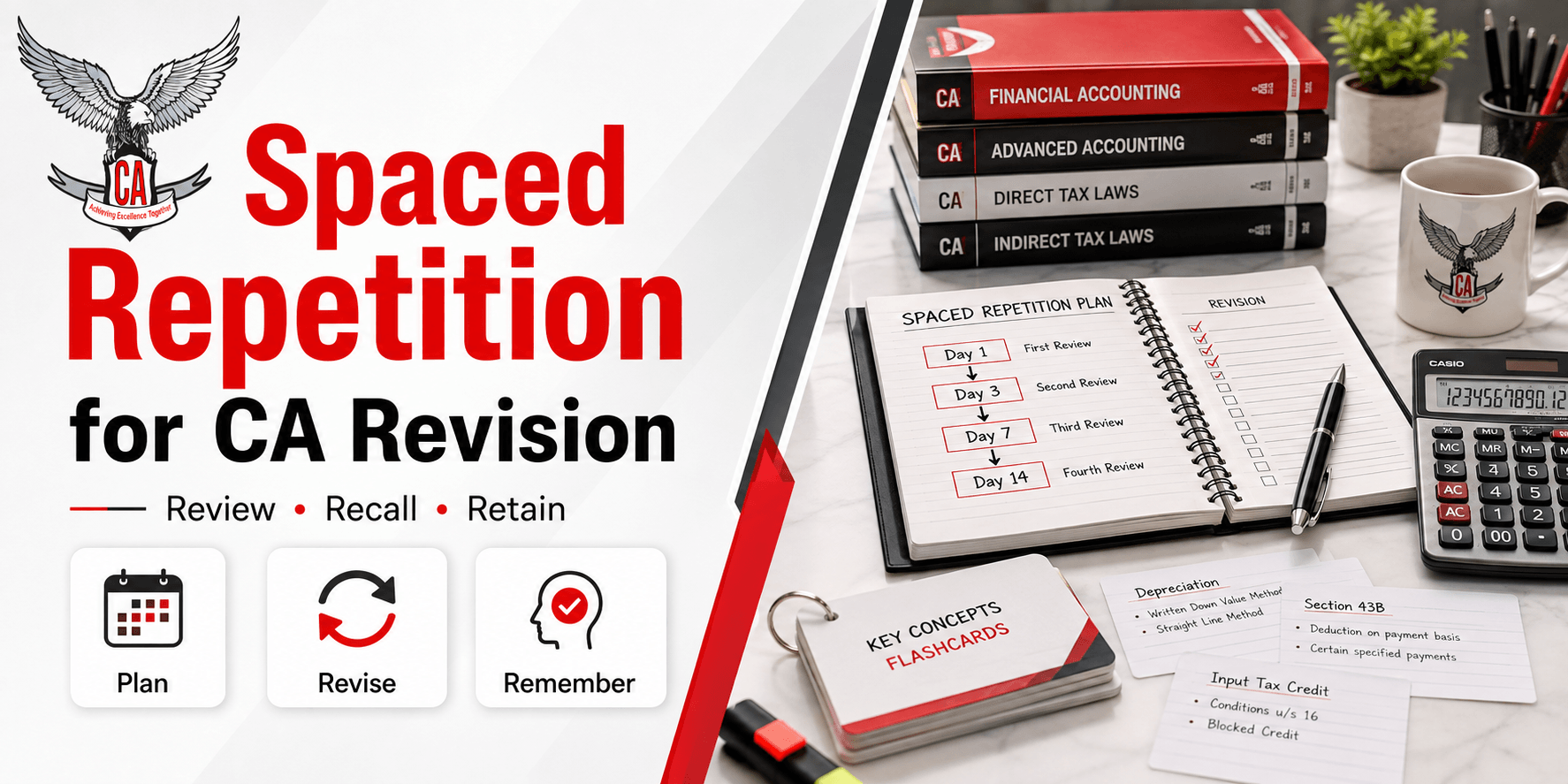
Spaced repetition is a revision technique in which previously learned material is reviewed at planned intervals instead of repeatedly studying the same topic within a short period. For example, after learning a concept on Day 0, you might review it on Day 1, Day 3, Day 7, Day 14, and Day 30. If you remember a topic easily, the next review can be delayed; if you struggle to recall it, the topic should return sooner. This makes revision more personalised because weaker chapters receive more attention while stronger topics require fewer repetitions.
Why It Works Better Than Re-Reading
Re-reading mainly exposes you to information you have already seen, whereas spaced repetition works best when each review requires you to retrieve the information from memory. Instead of looking at a formula first, try writing it without notes; instead of rereading a legal provision, explain its conditions from memory. This turns revision from passive recognition into active retrieval, which is much closer to what students need to do during CA exams.
Why Spaced Repetition Is Useful for CA Students
The CA syllabus contains both memory-heavy and application-heavy subjects, making repeated full-syllabus revision difficult. Spaced repetition allows students to maintain contact with older topics while continuing to learn new ones. It also helps identify chapters that require more frequent revision, reduces the need to relearn forgotten material from the beginning, and makes multiple revision cycles more manageable as the examination approaches.
Benefit | How It Helps CA Students |
Better retention | Keeps previously studied concepts active for longer |
Efficient revision | Reduces unnecessary revision of already-strong topics |
Weak-area focus | Gives difficult chapters shorter review intervals |
Better exam recall | Encourages retrieval without notes |
Lower revision pressure | Spreads revision across weeks instead of the final days |
Improved test preparation | Connects revision with question practice and mock tests |
What Should CA Students Revise Using Spaced Repetition?
Not every page of ICAI study material needs to become part of a spaced repetition system. Students should prioritise information that must be accurately remembered or repeatedly applied, such as formulas, Accounting Standards, Auditing Standards, legal provisions, tax rules, important exceptions, common adjustments, difficult question types, amendments, and mistakes identified during mock tests. Limiting the system to high-value material prevents the daily revision queue from becoming unnecessarily large.
How to Use Spaced Repetition for CA Exam Revision Step by Step
A practical spaced repetition system should remain simple enough to follow consistently. Start by dividing subjects into chapters and smaller concepts, identify what requires repeated recall, convert important points into questions or practice tasks, assign review dates, and adjust those dates based on your performance. A notebook, spreadsheet, calendar, flashcard app, or a combination of these can work as long as you can clearly see what needs revision and when.
Step 1: Break the Syllabus into Small Revision Units: Avoid scheduling an entire large chapter as one revision task because it becomes difficult to determine which part you actually remember. Divide chapters into manageable units such as one Accounting Standard, one taxation provision, one audit procedure, one formula group, one legal concept, or one practical question type. Smaller units make reviews faster and allow weak concepts to receive more attention without requiring you to revise the complete chapter.
Step 2: Turn Important Material into Active Recall Questions: Instead of copying large sections of notes, create questions that force you to retrieve information. For theory subjects, ask yourself to explain a concept, list conditions, identify exceptions, or apply a rule to a short scenario. For practical subjects, use formula cues, incomplete calculations, working-note prompts, or short numerical problems. Each prompt should ideally test one main concept so that you can clearly identify whether it has been mastered.
Step 3: Schedule Reviews at Increasing Intervals
A simple schedule such as Day 1, Day 3, Day 7, Day 14, and Day 30 can serve as a starting point. Students should not treat these intervals as fixed rules; the next review should depend on how well the topic was recalled. Strong topics can move to longer intervals, while weak or forgotten concepts should return sooner.
Stage | Suggested Review | What to Do |
Initial learning | Day 0 | Understand the topic and solve examples |
First review | Day 1 | Recall without notes |
Second review | Day 3 | Test definitions, formulas, or concepts |
Third review | Day 7 | Attempt an application-based question |
Fourth review | Day 14 | Check longer-term retention |
Fifth review | Day 30 | Retest key concepts and weak areas |
Step 4: Adjust the Interval Based on Recall: If you can explain or apply a topic correctly without hesitation, increase the interval before reviewing it again. If you remember only part of the answer, correct the missing information and schedule another review relatively soon. If you completely forget the concept, return to the underlying explanation, rebuild your understanding, and place the topic back into a short revision cycle.
How to Apply Spaced Repetition to Different CA Subjects
Different CA subjects require different forms of repetition. Theory-heavy subjects benefit from frequent short recall sessions, while numerical subjects need repeated application through questions. The goal is not merely to remember information but to ensure that you can retrieve and use it correctly under examination conditions.
Theory-Heavy Subjects
Law, Audit and Strategic Management
For Law, use spaced repetition for sections, conditions, exceptions, consequences, and case-based application; for Audit, revise Standards on Auditing, procedures, responsibilities, ethics, and reporting requirements; and for Strategic Management, focus on frameworks, keywords, differences, processes, and application-based concepts. Instead of memorising complete paragraphs, practise retrieving the structure and essential points of an answer.
Practical Subjects
Accounting, Costing, Financial Management and Taxation
Practical subjects require spaced problem-solving rather than simply looking at formulas or solved answers. Revisit representative questions, important adjustments, calculation sequences, formulas, and previously incorrect problems at planned intervals. Taxation requires a hybrid approach because students must remember provisions and also apply them correctly in calculations and case-based situations.
How CA Foundation, Inter and Final Students Can Adapt the Method
CA Foundation students can use spaced repetition for Accounting adjustments, Business Laws, Quantitative Aptitude formulas, and Economics concepts; CA Inter students can apply it to Advanced Accounting, Law, Taxation, Costing, Audit, Financial Management, and Strategic Management; while CA Final students should focus on advanced standards, complex calculations, professional requirements, taxation provisions, case-based questions, amendments, and recurring mock-test errors. The higher the CA level, the more important it becomes to combine recall with application rather than relying only on flashcards.
How to Combine Active Recall with Spaced Repetition
Active recall and spaced repetition work best together because spaced repetition determines when to revise while active recall determines how to revise. During every scheduled review, close your notes before answering, use blank-page recall, explain concepts aloud, reproduce formulas from memory, or solve a question before checking the solution. Any concept you fail to recall should become a future revision prompt rather than simply being reread and forgotten again.
How to Combine Spaced Repetition with CA Mock Tests
Mock tests provide evidence of whether your revision is actually working under exam conditions. After completing several revision cycles, attempt chapter-wise questions, analyse incorrect and incomplete answers, and add the underlying weak concepts to your revision queue. Once weak areas improve, retest the chapter and gradually progress toward full-syllabus mock examinations.
Using CA Test Series in Your Revision Cycle
CA Test Series can support this approach through chapter-wise tests, ICAI-pattern questions, full-syllabus mock exams, expert answer evaluation, and performance feedback. Instead of treating test results as final scores, convert feedback into specific revision tasks—for example, revisiting a missed adjustment, practising a difficult calculation, improving an incomplete theory answer, or retesting a chapter after another spaced revision cycle.
Flashcards vs Notes vs Revision Trackers
Flashcards work best for formulas, definitions, standards, conditions, and short recall questions; concise revision notes are more suitable for interconnected concepts and larger frameworks; and spreadsheets or trackers help organise review dates, weak areas, recall accuracy, and test scores. Many CA students may benefit from a hybrid system in which flashcards handle quick recall, short notes handle broader revision, a tracker manages scheduling, and mock tests evaluate application.
Common Spaced Repetition Mistakes to Avoid
The most common mistakes include rereading instead of actively recalling, creating hundreds of unnecessary flashcards, putting too much information on one card, reviewing every topic at identical intervals, ignoring practical questions, spending more time building revision systems than studying, and failing to use mock-test mistakes as future revision tasks. Spaced repetition should simplify CA revision rather than become another complicated workload.
How to Know Whether Your Revision System Is Working
Measure progress by checking whether you can recall concepts after increasingly longer intervals, whether repeated mistakes are decreasing, whether chapter-wise scores are improving, and whether mock-test performance becomes more consistent. When a topic can be recalled accurately and applied correctly across several sessions, extend its revision interval and shift more attention toward weaker material.
Conclusion
Spaced Repetition for CA Exam Revision is most effective when it becomes part of a complete revision system rather than being used as an isolated study technique. Prioritise important and weak topics, retrieve information actively, solve practical questions, analyse mock-test mistakes, and continuously adjust review intervals according to performance. A simple cycle of Learn → Recall → Practice → Analyse Mistakes → Reschedule → Retest can help CA Foundation, Inter, and Final students build stronger long-term retention while making exam preparation more organised, targeted, and manageable.