How to Use Past Mistakes in CA Mock Tests to Create a Targeted Revision Plan
A low score in a CA mock test can feel disappointing. But the score itself is rarely the most useful part of the test.
The real value is hidden in the questions you got wrong, the questions you guessed, the topics you forgot, and even the questions you answered correctly for the wrong reason.
A mock test should not simply tell you how many marks you can score today. It should tell you what you need to fix before the actual CA examination.
ICAI's Board of Studies regularly provides mock test papers, revision material, suggested answers and other academic resources for CA students. For example, ICAI has released Mock Test Paper Series I and II for students appearing in the September 2026 Foundation and Intermediate examinations.
The important question is: How do you turn those tests into a revision plan instead of simply checking the answer key and moving on?
Here's a practical system.
Quick Answer: Don't Revise Everything After a Bad Mock Test
One of the biggest mistakes students make is this:
“I scored 48%, so I need to revise the entire syllabus again.”
Usually, that's not the most efficient approach.
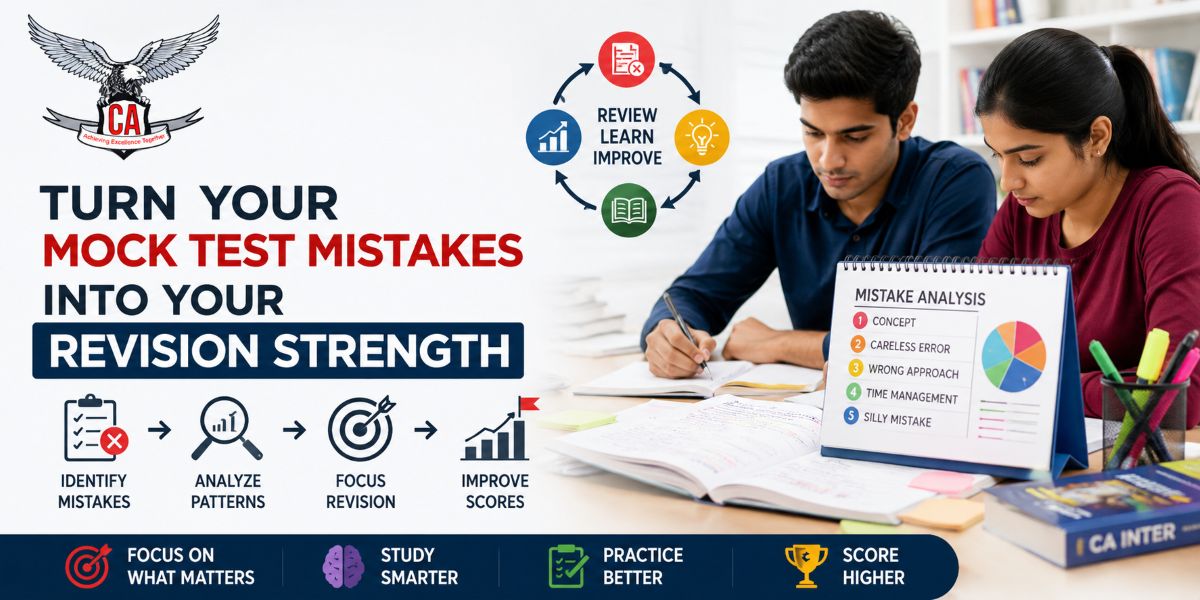
Instead, divide your mistakes into categories:
I didn't know the concept.
I knew it but couldn't recall it.
I understood the concept but applied it incorrectly.
I made a calculation or presentation mistake.
I misunderstood the question.
I ran out of time.
I guessed correctly but wasn't actually confident.
Each problem requires a different solution.
That is the foundation of a targeted revision plan.
Step 1: Don't Check Only Your Final Score
Imagine you scored 52/100 in a mock test.
At first glance, 52 seems like the only number that matters.
But consider what happened inside those 52 marks.
Perhaps you:
Lost 15 marks because of conceptual gaps.
Lost 8 marks because of calculation mistakes.
Lost 10 marks because you couldn't finish the paper.
Lost 5 marks because you misread questions.
Lost 10 marks because you forgot provisions you had studied.
Now the problem is much clearer.
You don't necessarily have a "52-mark preparation level."
You have several different problems happening at the same time.
And each one needs a different fix.
Step 2: Create a Mock Test Error Log
After every mock test, create a simple error log.
You don't need complicated software. A notebook, spreadsheet, or document is enough.
Question | Topic | What Went Wrong? | Error Type | Action |
|---|---|---|---|---|
Q4 | Partnership | Forgot adjustment | Recall | Revise concept |
Q9 | Ratio | Used wrong formula | Concept | Relearn |
Q15 | Accounting | Calculation error | Careless | Practise |
Q22 | Law | Missed key provision | Recall | Make flash note |
Q31 | Tax | Ran out of time | Time | Timed practice |
This changes your revision from:
“I need to study more.”
to:
“I need to fix these five specific problems.”
That's a much more useful starting point.
Step 3: Separate Knowledge Gaps From Silly Mistakes
Not every wrong answer means you don't know the chapter.
This distinction is extremely important.
Type 1: Knowledge Gap
You genuinely didn't know how to solve the question.
Example
A CA Foundation student sees a question based on a concept they have never studied properly.
They choose an answer randomly.
Solution: Relearn the concept.
Type 2: Recall Failure
You studied the topic but couldn't remember the relevant rule during the test.
Example
You know the legal provision when reading your notes, but during the mock you couldn't remember the exception.
Solution: Active recall, short revision notes and repeated testing.
Type 3: Application Error
You understood the rule but couldn't apply it to a changed situation.
Example
You know the accounting formula but select the wrong treatment when the question changes the underlying facts.
Solution: Solve more case-based and application-oriented questions.
Type 4: Calculation Error
You knew exactly what to do but made a basic arithmetic mistake.
Solution: Slow down at critical calculation steps and practise similar problems.
Type 5: Question-Reading Error
You missed words such as:
Not
Except
Incorrect
Minimum
Maximum
Before
After
This is particularly dangerous in MCQs.
Solution: Train yourself to underline or mentally highlight the actual requirement before solving.
Step 4: Look at Questions You Guessed Correctly
This is one of the most overlooked parts of mock-test analysis.
Suppose you answered five questions correctly.
But you guessed three of them.
Your result may show those three as correct.
Your revision analysis shouldn't.
Mark them as:
“Correct but uncertain.”
Why?
Because a lucky answer can create false confidence.
A useful classification is:
🟢 Correct + confident
🟡 Correct + uncertain
🔴 Incorrect
The yellow category deserves revision too.
Step 5: Find Your Repeating Mistakes
One bad answer doesn't necessarily indicate a major weakness.
A repeated mistake does.
Suppose you take three mock tests.
Mock 1
You lose marks in Partnership.
Mock 2
You again make mistakes in Partnership.
Mock 3
You understand most questions but still make errors in Partnership adjustments.
That's no longer random.
It's a pattern.
Your revision plan should now give Partnership additional attention.
This is why keeping old mock-test records is so useful.
Step 6: Calculate Your Topic-Wise Accuracy
You can make your analysis even more precise.
Suppose you attempted 20 questions from a particular topic across several tests.
You got:
15 correct
3 wrong
2 unanswered
Your effective accuracy is not something you should simply judge from the overall paper score.
Look at the topic separately.
Create a table like this:
Topic | Questions Attempted | Correct | Accuracy | Priority |
|---|---|---|---|---|
Ratio Analysis | 20 | 17 | 85% | Low |
Partnership | 20 | 11 | 55% | High |
Company Law | 20 | 14 | 70% | Medium |
Economics | 20 | 18 | 90% | Low |
Tax Basics | 20 | 12 | 60% | High |
Now you know where your revision hours should go.
Step 7: Build a Red-Amber-Green Revision System
A simple traffic-light system works extremely well.
🔴 Red — Weak
These are topics where:
You repeatedly score poorly.
You don't understand the concept.
You cannot solve standard questions independently.
You repeatedly make the same mistake.
Action: Relearn + practise + retest.
🟠 Amber — Needs Attention
You understand the basics but make occasional errors.
Action: Short revision + targeted questions.
🟢 Green — Strong
You consistently answer questions correctly and understand why the answer is correct.
Action: Maintain with periodic revision.
Don't spend four hours revising a green topic simply because you enjoy it.
Step 8: Turn Your Error Log Into a Weekly Revision Plan
Here's where the analysis becomes useful.
Suppose your mock test reveals:
Accounting calculations: weak
Business Law provisions: weak
Economics concepts: strong
Maths: moderate
English comprehension: moderate
Instead of studying everything equally, your week could look like:
Day | Main Revision | Practice |
|---|---|---|
Monday | Accounting weak chapters | 20 problems |
Tuesday | Business Law | 25 MCQs |
Wednesday | Maths weak area | Timed practice |
Thursday | Accounting | Mixed questions |
Friday | Business Law | Case-based questions |
Saturday | Economics + strong areas | Quick revision |
Sunday | Full mock test | Error analysis |
The exact schedule will depend on your exam level, remaining syllabus and available study time.
The important principle is:
Your mock test should determine your next revision priorities.
Step 9: Use the 24–72 Hour Rule
Don't postpone fixing a major mistake for two weeks.
If you discover a serious conceptual gap today, try to revisit it within the next 24–72 hours.
Why?
Because the mistake is still fresh in your memory.
For example:
Monday: You make a mistake in a Tax concept.
Tuesday: Relearn the concept.
Wednesday: Solve five similar questions.
Sunday: Test yourself again without looking at the notes.
Now you've converted a mistake into a learning cycle.
Step 10: Retest the Same Weak Area
This is the step that many students skip.
They identify a mistake, read the solution and move on.
That's not enough.
Suppose you got a question wrong because you didn't understand a particular accounting adjustment.
Your process should be:
Wrong question → Understand why → Relearn → Solve similar questions → Retest later
If you can solve the new questions independently, the problem is probably improving.
If you make the same mistake again, the topic remains red.
Real-Life Example: Turning a 48% Mock Into a Better Plan
Imagine Riya takes a CA mock test and scores 48/100.
Her initial reaction is:
“I am nowhere near ready.”
Instead of starting the entire syllabus again, she analyses her paper.
She discovers:
12 marks lost through conceptual gaps
8 marks lost through calculation errors
10 marks lost because of time management
7 marks lost through poor recall
5 marks lost through misreading questions
10 marks lost on genuinely difficult questions
Now her plan becomes:
Week 1
Relearn the major conceptual gaps.
Week 2
Practise calculation-heavy questions.
Week 3
Do timed sectional tests.
Week 4
Focus on recall and repeated mistakes.
Her next mock score improves—but more importantly, she understands why it improved.
That's the real purpose of mock testing.
What to Do With Your Previous Mock Tests
Don't throw them away after checking the answers.
Create a Mock Test Mistake Bank.
For every important mistake, record:
Question → Topic → Mistake → Correct Concept → Prevention Rule
For example:
Topic: Partnership
Mistake: Applied the wrong adjustment
Correct concept: Recheck the treatment of the adjustment before preparing the final calculation
Prevention rule: Read the adjustment twice before starting the working
After five or six tests, you'll have something much more valuable than a collection of scores.
You'll have a personal list of the mistakes you repeatedly make.
Use Official Mock Tests as a Benchmark
Your additional practice should complement—not replace—the official examination resources.
ICAI's Board of Studies provides mock test papers, revision test papers, suggested answers, study material and other academic resources through its student and BoS platforms.
For the September 2026 cycle, for example, ICAI has published Mock Test Paper Series I and II for Foundation and Intermediate students.
Students preparing through CatestSeries.org can similarly use additional mock tests and practice questions to identify weak areas. The important part is not simply taking more tests—it is analysing each test properly afterward.
Internal linking opportunity: Add a natural link here to the relevant CatestSeries mock-test or practice-question category, if available.
A 30-Minute Mock Test Analysis Method
You don't need to spend three hours analysing every test.
Try this immediately after completing one.
First 5 minutes: Check the score
Record:
Total marks
Attempted
Correct
Wrong
Unanswered
Next 10 minutes: Mark the mistakes
Classify each important error:
Concept
Recall
Application
Calculation
Time
Question-reading
Next 10 minutes: Identify patterns
Ask:
Which topic produced the most errors?
Which mistake appeared repeatedly?
Which questions were guessed?
Where did I lose time?
Final 5 minutes: Set the next actions
Write down three specific revision tasks.
Not:
“Study Tax.”
Instead:
“Revise TDS conditions and solve 15 application questions.”
That's a targeted revision plan.
Common Mistakes Students Make After Mock Tests
Only Looking at the Score
A score tells you the outcome, not the reason.
Checking the Answer Key Without Understanding the Error
Knowing the correct answer isn't the same as understanding why your answer was wrong.
Revising Strong Topics Because They Feel Comfortable
Students naturally prefer subjects they already understand.
That can waste valuable revision time.
Ignoring Time-Management Errors
If you repeatedly leave 15 marks unanswered, that's not just a knowledge problem.
It's an exam strategy problem.
Taking Too Many Tests Without Analysis
Ten unanalysed tests can be less useful than three properly analysed tests.
Repeating the Same Mistake
If the same error appears in multiple tests, it should move to the top of your revision list.
A Simple CA Mock Test Revision Checklist
After every mock test, ask yourself:
What was my score?
Which questions did I get wrong?
Which correct answers were guesses?
Which topics caused repeated mistakes?
Did I misunderstand any questions?
Did I make calculation errors?
Did I run out of time?
Which three topics need immediate revision?
Have I solved similar questions after reviewing the mistake?
Have I retested the weak topic later?
If you can answer these questions consistently, your mock tests become a feedback system rather than just another examination.
What You Should Do After Your Next Mock Test
Don't close the paper after checking your marks.
Spend another 20–30 minutes asking:
What exactly caused me to lose each mark?
Then convert those answers into actions.
If the problem is knowledge, relearn.
If it's recall, actively revise.
If it's application, solve more cases.
If it's calculation, practice carefully.
If it's time management, take timed tests.
If it's question interpretation, slow down and read more carefully.
And if the same mistake keeps appearing, move that topic to the top of your revision list.
The goal of a CA mock test isn't to prove that you're already ready for the examination.
Its real purpose is to show you where you're not ready yet.
Once you start treating every wrong answer as diagnostic information, your mock-test scores become much more useful. Instead of repeatedly studying the entire syllabus, you can build a revision plan around your actual weaknesses—and make every subsequent study session more focused.