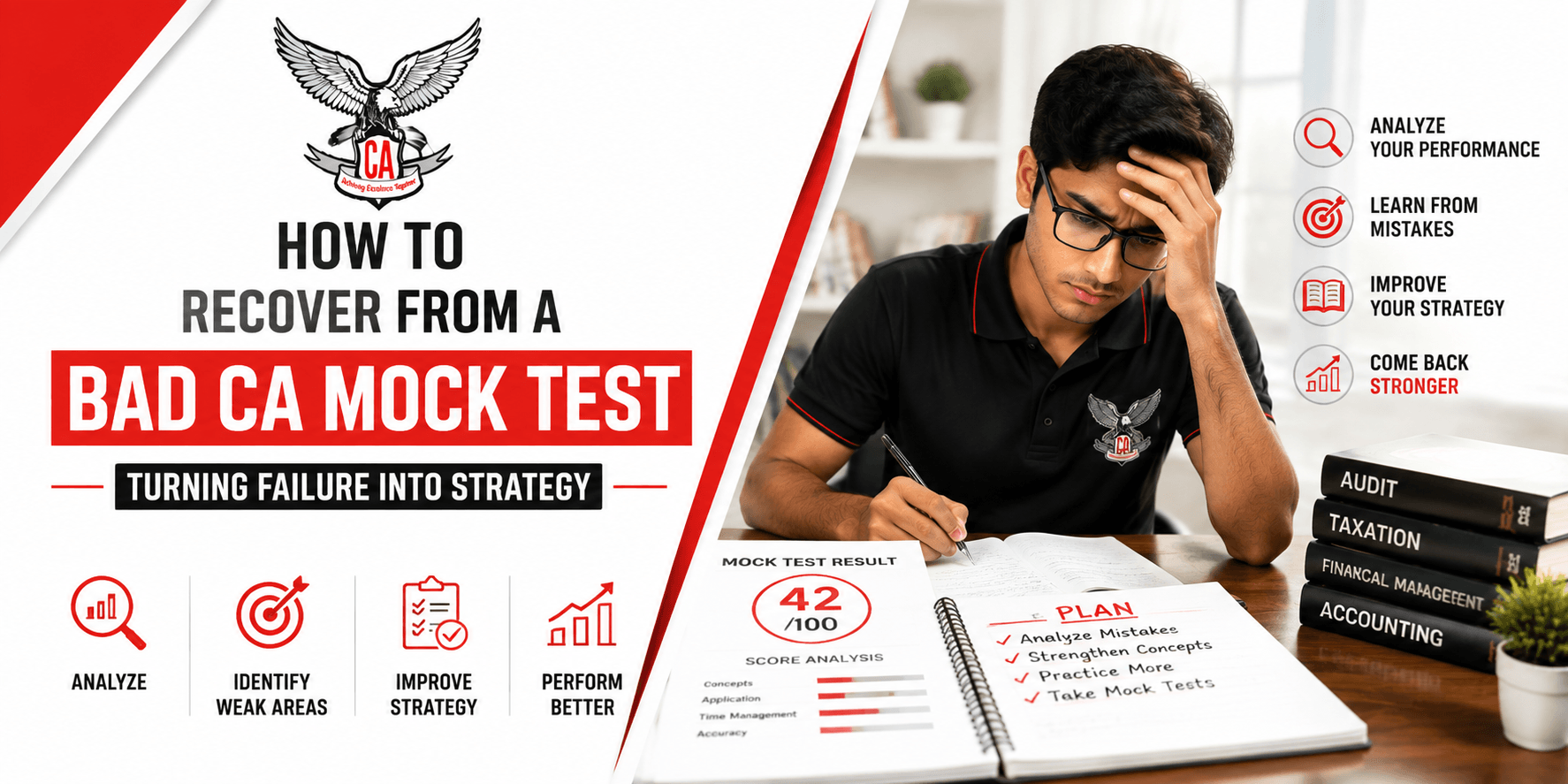
A bad CA mock test result can be frustrating, especially when you have spent weeks preparing and expected better performance. Many students lose confidence after scoring poorly and start questioning their ability to clear the CA examination. However, a mock test score is not a reflection of your final result; it is a tool that shows where improvement is needed. Learning how to recover from a bad CA mock test requires a positive mindset, proper mistake analysis, and a focused revision strategy that helps you perform better in future attempts.
Why a Bad CA Mock Test Score Feels So Discouraging
Scoring low in a CA mock test can create emotional pressure because students often connect their marks with their chances of success. A poor result may lead to loss of confidence, fear of CA failure, comparison with friends, and the feeling that their preparation is not enough. These reactions are natural, but allowing negative thoughts to control your preparation can reduce your motivation and affect your future performance.
Why One Mock Test Does Not Predict Your CA Result
One bad mock test cannot determine your CA exam result because mock tests are designed for practice and improvement, not final judgment. They help you experience exam conditions, identify weaknesses, and understand areas that require more attention. By analysing mistakes and correcting them properly, students can improve their knowledge, exam technique, and confidence before the actual examination.
The First Step After a Bad CA Mock Test: Avoid Panic and Analyse
After receiving a low score, many CA students react emotionally and make decisions that do not help their preparation. Restarting the entire syllabus unnecessarily, changing study methods immediately, ignoring the mock test completely, or comparing scores with others can create more stress and confusion. Instead of reacting negatively, students should focus on understanding the real reasons behind their performance.
What You Should Do Instead
The right approach after a poor mock test is to calmly review your performance and identify areas that need improvement. Analyse where marks were lost, understand the mistakes you made, and create specific actions to fix those weaknesses. A proper review process helps transform a disappointing score into a useful learning experience.
How to Analyse Your CA Mock Test Mistakes Effectively
Your final mock test score only shows the result, but it does not explain the reasons behind your performance. A student scoring low may have problems with concepts, revision, time management, calculation accuracy, or answer presentation. Instead of focusing only on marks, analyse how those marks were lost and identify the specific areas that require improvement.
Classify Your Mistakes Into Different Categories
Every mistake in a CA mock test should be classified according to its cause because different problems require different solutions. Concept gaps require proper learning, recall problems require better revision methods, application errors need more practice, calculation mistakes require accuracy improvement, time management issues need timed practice, and question-reading mistakes require better exam awareness. This classification helps students create a targeted preparation plan.
Mistake Type | Meaning | Solution |
Concept Gap | Did not understand topic | Relearn concept |
Recall Problem | Forgot studied information | Active revision |
Application Error | Could not apply concept | Solve more practical questions |
Calculation Mistake | Careless numerical error | More practice |
Time Management Issue | Could not complete paper | Timed practice |
Question Reading Error | Misunderstood requirement | Improve reading approach |
Create a CA Mock Test Error Log to Prevent Repeated Mistakes
A mock test mistake bank is a personal record where students track errors from every CA mock test they attempt. Instead of checking answers and moving on, students record their mistakes, understand why they happened, and note the correct approach. This helps identify repeated problems and creates a stronger revision system.
What Information Should You Track?
A useful CA mock test error log should include important details such as question number, subject or topic, reason for the mistake, correct concept, action required, and retest date. Maintaining this information allows students to organise their revision properly and focus more time on areas where improvement is required.
Why Tracking Mistakes Improves CA Preparation
Tracking mistakes improves CA preparation because it helps students identify patterns in their performance. When the same errors appear repeatedly, students can take corrective action before the final examination. This approach makes revision more targeted, saves time, and improves overall exam readiness.
How to Turn a Bad Mock Test Into a Smart Revision Plan
Identify High-Priority Topics: After analysing your mock test, divide topics based on their importance and weakness level. Red topics are areas where your understanding is weak and require complete revision, yellow topics are areas where you understand the basics but need more practice, and green topics are strong areas that only require regular revision. This priority-based approach helps students use their study time efficiently.
Follow the 24–72 Hour Correction Rule: Mistakes should be corrected as soon as possible because the memory of the mistake is still fresh. Reviewing errors within 24 to 72 hours helps students understand the problem quickly, revise the related concept, and practise similar questions before forgetting the learning point. This creates a stronger connection between mistakes and improvement.
Retest Your Weak Areas Before Moving Forward: Reviewing mistakes alone is not enough; students need to confirm whether they have actually improved. The correct process is to identify the wrong question, understand the reason behind the error, revise the concept, practise similar problems, and retest the topic. This ensures that weaknesses are properly corrected before moving ahead.
How to Improve Confidence After a Low CA Mock Test Score
A poor mock test performance does not always mean that your preparation is weak. Sometimes students know the concepts but perform poorly due to exam pressure, lack of writing practice, poor time management, or difficulty applying knowledge under pressure. Understanding the difference between preparation quality and temporary performance helps students maintain confidence.
Focus on Small Wins Instead of Immediate Perfection
Confidence is rebuilt through consistent improvement rather than expecting instant success. Students should focus on small achievements such as improving one weak chapter, increasing answer accuracy, completing papers within time, and reducing repeated mistakes. These small improvements gradually create stronger confidence for the CA examination.
Common Mistakes Students Make After a Bad CA Mock Test
Studying the Entire Syllabus Again: One common mistake students make after a poor mock test is restarting the entire syllabus from the beginning. This approach wastes valuable time because the problem is usually limited to specific topics or skills. A better strategy is to analyse mistakes and revise only the areas that need improvement.
Ignoring Mock Test Analysis: Many students check their marks and answers but fail to analyse why they made mistakes. Without understanding the reason behind errors, students often repeat the same problems in future mock tests and fail to achieve meaningful improvement.
Taking Multiple Mock Tests Without Improvement: Attempting many mock tests without proper analysis does not guarantee better performance. The real value of mock tests comes from reviewing mistakes, understanding weaknesses, and applying corrections. Quality analysis is more important than simply increasing the number of tests attempted.
Revising Only Comfortable Subjects: Students often spend more time revising subjects they already feel confident about because they seem easier and more enjoyable. However, improvement requires attention to weaker areas where marks are being lost. A balanced revision strategy helps achieve better overall CA exam performance.
A Practical 7-Day Recovery Plan After a Bad CA Mock Test
Day 1: Analyse Your Mock Test: The first day after a bad CA mock test should focus on understanding your performance rather than immediately starting new revision. Review every mistake carefully, categorise errors based on their causes, and create a clear mistake list. Identify whether marks were lost due to weak concepts, lack of revision, calculation mistakes, poor time management, or question interpretation issues. This analysis will help you understand exactly what needs to be improved.
Day 2–4: Fix Weak Concepts: After identifying your weak areas, spend the next few days rebuilding your understanding of important topics. Revise the chapters where you made repeated mistakes and practise similar questions to strengthen your concepts. Instead of revising everything equally, focus on high-priority areas that have the greatest impact on your CA exam performance.
Day 5–6: Practice Under Exam Conditions: Once your weak concepts start improving, shift your focus towards exam-style practice. Attempt questions within a fixed time limit to improve your speed, accuracy, and ability to handle pressure. Practising under exam conditions helps you develop the confidence and discipline required to perform effectively during the actual CA examination.
Day 7: Take Another Practice Test: The final step of your recovery plan is to test your improvement through another mock test or practice exam. Compare your performance with the previous attempt, measure whether your mistakes have reduced, and review any remaining weaknesses. Continuous testing and correction help create steady progress throughout your CA preparation journey.
How CA Test Series Helps You Improve After a Poor Mock Test Performance
Practice With ICAI Pattern Mock Tests: CA Test Series helps students prepare with mock tests designed according to the ICAI examination pattern. Practising in a realistic exam environment allows students to understand the paper structure, improve time management, and experience the pressure of the actual examination. Full syllabus mock tests and chapter-wise practice tests help students strengthen their preparation at every stage of their CA journey.
Identify Weak Areas Through Performance Analysis: Effective improvement requires knowing where you are losing marks. CA Test Series helps students track their performance, identify mistakes, and understand weak areas through detailed analysis. By reviewing scores and performance patterns, students can create a more focused revision strategy and spend their study time on topics that require the most attention.
Improve Answer Writing and Exam Strategy: Success in CA exams depends not only on knowledge but also on how effectively students present their answers. CA Test Series supports students in improving answer presentation, practising exam techniques, managing time properly, and building confidence. Regular practice with evaluation and feedback helps students develop the skills required to perform better in the final examination.
Conclusion
A bad CA mock test is not a sign of failure; it is an opportunity to understand your weaknesses and improve before the actual examination. The most successful students are not those who never make mistakes, but those who learn from their mistakes and develop better strategies. By analysing your mock test, creating a targeted revision plan, practising consistently, and improving through regular feedback, you can turn a disappointing score into a stepping stone toward better CA exam performance. With the right approach and resources like CA Test Series, every mock test can become a valuable learning experience that brings you closer to your goal.