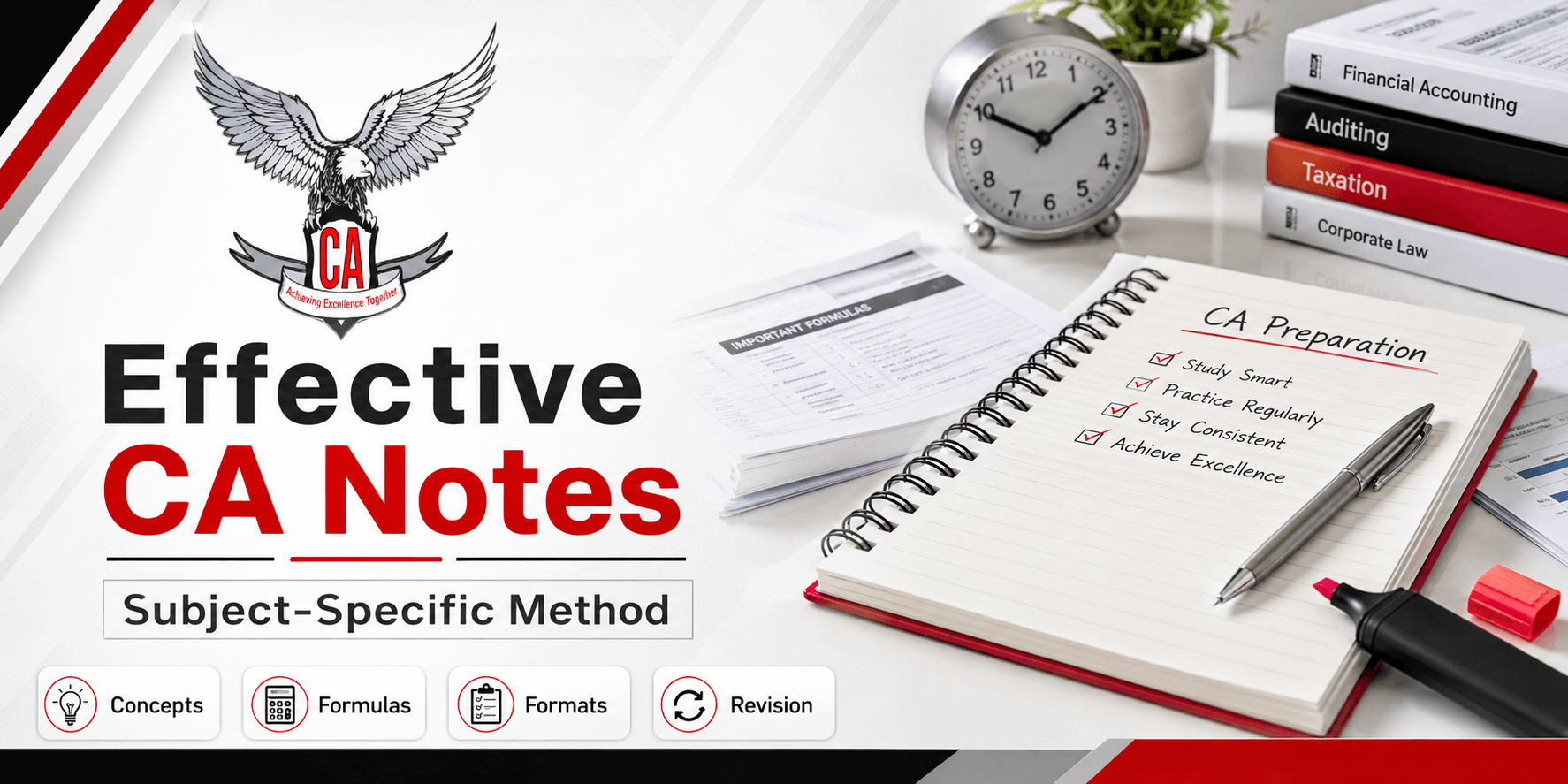
Preparing for CA exams requires more than reading ICAI study material, attending classes, and solving questions. Students need to understand large volumes of information, remember technical concepts, apply them correctly, and revise the entire syllabus several times. This is where effective note-making becomes extremely useful. Knowing how to make effective notes for CA exams can help you simplify difficult concepts, organise important formulas and provisions, identify weak areas, and create a reliable resource for quick revision. However, Accounting notes should not look like Audit notes, and Taxation notes should not follow the same method as Financial Management. The most effective approach is to create notes according to the nature of each CA subject.
Why Effective Note-Making Is Important for CA Exam Preparation
Effective notes turn lengthy chapters into focused revision material. When students write concepts in their own words, organise formulas and provisions, and record important mistakes, they actively process the subject instead of simply reading it. Well-prepared CA revision notes can also reduce dependence on full books during later revisions, improve recall, highlight difficult areas, and make it easier to complete multiple revisions before the examination.
How to Make Effective Notes for CA Exams
The objective of note-making is not to rewrite the entire ICAI module. Your notes should contain the information you are most likely to need again during revision.
Step 1: Understand Before You Write: Read the topic properly before preparing notes. Understand the main concept, its purpose, important conditions, and how it may be applied in questions. Writing notes before understanding the topic often results in unnecessary copying and lengthy notebooks that are difficult to revise.
Step 2: Identify Exam-Relevant Information: Focus on concepts, formulas, provisions, conditions, exceptions, adjustments, standards, important ICAI illustrations, and common question patterns. Information that is easy to understand and remember does not always need to be included in your notes.
Step 3: Use Your Own Words: Explain concepts in language that you can easily understand later, while preserving important technical terms used by ICAI. This is especially important in subjects such as Law, Audit, Taxation, and Accounting Standards, where technical wording may affect the accuracy of an answer.
Step 4: Keep Notes Short but Complete: Good notes should be shorter than your original study material while still containing enough information to rebuild the concept during revision. Use headings, keywords, formulas, tables, flowcharts, and short reminders instead of long paragraphs wherever possible.
Step 5: Add Question References and Mistakes: Mention important ICAI illustrations, previous year questions, RTPs, MTPs, and mock-test mistakes beside the relevant topic. You do not need to copy complete questions; a short reference and the main learning point are usually enough.
The 3-Layer Note-Making Method for CA Students
Instead of using the same notes throughout your preparation, gradually compress them as your understanding improves.
Note Layer | Purpose | What to Include |
Detailed Concept Notes | First-stage learning | Concepts, formulas, provisions, examples, exceptions |
Revision Notes | Second and third revisions | Keywords, formulas, sections, difficult adjustments, mistakes |
Last-Day Notes | Final quick revision | Formula sheets, limits, amendments, exceptions, error points |
Layer 1: Detailed Concept Notes: Prepare detailed notes when studying a chapter properly for the first time. Include enough explanation to understand the concept without reopening the complete study material repeatedly.
Layer 2: Revision Notes: During later revisions, remove explanations you already remember and retain formulas, keywords, provisions, exceptions, important adjustments, and difficult concepts.
Layer 3: Last-Day Quick Revision Notes: These should be extremely concise. Include only information that requires last-minute recall, such as formulas, important sections, amendments, limits, tricky provisions, and recurring mistakes.
Subject-Specific Note-Making Methods for CA Exams
Different CA papers test different abilities, so using one note-making format for every subject is inefficient.
How to Make Notes for Practical CA Subjects
Practical subject notes should focus on application, calculations, formats, adjustments, formulas, and problem-solving methods.
Subject | Best Note-Making Method | Important Items |
Accounting / Advanced Accounting | Treatment and adjustment notes | Formats, AS concepts, workings, exceptions |
Cost and Management Accounting | Formula + problem-type notes | Formulas, decision rules, common traps |
Financial Management | Formula + interpretation notes | Formula, variables, result interpretation |
Taxation | Provision-based notes | Sections, rates, limits, conditions, amendments |
Accounting and Advanced Accounting: Organise notes chapter-wise around concepts, journal treatment, formats, adjustments, Accounting Standards, and frequently used workings. Add difficult adjustments and mistakes found while solving questions so that they can be reviewed before the next test.
Cost and Management Accounting: Create chapter-wise formula sheets and connect each formula with the type of question in which it is normally used. Record confusing formulas, assumptions, relevant cost treatments, and mistakes involving units or calculations.
Financial Management: Along with every important formula, note what each variable represents, where the formula is used, and how the final result should be interpreted. This helps prevent situations where students can calculate an answer but cannot explain the financial decision.
Taxation: Tax notes should be arranged around provisions, rates, limits, conditions, deductions, exceptions, and amendments. Tables and flowcharts are particularly useful where several conditions determine the final tax treatment.
How to Make Notes for Theory CA Subjects
Theory notes should focus on keywords, logical answer structure, technical terminology, provisions, conditions, and exceptions rather than lengthy explanations.
Subject | Recommended Structure |
Corporate and Other Laws | Provision → Conditions → Exception → Consequence → Application |
Auditing and Ethics | Objective → Requirement → Procedure → Keywords → Conclusion |
Strategic Management | Framework → Components → Process → Application |
Corporate and Other Laws: Prepare provision-based notes containing the relevant rule, conditions, exceptions, consequences, and practical application. Use comparison tables when similar legal concepts are easy to confuse.
Auditing and Ethics: Highlight important ICAI terminology and create keyword-based summaries for descriptive questions. Your keywords should follow the same logical order in which you would ideally write the answer in the examination.
Strategic Management: Use frameworks, flowcharts, diagrams, and keyword lists to summarise models and processes. Keep the purpose, major components, sequence, and application of each framework together.
What Should You Include in Your CA Notes?
Every subject will require a slightly different approach, but most effective CA study notes should contain important concepts, formulas, provisions, Accounting or Auditing Standards, limits, dates, conditions, exceptions, amendments, ICAI illustrations, RTP and MTP references, previous year questions, and personal mistakes from mock tests.
How to Use ICAI Study Material While Making Notes
ICAI study material should remain your primary reference for prescribed concepts, technical terminology, illustrations, and examination-oriented content. Instead of copying complete paragraphs, extract definitions, formulas, provisions, standards, exceptions, important questions, and application points. For important illustrations, note the question or illustration number and briefly mention what makes it useful.
Handwritten vs Digital Notes for CA Exams
Both methods can work well. Handwritten notes are useful for active learning, formulas, calculations, and quick diagrams, while digital notes are easier to search, organise, edit, and update when amendments are released. A hybrid system can be particularly practical—for example, handwritten formula sheets combined with digital amendment and question-reference notes.
How to Turn Mock Test Mistakes Into Revision Notes
Do not check only your marks after completing a mock test. Maintain a short error log containing the topic, mistake, correct approach, and reason for the error. Separate conceptual mistakes, calculation errors, forgotten provisions, and presentation problems. If the same mistake appears repeatedly, move it into your final revision notes so that it receives additional attention.
How Often Should CA Students Revise Their Notes?
Your first revision should focus on understanding and completing missing points, while the second should focus more on active recall. The third revision should be faster and centred on difficult areas, formulas, exceptions, amendments, and mistakes. Before mock tests, revise chapter summaries and error notes, while the final revision should rely primarily on one-page summaries, formula sheets, provision charts, and last-minute notes.
Common Note-Making Mistakes CA Students Should Avoid
Avoid copying the entire study material, making notes before understanding the chapter, using too many colours, writing unnecessarily detailed explanations, ignoring important ICAI terminology, failing to update amendments, and making notes that are never revised. Most importantly, do not replace question practice with note-making because CA exams test your ability to apply knowledge, not simply remember written material.
Quick Checklist for Effective CA Notes
Before considering your notes complete, ask whether they are easy to understand, significantly shorter than the original material, updated for your applicable syllabus, linked with important ICAI questions, and focused on information you are likely to forget. Practical notes should contain formulas and problem-solving steps, while theory notes should contain keywords, provisions, and answer structures. Final revision notes should be short enough to review quickly before the examination.
Conclusion
Learning how to make effective notes for CA exams is about creating a personalised revision system rather than writing more pages. Start with detailed concept notes, improve them through ICAI question practice and mock tests, and gradually compress them into revision sheets and last-day summaries. By adapting your note-making method for Accounting, Costing, Financial Management, Taxation, Law, Auditing, and Strategic Management, you can make your CA preparation more organised, focused, and easier to revise.