How to decide between revision and reattempt
Every CA aspirant reaches this point: the attempt is close, or a result has just disappointed you, and one question decides your next few months. Should you revise what you’ve studied, or restart your preparation properly?
Revision and reattempt preparation aren’t opposites. Most students need some of both: revisiting concepts while practicing exam-style questions. The real question is where to put most of your effort. Here is how to decide.

Step 1: Evaluation of Syllabus Coverage
Be realistic in considering two issues: how far you have been able to cover the syllabus and how well you have remembered your studies. If you studied any chapter but cannot recollect anything about it, then consider that partially covered.
Step 2: Test Conceptual Understanding
Try to solve a problem that is new to you, such as one that appears in ICAI RTP or MTP. If you are able to solve the problem, then your concepts are clear. Otherwise, you are simply identifying the solution rather than understanding the concept.
Step 3: Review Recent Timed-Test Performance
See how you have performed in your recent mock examinations. Have you been completing your exam paper on time? Have marks been deducted because of wrong concepts or due to insufficient answers?
Step 4: Identify the Size of the Gap
Some weak topics require attention and fixing. If a person performs poorly in many chapters, then it means that he lacks comprehension. It is pointless to fix both issues in the same way.
Step 5: Choose Your Primary Focus
You should concentrate on one of these or a combination thereof:
Building concepts
Revision with structure
Timed practices
Step 6: Build a Weekly Plan
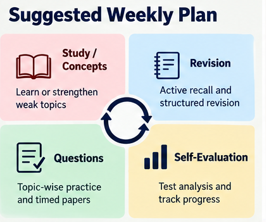
Split your week into four segments: study, revision, questions, and self-evaluation. This will vary based on your circumstances (details below). Ensure you allocate a constant block of time for test evaluation.
Situation | Study/concepts | Revision | Questions | Self-evaluation |
A – Coverage gap | Largest share | Small | Topic-wise, regular | Fixed weekly slot |
B – Recall and application gap | Small | Largest share | Topic-wise | Fixed weekly slot |
C – Timing gap | Minimal | Moderate | Timed papers (largest) | Fixed weekly slot |
D – Consistency gap | only. | Moderate | Mixed | Test analysis first. |
Step 7: Review Progress Regularly
Every two weeks, take a short assessment on the topics you worked on. If scores aren’t moving, change the method, not just the hours.
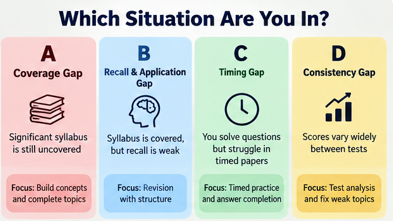
Situation | What it looks like | What to prioritise |
A | Significant syllabus is still uncovered | Complete essential topics and build conceptual understanding, with regular practice alongside |
B | Syllabus is covered, but recall is weak | Active recall, spaced revision and topic-wise questions |
C | You solve questions but struggle in timed papers | Timed practice, question selection and answer completion |
D | Scores vary widely between tests | Investigate consistency, topic-level gaps and exam conditions before repeating the same study plan |
Decision Framework: Which Situation Are You In?
Quick Self-Assessment Quiz
Answer Yes or No:
Have you completed less than most of the syllabus?
Do you struggle to explain concepts without looking at notes?
Are you finding that new questions are much more difficult than the practiced ones?
Are you running out of time during mock exams?
Does your score fluctuate wildly from exam to exam?
Your result:
Q1 is Yes: Use Situation A. Complete the syllabus first.
Q2 or Q3 is Yes: Use Situation B. Concentrate on active learning and topic-based study.
Q4 is Yes: Use Situation C. Timed papers should be your main concern now.
Q5 is Yes: Use Situation D. Analyse your tests before changing strategy.
Yes to several: Begin with the earliest question you answered Yes to, and add timed practice once that gap narrows.
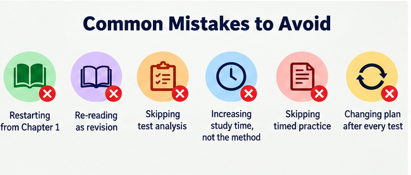
Common Mistakes to Avoid
However, knowing whether one should continue revising or rewrite is just part of the process; what is done next plays an equally important role in making sure that effort does not go to waste. Here is where most students fail, even when they understand their predicament.
Restarting on those few topics where the concepts are lacking. It is not a good idea to restart from chapter one since there are other sections that are well known.
Re-reading as revision. It is not advisable to re-read books, as it will only make the material familiar. Close your notes and revise what you have learned or do exercises.
Skipping test analysis. The test score says nothing about how to go forward. Identify whether poor scores are because of a lack of concepts, time, or inadequate answers.
Increasing the study time, not the method. When scores do not move, try to revise the way you study, not add more time.
Skipping timed practices. It is advisable to write full papers during examination time even once in a while.
Modifying the plan after each test. Poor performance in a single test is not necessarily a trend. Do two or three tests first.
Final Thoughts
You do not have to make an either-or choice in relation to revision and starting over. Determine your exact position, decide on one main area, and keep yourself updated after every two weeks. For self-evaluation, take practice exams in a CAT exam pattern at CATestSeries.org and let the outcome decide your next move.