Preparing for the CS Professional examination requires more than reading study material. Students must understand legal provisions, apply concepts to practical situations, write structured answers, and complete the paper within the prescribed time. A well-designed CS Professional test series helps develop these skills through realistic mock examinations and detailed feedback. The right test series should align with the latest ICSI syllabus, include relevant question types, provide expert evaluation, and help students measure improvement. It should work alongside official ICSI study material rather than replace it.
What to Check Before Choosing a CS Professional Test Series
Several factors can help students compare different test-series providers.
Selection Factor | What to Look For | Why It Matters |
| Syllabus alignment | Latest applicable ICSI syllabus and amendments | Prevents preparation from outdated content |
| Question quality | Case studies, practical and analytical questions | Builds application and professional reasoning |
| Evaluation | Detailed comments and model answers | Shows how to improve answers |
| Test frequency | Topic, subject, module and full-length tests | Supports preparation at every stage |
| Accessibility | Online access, digital submission and result tracking | Makes practice convenient |
| Student support | Doubt-solving and revision resources | Helps resolve preparation difficulties |
Check ICSI Exam Pattern Alignment
Updated syllabus coverage: The test series must cover the syllabus under which the student is registered. It should include updated provisions, recent amendments, revised subjects, and the current examination structure. Students should compare the provider’s syllabus with the latest ICSI academic resources before enrolling. Using outdated papers can lead to confusion and waste valuable preparation time.
Relevant question style
A strong CS Professional test series includes different question formats, such as:
- Conceptual questions
- Case studies
- Practical problems
- Analytical questions
- Compliance-based situations
- Drafting and professional writing tasks
The questions should test application, not only memorisation. For example, instead of asking students to define corporate restructuring, a paper may present a business situation and ask them to identify the relevant legal provisions and explain the correct procedure.
Look for Quality Evaluation and Feedback: Marks alone cannot show why a student is losing points. The provider should offer detailed evaluation of the answer script.
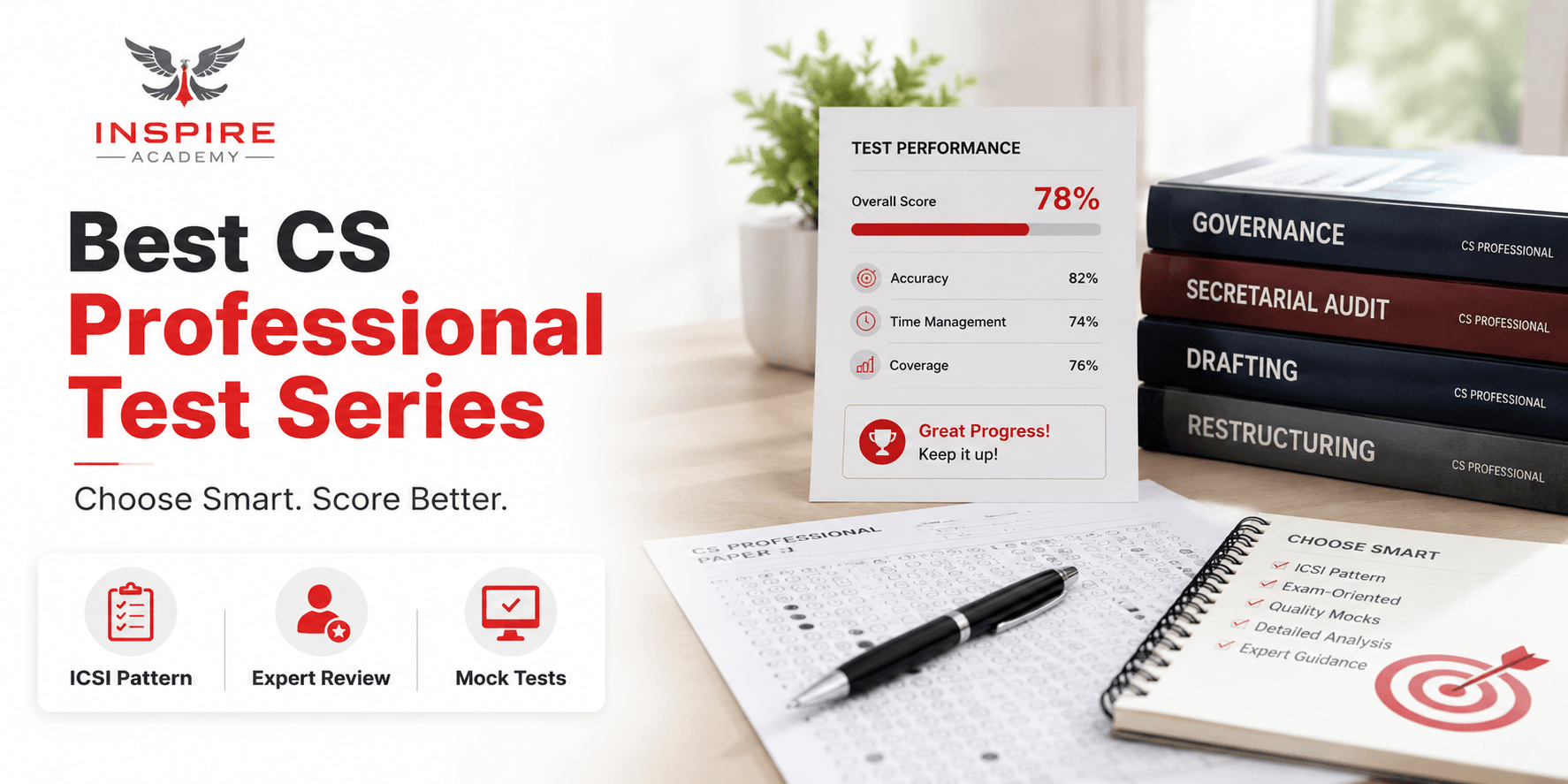
Detailed performance reports: A useful report may include question-wise marks, subject-wise performance, time-management observations, completion status, strengths, and weaknesses. This helps students understand their actual preparation level.
Improvement suggestions
Good feedback should explain whether the student:
- Used the correct provision
- Applied the law to the facts
- Addressed every part of the question
- Used suitable headings
- Reached a clear conclusion
- Wrote within the expected level of detail
Specific comments are far more useful than a general instruction to “study harder.”
Ensure Regular Tests and Flexible Access: Students need repeated practice to improve. Look for a test series that offers topic-wise, subject-wise, module-wise, and full-syllabus papers. Online access is also important. Students should be able to view question papers, submit answers, receive evaluated scripts, check results, and review feedback using a phone, tablet, or computer.
Consider Student Support and Learning Resources: Additional support can make a test series more effective. Useful features may include doubt-solving sessions, model answers, revision notes, amendment updates, important-question analysis, and answer-writing guidance. These resources should support official ICSI study material, not replace it.
How to Use a CS Professional Test Series Effectively
Attempt Tests According to a Study Plan: Do not attempt random tests without a clear purpose. Start with topic-wise tests after completing individual chapters. Move to subject-wise tests after finishing each subject, followed by module-wise and full-syllabus papers during revision.
A practical preparation cycle is:
- Study the topic from the official material.
- Prepare short revision notes.
- Attempt a topic or subject test.
- Review the evaluated script.
- Revise weak areas.
- Attempt a similar test again.
This approach connects learning, practice, and improvement.
Analyse Mistakes After Every Test: The real benefit of a mock test begins after submission. Students should review every incorrect, incomplete, or poorly presented answer. Check whether you forgot a legal provision, misunderstood the question, failed to apply the rule, wrote too slowly, or missed an important conclusion. Maintain an error notebook and record repeated mistakes. Before every new test, revise the points listed in it.
Practise Writing Answers Within Time Limits: Every full-length mock test should be attempted under actual examination conditions. Sit at a desk, use a timer, keep study material away, avoid long breaks, and complete the paper in one sitting.
Practise deciding:
- Which questions to answer first
- How much time to allocate to each answer
- When to move on from a difficult question
- How much time to reserve for checking
This develops exam-day discipline and reduces the risk of leaving questions unanswered.
Repeat Revision Based on Test Performance
Use test results to divide topics into three groups:
- Strong topics requiring brief revision
- Average topics requiring more practice
- Weak topics requiring detailed re-study
This makes revision more focused than simply reading the entire syllabus repeatedly.
Common Mistakes Students Make
Attempting Tests Without Basic Preparation;’ Mock tests cannot replace conceptual learning. Attempting full papers before understanding the basic syllabus may create confusion and discourage students. Build a foundation first, then use testing to measure application and retention.
Ignoring Evaluation Reports: Some students check their marks but never read the evaluator’s comments. As a result, the same mistakes appear in every paper. Feedback should be treated as a personal improvement plan.
Focusing Only on Marks: Marks are important, but progress should also be measured through writing speed, answer structure, completion rate, accuracy, and reduced repetition of errors.
Not Simulating Real Exam Conditions: Solving a paper casually while checking notes does not prepare students for the pressure of the actual examination. Realistic, timed practice is essential.
Which Students Benefit Most from a Test Series?
First-Time CS Professional Aspirants: New candidates can use mock tests to learn professional answer writing, understand question requirements, and build confidence. Subject-wise tests are often a useful starting point.
Students Preparing for One Module: Students preparing for Module 1 or Module 2 can focus their practice on the relevant subjects. This supports targeted revision and helps identify weak papers before the examination.
Students Reappearing After Failure: Reappearing students should analyse their previous result before choosing a new strategy. A test series can reveal whether the earlier problem was incomplete coverage, poor time management, weak presentation, or inadequate application of provisions.
Conclusion
The best CS Professional test series should recreate the ICSI examination environment as closely as possible. It must combine updated syllabus coverage, realistic questions, timed practice, professional evaluation, and continuous performance tracking.Students should use mock tests alongside official study material, not as a substitute for it. By attempting papers regularly, analysing mistakes, revising weak topics, and improving answer presentation, candidates can enter the CS Professional examination with better knowledge, stronger strategy, and greater confidence.