Free CA Result Analysis Checklist
The outcome of the CA test will help you understand where you succeeded, where you failed, and what needs to be done differently during the next test. To get the maximum advantage out of the results, you need to follow a systematic checklist and then formulate a study plan according to your past test outcomes.
It does not matter whether you are preparing for CA Foundation, Intermediate, or Final – this manual is useful in all cases.
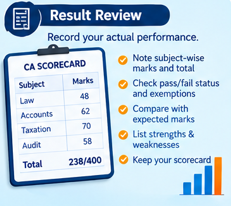
Result Review: Record Your Actual Performance
Get the facts straight first. The CA Exam result analysis starts with an objective evaluation of marks.
Document the marks in each subject, and total marks.
Write down your pass/fail status, and exemptions applicable to you.
Match your actual marks with the marks you had planned to score.
Document the subjects in which you performed well and those you did not perform well in.
Keep your mark sheet as you may want to compare it later with future performance.
Action: Select two subjects that require urgent attention.
Preparation Review: Evaluate Your Study Plan
Disappointing results could indicate issues with completion of syllabus revision and practice. Take note of what you have really completed before taking the test.
Note down syllabus completion of each subject.
Note down the number of revisions of each subject.
Note down the number of practice papers/ mock tests that you have taken.
Take note of the chapters left un-revised or under-revised.
Take note of the topics that you have studied but not enough question practices.
Action: Note down the list of incomplete chapters.
Performance Review: Compare Mock Tests With Actual Marks
Mock tests reveal if your preparation has resulted in performance in exams. This can happen only if your mock test environment is comparable to your actual exam environment.
Compare your scores in mock tests with your exam scores.
Find out which subjects gave scores below expectations.
See if you had the same mistakes in calculations/concepts/presentation.
Analyze your graded papers wherever possible.
You should never evaluate your preparation based on a single mock test.
Action point: Identify a mistake and take steps not to repeat it.
Difficulty Review: Identify Your Weak Topics
General comments like “Law is difficult” or “Accounts are poor” will not help you prepare. Identify the exact chapters and types of questions. Categorize each problem as:
Gap in understanding
Revision or memory issue
Not enough question practice
Time management
Mistake in calculation or reading of question
Start with problems which have appeared more than once or in important chapters and then select a solution for each one.
Action point: Choose three weak areas to correct first.
Exam Execution Review: Assess Your Exam-Hall Strategy
Performance consists of many factors besides preparation. Time management, question choice, and answering questions are some of them.
Did you effectively manage your time during the test in the examination room?
Did hard questions make you waste time?
Was there any question left unanswered?
Did your work make sense?
Did you have time to revise your work?
Action point: Practice timed tests and allocate time to each section.
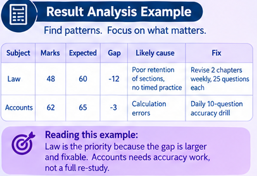
Subject | Marks | Expected | Gap | Likely cause | Fix |
48 | 60 | -12 | Poor retention of sections, no timed practice | Revise 2 chapters weekly, 25 questions each | |
62 | 65 | -3 | Miscalculation | Daily 10-problem accuracy exercise |
Interpretation of this example: The law is the area that needs to be addressed since the discrepancy is significant, and the source of the problem is rectifiable.
Next-Attempt Planning: Build an Action Plan
Try to have your results generate a focused and realistic study schedule.
Choose three to five objectives that should be achieved.
Each objective should have an activity.
Revise, formulate questions, and take practice tests.
Have a weekly objective and realistic deadlines for achieving them.
Choose a day in the week when you will evaluate the effectiveness of your study schedule.
For example: Revising one chapter that is not well done, formulating 25 questions, and taking a practice test in one week.
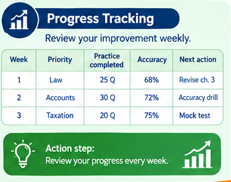
Progress Tracking: Review Your Improvement Weekly
Maintain a simple record to check whether your changes are producing measurable results.
Week | Priority | Completed practice | Result/accuracy | Next step |
Week 1 | Chapter to improve on | Score recorded | Check errors | |
Week 2 | Speed | One test | Score recorded | Increase speed |
Week 3 | Revising | Revision of chapter | Accuracy recorded | Test weaker areas |
At the end of each week, ask yourself:
What has gotten better?
What proof do I have of improvement?
What problem remains to be solved?
What will be changed in the coming week?
Regular monitoring helps determine if your approach to preparation works well or not.
Download Your Free CA Result Analysis Checklist
Fill out the free downloadable checklist to document your results and organize yourself for your next attempt. This checklist contains:
Results Review per Subject
Assessment of Syllabus & Revision
Analysis of Mock-test Results
Identification of Weak Topics
Analysis of Exam Performance
Action Plan for Next Attempt
Progress Tracking on a Weekly Basis
Download The Free CA Result Analysis Checklist (.docx)
Always fill out this checklist after every result and follow it on a weekly basis.
Conclusion
The process of CA result analysis is not about looking at scores and competing with other students. The process is meant to help you understand your performance and use the data collected during the review for better future preparation. You should consider marks in different subjects, analyze your weak topics, assess your performance in the mock test, monitor the progress each week, and plan your study process accordingly. Use the free CA Result Analysis Checklist and transform all your weaknesses into improvement goals.