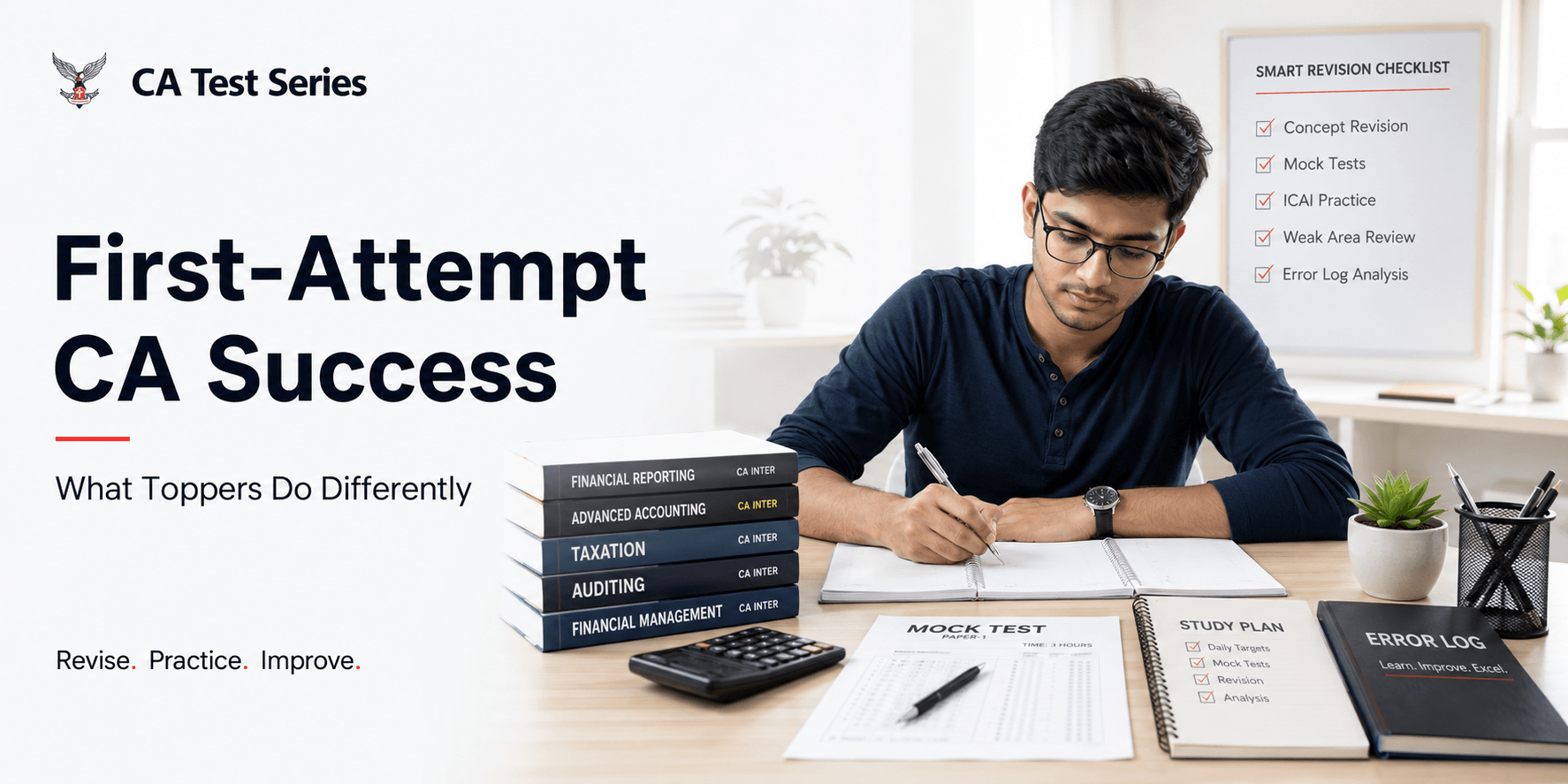
Students aiming for First-Attempt CA Exam Clearing should address difficult subjects early instead of postponing them until the final revision. Strong preparation means identifying the exact weakness, giving it targeted attention, and checking improvement through revision and testing without allowing one difficult chapter to consume the entire study schedule.
Identify Whether the Problem Is Concept, Practice, or Recall: mBefore increasing study hours, identify whether the difficulty comes from weak conceptual understanding, insufficient question practice, or poor recall. Conceptual gaps need relearning, application problems need more questions, and recall problems require active recall and shorter revision intervals.
Break Difficult Chapters Into Smaller Targets: Large chapters become easier to manage when divided into concepts, illustrations, provisions, question types, or smaller subtopics. Specific targets such as completing one concept and its practice questions are more practical than repeatedly scheduling an entire difficult chapter.
Give Weak Areas More Revision and Testing: Weak topics should appear more frequently in the revision schedule until accuracy and recall improve. Use chapter-wise tests and timed questions to verify progress rather than assuming a topic is strong simply because it feels familiar after rereading.
Know When to Move On: Trying to perfect one chapter can reduce overall syllabus coverage. Once the essential concepts are understood and sufficient practice is completed, continue with the syllabus and revisit the topic during the next revision cycle.
How to Stay Consistent During Months of CA Preparation
CA preparation rewards sustainable consistency more than occasional periods of extreme study. A realistic routine, measurable weekly goals, controlled distractions, proper recovery, and regular progress reviews help students continue preparing effectively even when motivation changes.
Create a Repeatable Daily Routine: Build fixed study blocks for learning, revision, question practice, and breaks so that studying becomes a predictable part of the day. The routine can remain flexible, but each study session should have a clear and achievable objective.
Control Phone and Social Media Distractions: Keep unnecessary notifications off and consider placing the phone away during focused sessions. Social media does not need to disappear completely, but it should not repeatedly interrupt the periods reserved for serious CA preparation.
Handle Low-Productivity Days Properly: One poor study day should not become an unproductive week. On difficult days, switch to lighter tasks such as formula revision, short notes, error-log review, or a small practice set while maintaining basic study momentum.
Protect Sleep and Mental Energy: Adequate sleep, regular meals, movement, and planned breaks support concentration and retention. Sacrificing recovery for unrealistic study hours can reduce the quality of preparation over a long CA exam cycle.
Common Mistakes That Reduce Your Chances of Clearing CA in the First Attempt
Many first-attempt students work hard but lose marks because their preparation is poorly structured. Avoiding common mistakes helps ensure that study time contributes to syllabus completion, revision, practice, and actual exam readiness.
Starting Serious Preparation Too Late: Late preparation leaves limited time for repeated revision, mock tests, and weak-area correction. Starting early creates the buffer needed for difficult chapters, unexpected delays, and multiple revision cycles.
Focusing Only on Completing Lectures: Completing classes is not the same as becoming exam-ready. Lectures should be followed by self-study, active recall, question practice, revision, and written tests so that concepts can be reproduced independently.
Using Too Many Study Materials: Multiple books, notes, PDFs, and question banks can create unnecessary duplication. Choose reliable core resources, use ICAI-oriented material appropriately, and add another resource only when it solves a specific preparation problem.
Ignoring ICAI-Oriented Practice: ICAI study material questions, RTPs, MTPs, and relevant previous papers should form part of exam-oriented preparation. They help students practise applying concepts in question formats closer to professional examination expectations.
Revising or Testing Too Little: Finishing the syllabus once does not guarantee exam-time recall. Multiple revision cycles and mock tests help improve retention, speed, accuracy, presentation, and confidence while revealing weaknesses before the real examination.
Changing Your Strategy Too Frequently: Constantly switching timetables, books, teachers, or revision methods can disrupt progress. Make changes when performance data shows a genuine problem, but allow a sensible preparation system enough time to work.
The Final 30-Day Strategy for First-Attempt CA Exam Clearing
The final month should focus on consolidation rather than collecting new material. Revision, timed practice, mock-test analysis, active recall, and weak-area correction should gradually replace detailed first-time learning as the examination approaches.
Period | Main Priority | Recommended Actions |
Days 30–21 | Major revision | Cover important chapters, repair major weaknesses, attempt selected questions |
Days 20–11 | Second revision | Increase timed practice, review mistakes, use short notes and formula sheets |
Days 10–4 | Exam simulation | Attempt full-syllabus mocks, improve speed, accuracy and paper completion |
Final 3 Days | Rapid recall | Review formulas, provisions, adjustments, error logs and priority topics |
What Not to Do During the Final Month: Avoid starting several new resources, rebuilding the entire study plan, comparing mock scores excessively, sacrificing sleep, or spending several days perfecting one low-priority chapter. The final month should strengthen what you have already prepared.
How to Know If You Are Ready for the CA Exam
Exam readiness should be measured through performance rather than feelings alone. A student is moving toward readiness when important concepts can be recalled independently, standard questions can be completed within reasonable time, repeated errors are falling, and mock-test performance is becoming more stable.
You Can Recall Core Concepts Without Constantly Checking Notes: You should be able to reproduce important formulas, provisions, concepts, steps, and chapter frameworks without repeatedly reopening detailed study material. Active recall is a practical way to test whether learning has become retrievable.
You Can Solve Standard Questions Within Time Limits: Familiar examination-style questions should be manageable without excessive hesitation. If standard problems still take too long, additional timed question practice may be more useful than another passive reading of the chapter.
Your Mock-Test Performance Is Becoming More Consistent: Do not judge readiness by one unusually high or low score. Look for broader improvement in accuracy, completion rate, time management, presentation, and the number of repeated mistakes across multiple tests.
You Have a Clear Final Revision Plan: Before examinations begin, know which short notes, formulas, marked questions, provisions, and error logs you will review before each paper. Organising this material in advance reduces last-minute confusion.
What Consistent Toppers Do During the Actual CA Exam
Preparation must translate into disciplined execution inside the examination hall. Students should read requirements carefully, choose questions strategically, manage time according to marks, maintain clear presentation, and avoid allowing one difficult question to disrupt the entire paper.
Read and Prioritize Questions Strategically: Use the initial reading period to understand the paper and identify questions you can attempt confidently. Follow compulsory requirements while choosing an order that allows you to build momentum without wasting excessive time.
Allocate Time According to Marks: Set approximate time limits according to marks and practise these limits during mock tests. If a difficult question exceeds its time budget, move forward and return later if sufficient time remains.
Maintain Accuracy and Presentation Under Pressure: Keep calculations, working notes, question numbers, and theory answers organised even during the final part of the examination. After completing a paper, shift attention toward the next subject instead of spending valuable preparation time debating answers.
First-Attempt CA Exam Clearing Checklist
Use the following checklist before your examination cycle to identify gaps that still require attention.
Preparation Area | What You Should Check |
Syllabus | Major chapters completed and conceptual doubts resolved |
Revision | Multiple revision cycles completed or scheduled |
ICAI Practice | Relevant study material questions, RTPs, MTPs and previous papers covered |
Mock Tests | Timed papers attempted and properly analysed |
Weak Areas | Repeated conceptual, calculation and recall errors addressed |
Final Readiness | Revision resources, exam materials and paper-wise plans organised |
How CA Test Series Can Support Your First-Attempt Preparation
CA Test Series can complement self-study by providing structured chapter-wise practice, ICAI-pattern test papers, full-syllabus mock exams, expert answer evaluation, and performance feedback. These tools help students move beyond syllabus completion and check whether their preparation is translating into examination-ready performance.
Chapter-Wise and ICAI-Pattern Practice: Chapter-wise practice allows students to detect weaknesses shortly after completing a topic, while ICAI-pattern tests provide more exam-oriented application and answer-writing practice.
Full-Syllabus Mock Exams: Full-syllabus mocks help students test recall, paper completion, question selection, accuracy, and concentration under timed conditions before facing the actual CA examination.
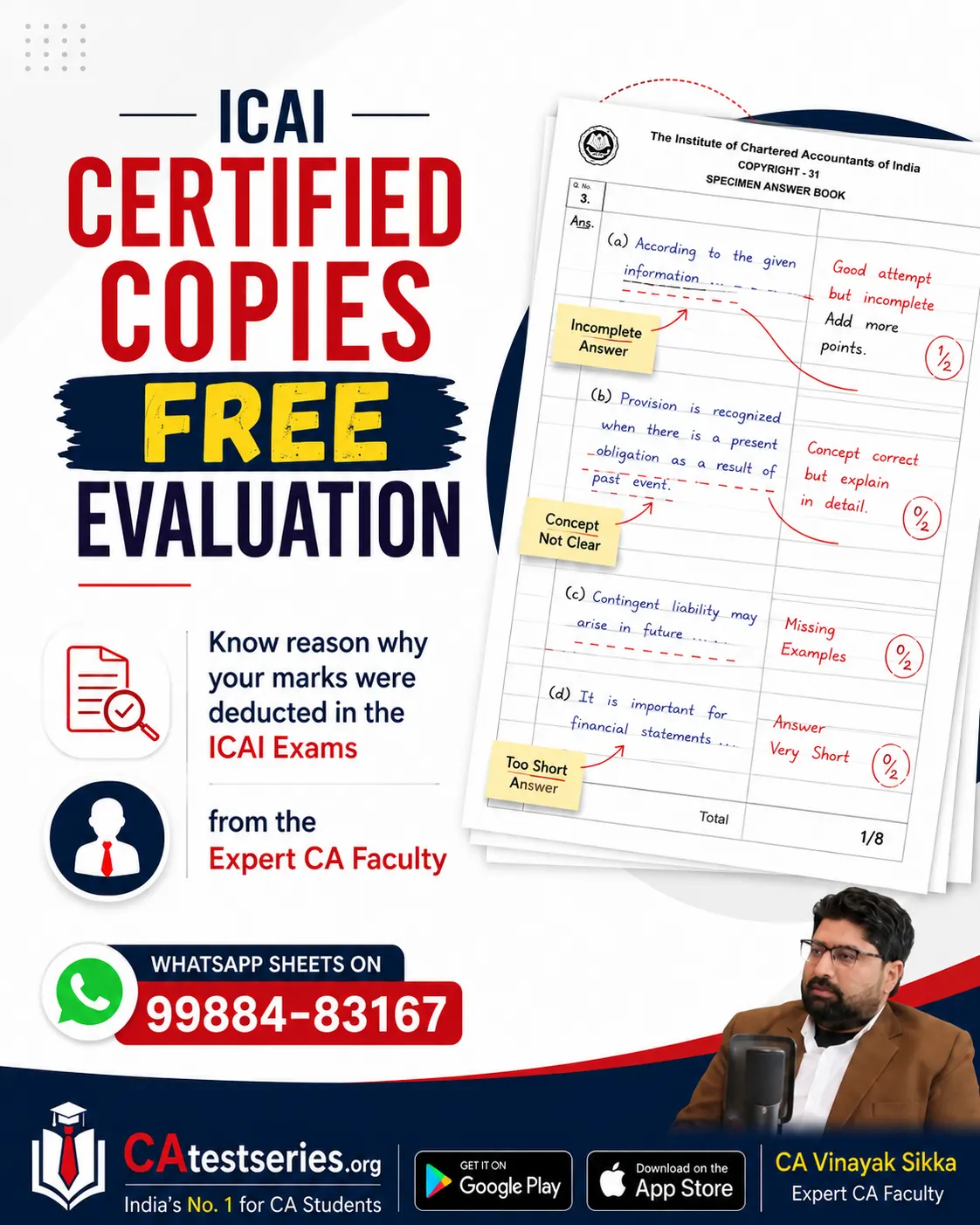
Expert Evaluation and Performance Feedback: Expert answer evaluation can highlight weak presentation, missing workings, incomplete responses, or interpretation issues. Performance feedback can then guide the next revision cycle toward specific areas that need improvement.
Conclusion
First-Attempt CA Exam Clearing does not depend on a secret topper formula. It depends on building a repeatable preparation system that combines timely syllabus completion, multiple revisions, ICAI-oriented question practice, mock tests, mistake analysis, and continuous weak-area improvement. With structured practice and performance feedback from the CA Test Series, students can evaluate their preparation more objectively and approach the examination with stronger readiness and confidence.