
Failed One CA Subject? Your First 7 Steps After the Result
Failed a CA subject while the rest of your result is quite impressive? Think before making any hasty decisions, but keep in mind the deadlines that will be provided in Step 5. This is not an easy situation, and frustration and numbness are completely understandable feelings. Regardless of whether you are a CA Inter or CA Final student, base your action plan on your scorecard data. Here are your first seven steps.
Throughout the guide, the terms “subject” and “paper” will be used interchangeably. A “group” is a collection of papers that you either pass or fail.
Step 1: Examine your exact result
Look at your scorecard and see the marks scored in each paper and the aggregate in the group. For you to pass a group, you must score a minimum of 40% in all papers and 50% in aggregate. It is possible that you failed either the paper minimum or the group aggregate.
Step 2: Find out your immediate choices
Find out if you have cleared either of the two groups. A cleared group does not require you to take it again. In case you fail any group, any paper of that group for which you score 60 and above can be considered for exemption from writing for the next three times, subject to the condition that you appear in all the papers of that group. Papers scoring less than 60 must be attempted again, even if you score 40 and above.
Step 3: Identify the source of your problem.
When you want to revise your study plan, try to first understand what is causing you to score poorly. This understanding will enable you to develop an appropriate solution.
Main difficulty | What to do |
Conceptual understanding | Reread the weak chapters from the study material and solve specific questions for each chapter. |
Incomplete syllabus coverage | Note all units, check which parts are not covered, and cover those first before making any changes. |
Recall under exam stress | Use spaced revision and closed-book recall tests every week. |
Question misunderstanding | Always underline the requirement and rewrite each question in your own words before answering. |
Answer presentation | Compare your answers to those provided by the ICAI and rewrite them in the same format. |
Time management | Complete full papers within the time limit and score marks per hour. |
Step 4: Review your preparation records
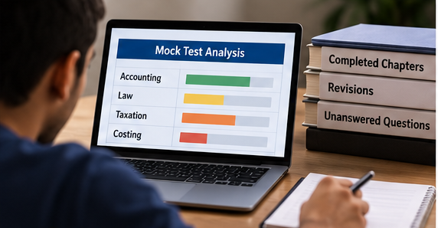
This must be done using records rather than your perception. Check your mock test scores, completed chapters, number of revisions done, and unanswered questions. These patterns found in your records will be more reliable than how the exam went.
Step 5: Verify deadlines and apply for verification if required
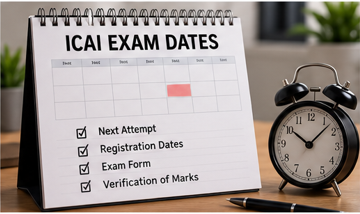
From the ICAI website, verify the dates for your next attempt, registration, and exam forms. Note that Inter exams are now conducted three times a year. So your next attempt will not take long to arrive. In case your marks are surprisingly poor, you can apply for verification of marks or certified copies of answer books through the ICAI Self Service Portal.
Step 6: Create a CA recovery plan that is targeted
Split your time between the weak paper and the areas you have already covered. Start with your biggest weaknesses and continue making small revisions on the areas you have covered. Set weekly goals for yourself, such as chapters revised, questions answered, and timed papers done.
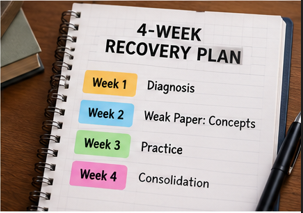
Sample four-week recovery plan
Week | Focus | Target |
Week 1 | Diagnosis | Look at mocks and your score, and identify weak chapters. |
Week 2 | Weak paper: concepts | Revise the top weak chapters and solve questions on each. |
Week 3 | Practice | Take two timed tests and note each error |
Week 4 | Consolidation | Revise strong topics, redo errors, and write one full-length paper |
Step 7: Select support that suits your analysis
Select a form of support that helps you address your area of weakness and not any popular form. This could be a different study method, timed exercises, professional help, or test series that provides answers to your questions.
Mistakes that Students Often Make When Failing a CA Subject
1. Neglecting Passing Mark Requirements: Understand the requirements of achieving 40% in each subject and 50% aggregate.
2. Delaying Marks Verification Application: Do not delay applying for marks verification if you feel they are abnormal, but revise at the same time.
3. Negligence Towards Time Limits: Beware of deadline limits for verifying marks, exam forms, and exam dates.
4. Not Taking Care of Strong Subjects: Maintain strong subjects to maintain accuracy.
5. Persisting With the Old Method: Enhance your revision, concept building, and answer-writing skills.
6. Ignoring Conceptual Gaps: Improve weak concepts rather than just depending on rote learning.
7. Avoiding Mock Tests: Practice tests within set time limits to increase speed and accuracy of presentation.

Conclusion
A single failed paper is merely an outcome, not a judgment of your capabilities. Check your grades, find out the reason, and take the next step based on facts. Should you require timed practice and feedback in writing, then CAtestseries.org is something that can be useful for you.