Choosing between Company Secretary, Chartered Accountancy, and Cost and Management Accountancy can be difficult. This CS vs CA vs CMA comparison explains the main differences so that you can select a course aligned with your strengths and goals.
CS vs CA vs CMA at a Glance
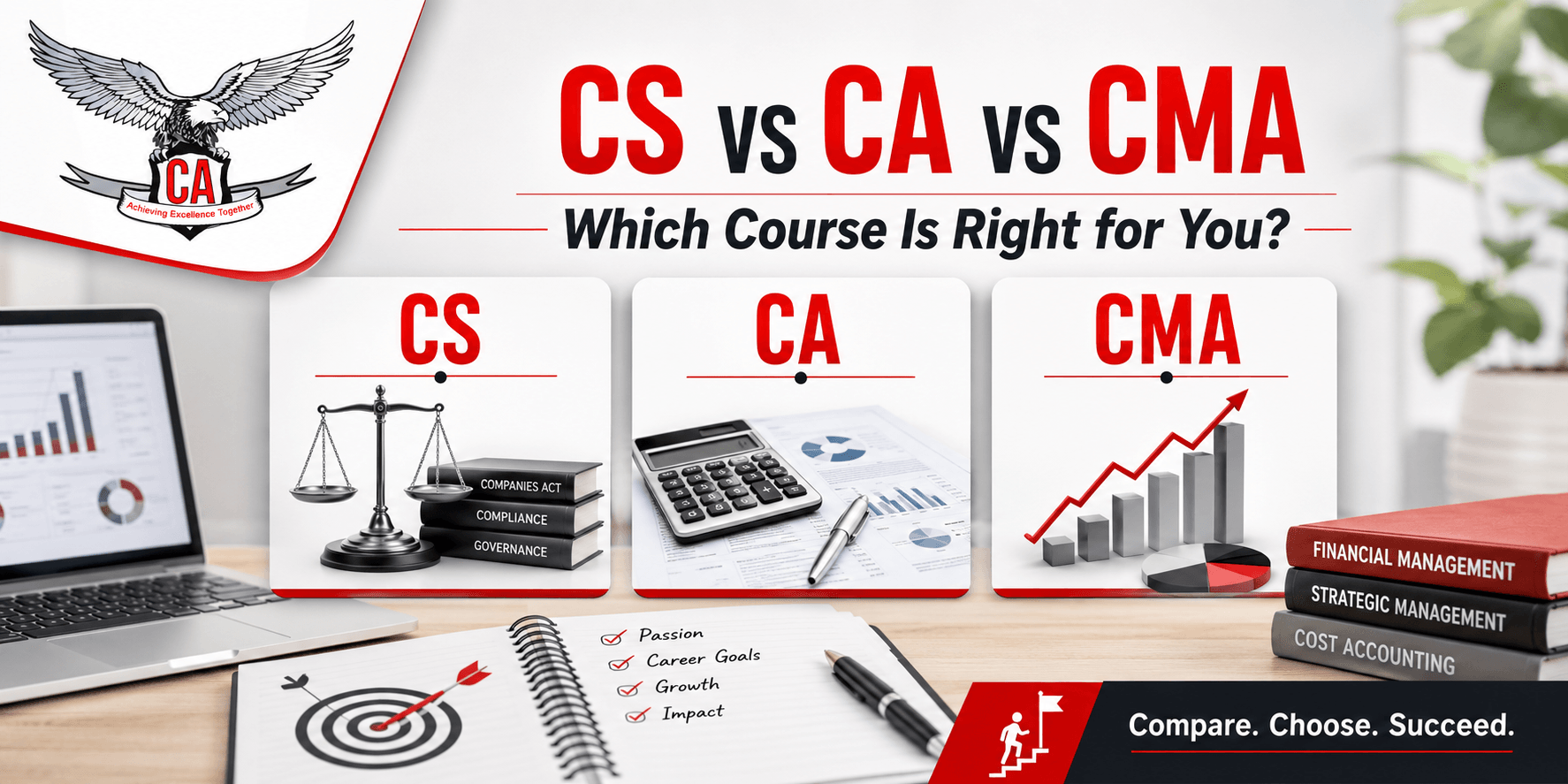
CA, CS, and CMA all support business decisions, but they work in different areas. CA focuses on accounting, audit, taxation, reporting, and finance. CS focuses on corporate law, governance, compliance, and board processes. CMA focuses on costing, budgeting, performance management, and strategic financial decisions.
Factor | CA | CS | CMA |
| Full form | Chartered Accountant | Company Secretary | Cost and Management Accountant |
| Institute | ICAI | ICSI | ICMAI |
| Main focus | Accounts, audit, tax, finance | Law, governance, compliance | Costing, budgets, performance |
| Levels | Foundation, Intermediate, Final | CSEET, Executive, Professional | Foundation, Intermediate, Final |
| Practical training | Two years | Twenty-one months | Fifteen months |
| Best suited for | Accounting and finance learners | Law and governance learners | Cost and strategy learners |
ICAI’s current scheme includes Foundation, Intermediate, Final, Self-Paced Online Modules, and two years of uninterrupted practical training. ICSI prescribes twenty-one months of long-term training, while ICMAI uses Foundation, Intermediate, and Final with fifteen months of practical training for applicable students.
What Is the Main Difference Between CA, CS, and CMA?
A CA examines financial records, taxes, audit evidence, and controls. A CS helps companies comply with corporate laws, conduct board processes, and maintain governance standards. A CMA analyses costs, budgets, margins, and operational performance to support management decisions.
CA: Accounting, Audit, Taxation, and Finance: CA suits students who enjoy accountancy, taxation, auditing, finance, and analytical problem-solving. Qualified CAs may work in audit firms, tax practice, consulting, banking, reporting, risk, corporate finance, or independent practice.
CS: Corporate Law, Governance, and Compliance: CS is suitable for students interested in company law, governance, compliance, drafting, and board-related work. A Company Secretary may organise statutory meetings, maintain records, monitor filings, advise directors, and support governance processes.
CMA: Cost Management, Budgeting, and Strategy: CMA is designed for students interested in cost accounting, budgeting, pricing, profitability, planning, and operational performance. CMAs help management analyse costs, prepare budgets, investigate variances, evaluate projects, and improve resource use.
CS vs CA vs CMA Syllabus Comparison
All three courses include accounting, law, taxation, finance, ethics, and management, but their emphasis differs. CA gives greater weight to accounting, audit, tax, and reporting. CS focuses more on corporate law, governance, drafting, and compliance. CMA provides deeper exposure to costing, budgeting, operations, and performance analysis.
Learning preference | Best match |
| Financial statements, audit, and taxation | CA |
| Corporate law and legal drafting | CS |
| Costing, budgets, and profitability | CMA |
| Numerical problem-solving | CA or CMA |
| Theory and legal interpretation | CS |
| Internal business decisions | CMA |
Which Course Is More Difficult?
There is no objectively easiest option. CA may feel harder if you struggle with accounting, tax, audit, and numerical application. CS may be more challenging if you dislike legal reading, drafting, and descriptive answers. CMA may feel difficult if costing, finance, budgeting, and analytical decision-making are not your strengths. Interest, discipline, and practice matter more than pass-rate comparisons.
Which Course Should You Choose After Class 12?
Students can begin the standard route for these qualifications after Class 12, subject to each institute’s rules. Commerce students may have an early advantage, but science and arts students can also apply by strengthening the required foundation subjects. Before registering, review the syllabus, sample papers, training structure, study commitment, and typical job responsibilities.
Choose CA If You Are Strong in Accountancy: CA is usually the best fit if you enjoy financial statements, taxation, auditing, accounting standards, and broad finance work. It also suits students who want client-facing roles, corporate finance opportunities, or independent practice.
Choose CS If You Are Interested in Law: CS is the strongest fit if you prefer company law, governance, compliance, legal interpretation, and professional drafting. It is particularly suitable for students who want to work with boards, directors, regulators, and legal teams.
Choose CMA If You Like Costing and Business Decisions: CMA is appropriate if you enjoy cost calculations, budgets, pricing, variance analysis, planning, and understanding profitability. It can lead to careers in manufacturing finance, FP&A, management accounting, commercial finance, and decision support.
Can You Pursue Two Courses Together?
Dual qualifications are possible, but more qualifications do not automatically guarantee a better career. CA with CS combines finance with law and governance; CA with CMA combines reporting and audit with costing; and CS with CMA connects compliance with performance analysis. A dual route makes sense only when it supports a clear goal and the student can manage separate exams and training requirements.
Career Scope After CA, CS, and CMA
CAs commonly work in audit, taxation, reporting, accounting, advisory, risk, and corporate finance. CS professionals work in governance, compliance, corporate law, secretarial audit, and regulatory affairs. CMAs build careers in costing, budgeting, management accounting, FP&A, commercial finance, and performance management. All three may lead to employment, consulting, or independent practice.
How Technology Is Changing These Careers
Automation, cloud accounting, digital filing, enterprise software, and analytics are reducing repetitive work. Professionals increasingly add value by reviewing outputs, identifying risks, interpreting laws and financial data, and advising management. Students should build spreadsheet, data-analysis, business-writing, and accounting-software skills alongside their syllabus.
How to Prepare for Professional Exams Effectively
Successful preparation requires official study materials, conceptual learning, chapter-wise practice, revision, mock exams, and answer evaluation. Numerical papers need repeated problem-solving, while law, audit, governance, and theory papers require accurate interpretation and structured writing.
Build a Level-Wise Study Plan: Divide the syllabus into weekly targets, give extra time to difficult subjects, and schedule revision regularly. Include buffer days for college, training, illness, and unfinished chapters so that one delay does not disrupt the plan.
Practise Chapter-Wise and Full-Syllabus Tests: Chapter tests reveal topic-specific weaknesses, while full mock exams test recall, speed, stamina, question selection, and presentation. After each test, classify mistakes as conceptual, calculation-based, incomplete, poorly presented, or caused by time pressure.
Use Feedback to Improve the Next Attempt: Maintain an error log, revise weak concepts, and solve similar questions again. Evaluation becomes useful only when feedback changes how you study, calculate, write, or manage exam time.
How CA Test Series Supports CA Preparation
CA Test Series helps CA Foundation, CA Inter, and CA Final students through ICAI-pattern test papers, chapter-wise tests, full-syllabus mock exams, expert answer evaluation, study support, and detailed performance feedback. These resources help students identify weak areas, improve presentation, practise under exam-like conditions, and measure readiness before the examination.
Final CS vs CA vs CMA Comparison
Choose | When your strongest interest is |
| CA | Accounting, audit, taxation, reporting, and finance |
| CS | Corporate law, governance, compliance, and board work |
| CMA | Cost management, budgeting, performance, and strategy |
Conclusion
The right choice in the CS vs CA vs CMA debate depends on career fit rather than popularity. Choose CA for accounting, audit, taxation, and broad finance; choose CS for corporate law, governance, and compliance; and choose CMA for costing, planning, performance, and strategic financial decisions. Students who select CA can use structured mock exams, evaluated answers, and feedback from CA Test Series to improve preparation.