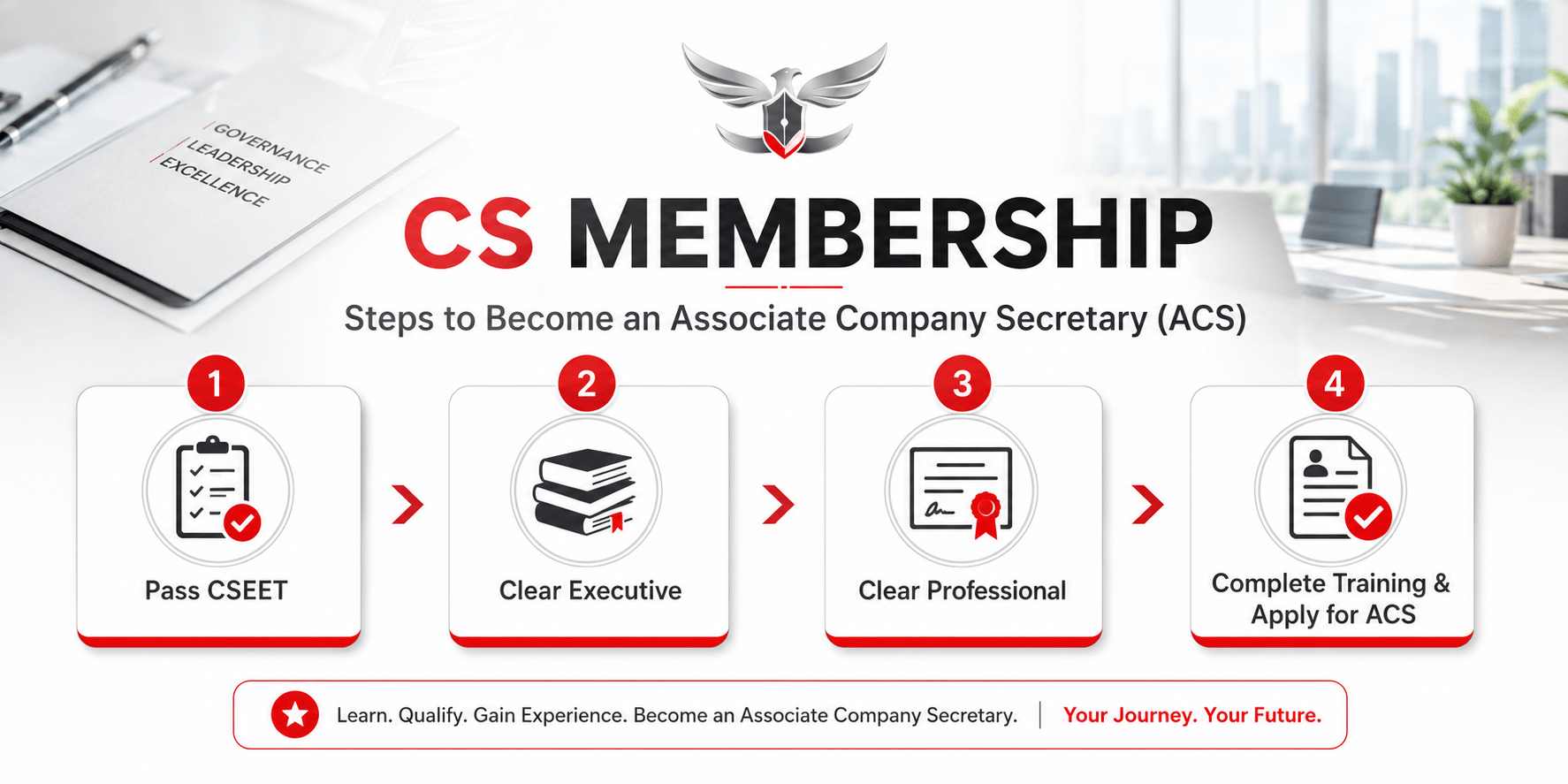
CS Membership is a professional recognition provided to individuals who successfully complete the Company Secretary qualification process and meet the membership requirements of a recognized professional institute. It allows qualified professionals to officially work as Company Secretaries and handle important responsibilities related to corporate law, compliance, governance, and regulatory matters. Becoming an Associate Company Secretary (ACS) is the first professional membership level that confirms an individual’s expertise and eligibility to enter the corporate sector. This guide explains the complete process of obtaining CS membership, including eligibility, documents, application steps, fees, approval time, benefits, and career opportunities.
What is CS Membership?
Meaning of CS Membership: CS Membership refers to the official registration of a qualified Company Secretary with a professional institute responsible for regulating the CS profession. It confirms that an individual has completed the required education, examinations, practical training, and other professional requirements. A CS member receives professional recognition and becomes eligible to use the designated membership title while performing corporate compliance, governance, and secretarial responsibilities for organizations.
What is an Associate Company Secretary (ACS)?
An Associate Company Secretary (ACS) is a qualified Company Secretary who has obtained professional membership after successfully completing the required CS course, examinations, and training. ACS is the initial level of professional membership that allows individuals to practice their knowledge in areas such as corporate governance, company law, statutory compliance, board management, and regulatory reporting. The ACS designation represents professional competence and recognition in the field of corporate administration.
Difference Between ACS and FCS Membership
ACS and FCS represent two different levels of professional membership in the Company Secretary profession. Associate Company Secretary (ACS) is granted to qualified professionals who have recently completed the required CS qualification and membership criteria. Fellow Company Secretary (FCS) is a higher membership category awarded to members with significant professional experience and additional eligibility requirements. While ACS represents professional entry status, FCS reflects advanced experience and senior professional standing.
Why CS Membership is Important for Career Growth
CS Membership is important for career growth because it provides official recognition as a corporate governance and compliance professional. It increases credibility among employers, companies, regulatory authorities, and clients. Membership also creates opportunities to work in senior corporate positions, participate in professional development activities, expand industry networks, and build a long-term career in corporate law and management.
Who Can Apply for CS Membership?
Eligibility Criteria for ACS Membership: Candidates who want to apply for ACS membership must fulfill the eligibility requirements set by the respective Company Secretary institute. Generally, applicants must complete the prescribed CS education program, pass all required examinations, complete mandatory practical training, and submit necessary documents with the membership application. Only candidates who satisfy all professional and administrative requirements are approved for ACS membership.
Educational Requirements: The educational requirements for CS membership usually include completing the academic stages of the Company Secretary course from a recognized institute. Candidates must have the required educational background before enrolling in the program and must successfully complete all prescribed subjects and examinations. The qualification ensures that applicants have sufficient knowledge of corporate law, finance, governance, and business regulations.
Training Requirements: Practical training is an essential part of becoming a Company Secretary because it provides candidates with real-world experience in corporate compliance and secretarial practices. Applicants must complete the required training period under approved organizations, companies, or practicing professionals according to institute guidelines. Training helps candidates develop practical skills required for managing legal and regulatory responsibilities.
Examination Requirements: Applicants must successfully complete all stages of the Company Secretary examination conducted by the professional institute before applying for membership. These examinations evaluate candidates’ knowledge of corporate laws, governance practices, taxation, financial management, and other professional areas. Passing the examinations demonstrates that the candidate has achieved the required level of professional competency.
Other Conditions (if applicable): Apart from education, examinations, and training, candidates may need to fulfill additional conditions before receiving CS membership. These conditions may include submitting accurate information, maintaining professional ethics, paying required fees, and completing the application process within the given timeline. Meeting all additional requirements ensures smooth approval of the membership application.
Important Things to Remember Before Applying
Document Checklist
Before applying for CS membership, candidates should carefully prepare and verify all required documents to avoid delays in the approval process. Important documents generally include identity proof, educational certificates, CS qualification records, training completion certificates, photographs, and other supporting documents required by the institute. Checking the document checklist in advance ensures that the application is complete and reduces the chances of rejection due to missing information.
Name and Certificate Matching: Applicants should ensure that their name and personal details are consistent across all submitted documents, including educational certificates, identity proof, and CS qualification documents. Any mismatch in spelling, initials, or personal information may create verification problems and delay the membership approval process. If there are differences, candidates should provide proper supporting documents or corrections before submitting the application.
Fee Verification: Before making payment for CS membership, applicants should verify the applicable admission fee, annual membership fee, and any additional charges required by the institute. Candidates should confirm the latest fee structure from the official membership portal and ensure that the payment details are correct. Proper fee verification helps prevent payment-related issues and unnecessary delays in processing the application.
Valid Contact Information: Applicants must provide valid and active contact information, including email address, phone number, and other required communication details during the membership application process. The institute may use these details for verification, approval updates, payment confirmation, or important professional notifications. Providing incorrect contact information may result in missed updates or difficulties in completing the membership process.
Keep Copies of Submitted Documents: Candidates should keep copies of all documents submitted during the CS membership application process, including the completed application form, uploaded certificates, payment receipts, and confirmation messages. Maintaining these records helps applicants track their application status and provides necessary proof if any issue occurs during verification or future membership-related procedures.
CS Membership Renewal and Annual Compliance
Annual Renewal Process: CS membership usually requires annual renewal to maintain active professional status. Members must complete the renewal process within the timeframe specified by the professional institute by submitting the required information and paying applicable renewal fees. Timely renewal ensures that members continue to enjoy professional privileges and remain eligible to use their membership designation.
Renewal Fees: Renewal fees are the charges paid by CS members to maintain their active membership status each year. The amount may vary depending on the institute’s rules, membership category, and applicable regulations. Members should regularly check official notifications regarding fee deadlines and payment procedures to avoid penalties or suspension of membership benefits.
Continuing Professional Education (CPE): Continuing Professional Education (CPE) helps Company Secretaries maintain and improve their professional knowledge through ongoing learning activities. Members may need to complete specific CPE requirements through seminars, workshops, training programs, and professional courses. These activities ensure that professionals stay updated with changes in corporate laws, regulations, governance practices, and industry standards.
Consequences of Non-Renewal: Failure to renew CS membership within the required period may result in inactive status, loss of certain professional privileges, or restrictions on using the membership designation. In some cases, members may need to pay additional charges or complete restoration procedures to reactivate their membership. Regular renewal helps maintain continuous professional recognition.
CS Membership vs CA Membership vs CMA Membership
Eligibility Comparison: CS, CA, and CMA memberships are professional qualifications with different eligibility requirements and areas of specialization. CS focuses mainly on corporate law, governance, compliance, and company administration, while CA emphasizes accounting, auditing, taxation, and financial reporting. CMA focuses on cost management, financial planning, and management accounting. Each profession has its own education, examination, and training requirements.
Professional Recognition: CS, CA, and CMA are highly recognized professional qualifications that provide career opportunities in different business fields. CS professionals are recognized as experts in corporate governance and regulatory compliance, CAs are known for expertise in accounting and auditing, and CMAs specialize in cost control and financial decision-making. The recognition of each membership depends on professional goals and industry requirements.
Career Scope: The career scope of CS, CA, and CMA differs based on their professional expertise. Company Secretaries mainly work in corporate compliance, board management, legal advisory, and governance roles. Chartered Accountants often work in auditing, taxation, finance, and accounting positions, while Cost and Management Accountants focus on budgeting, cost analysis, and strategic financial management.
Regulatory Authority: Each profession is regulated by a separate professional institute that establishes education standards, examination systems, ethical guidelines, and membership rules. CS professionals follow regulations related to company secretarial practice and corporate governance, while CA and CMA professionals follow standards related to accounting, auditing, taxation, and financial management.
Which Membership is Right for Different Career Goals?: The right professional membership depends on an individual’s career interests and long-term objectives. Candidates interested in corporate law, compliance, governance, and company management may choose CS membership. Those interested in accounting, auditing, taxation, or financial reporting may prefer CA, while individuals focused on cost management and business strategy may choose CMA.
Conclusion
CS Membership is an important professional milestone for individuals who want to build a career in corporate governance, compliance, and company administration. Becoming an Associate Company Secretary (ACS) requires completing the necessary education, examinations, training, documentation, and application procedures. By understanding the eligibility criteria, membership process, fees, renewal requirements, and career opportunities, candidates can successfully obtain and maintain their CS membership while developing a strong professional career in the corporate sector.