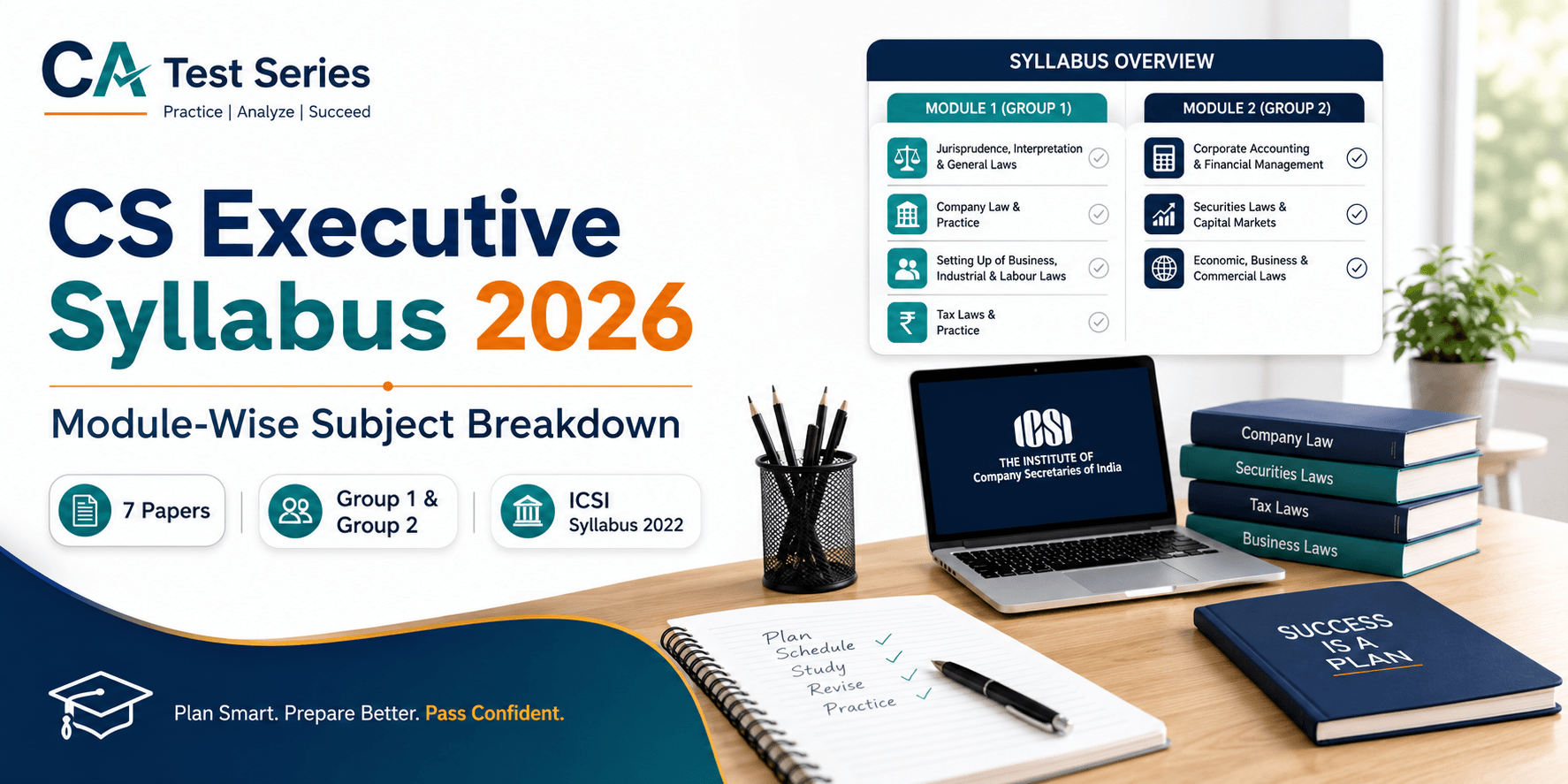
CS Executive Syllabus 2026: Module-Wise Subject Breakdown
The CS Executive Syllabus 2026 follows the ICSI Syllabus 2022 and contains seven papers divided into Group 1 and Group 2. Although many students still search for “Module 1” and “Module 2,” the official terminology under the current syllabus is “Group 1” and “Group 2.” This guide explains the CS Executive subjects, major topics, marks distribution, official study resources, and preparation strategy for the June and December 2026 examinations.
CS Executive Syllabus 2026 Overview
The Institute of Company Secretaries of India conducts the CS Executive examination in June and December. Each paper carries 100 marks, making the complete programme worth 700 marks. Group 1 contains four papers, while Group 2 contains three. Candidates should prepare with the latest ICSI study materials, supplements, and examination-specific amendments.
Particular | Details |
| Conducting body | Institute of Company Secretaries of India |
| Applicable syllabus | ICSI Syllabus 2022 |
| Number of groups | 2 |
| Total papers | 7 |
| Group 1 papers | 4 |
| Group 2 papers | 3 |
| Marks per paper | 100 |
| Total marks | 700 |
| Exam sessions | June and December |
| Official resource | ICSI Academic Portal |
CS Executive Subjects 2026
CS Executive Group 1 Subjects: Group 1 develops the legal, procedural, accounting, and financial knowledge required at the Executive level. It includes three law-oriented papers and one numerical paper, making it important for students to balance conceptual reading, answer-writing, and calculation practice.
Paper 1: Jurisprudence, Interpretation and General Laws: This paper covers jurisprudence, sources of law, the Constitution of India, interpretation of statutes, administrative law, torts, civil and criminal procedure, evidence, limitation, arbitration, information technology, contract law, and negotiable instruments. Students need strong legal interpretation, conceptual clarity, and regular case-based answer practice.
Paper 2: Company Law and Practice: Paper 2 includes Company Law, Principles and Concepts for 60 marks and Company Administration and Meetings for 40 marks. Important areas include company formation, memorandum and articles, share capital, members, charges, accounts, auditors, directors, board powers, meetings, key managerial personnel, managerial remuneration, and annual reports.
Paper 3: Setting Up of Business, Industrial and Labour Laws: This paper contains Setting Up of Business for 60 marks and Industrial and Labour Laws for 40 marks. It covers business structures, company incorporation, LLPs, start-ups, MSMEs, registrations, licences, overseas business setup, wages, industrial relations, social security, working conditions, labour codes, and workplace sexual-harassment law.
Paper 4: Corporate Accounting and Financial Management: Paper 4 combines Corporate Accounting for 60 marks with Financial Management for 40 marks. Major topics include share capital, debentures, company accounts, consolidation, cash-flow statements, financial analysis, capital budgeting, cost of capital, capital structure, working-capital management, dividend decisions, and security analysis.
CS Executive Group 2 Subjects
Group 2 focuses on capital markets, securities regulation, commercial laws, intellectual property, and taxation. These subjects require students to understand legal provisions while remaining updated with regulatory, procedural, and tax-related developments.
Paper 5: Capital Market and Securities Laws: Part I, Capital Market, carries 40 marks, while Part II, Securities Laws, carries 60 marks. The paper covers SEBI, stock exchanges, securities-market intermediaries, depositories, IFSCA, issue and listing of securities, takeovers, insider trading, disclosure requirements, buyback, delisting, mutual funds, and collective investment schemes.
Paper 6: Economic, Commercial and Intellectual Property Laws: This paper is divided into Economic and Commercial Laws for 60 marks and Intellectual Property Laws for 40 marks. It covers foreign exchange, foreign direct investment, overseas investment, competition law, consumer protection, money laundering, real-estate regulation, legal metrology, patents, trademarks, copyright, industrial designs, and geographical indications.
Paper 7: Tax Laws and Practice: Paper 7 includes Direct Tax for 60 marks and Indirect Tax for 40 marks. Students study income-tax concepts, heads of income, deductions, set-off and carry-forward of losses, total-income computation, entity taxation, GST, supply, input-tax credit, tax-liability computation, registration, returns, refunds, and customs basics.
CS Executive Paper-Wise Marks Distribution
Paper 1 is not formally divided into separate parts. Papers 2, 3, 4, 6, and 7 follow a 60:40 marks pattern, while Paper 5 follows a 40:60 pattern. Understanding this division helps students allocate preparation time, but it should not be treated as guaranteed chapter-wise weightage.
Group | Paper | Subject | Part I | Part II | Total |
| Group 1 | 1 | Jurisprudence, Interpretation and General Laws | Not divided | Not divided | 100 |
| Group 1 | 2 | Company Law and Practice | 60 | 40 | 100 |
| Group 1 | 3 | Setting Up of Business, Industrial and Labour Laws | 60 | 40 | 100 |
| Group 1 | 4 | Corporate Accounting and Financial Management | 60 | 40 | 100 |
| Group 2 | 5 | Capital Market and Securities Laws | 40 | 60 | 100 |
| Group 2 | 6 | Economic, Commercial and Intellectual Property Laws | 60 | 40 | 100 |
| Group 2 | 7 | Tax Laws and Practice | 60 | 40 | 100 |
| Total | 700 |
CS Executive Subject Classification
The law-heavy papers are Papers 1, 2, 3, 5, and 6. Paper 4 is the most numerical subject, while Paper 7 combines legal provisions with tax calculations. Company law, securities law, commercial laws, labour laws, and taxation are also amendment-sensitive, requiring students to check the latest academic updates.
Subject Type | Main Papers | Primary Skill Required |
| Law and theory | Papers 1, 2, 3, 5, and 6 | Legal interpretation and structured writing |
| Numerical and practical | Paper 4 | Accuracy and problem-solving |
| Theory plus calculation | Paper 7 | Tax knowledge and computation |
| Amendment-sensitive | Papers 2, 3, 5, 6, and 7 | Regular revision of updates |
Which CS Executive Subjects Are Difficult?
The difficulty of a CS Executive paper depends on the student’s educational background, interests, and existing skills. Papers 1, 2, 5, and 6 require strong legal interpretation, while Papers 4 and 7 demand consistent numerical practice. Commerce students may find accounting and taxation more familiar, whereas students comfortable with reading and analysis may perform better in law papers. Subject priority should therefore be based on individual strengths, available time, and mock-test performance.
CS Executive Syllabus PDF and Official Study Materials
Students should download the official syllabus and paper-wise study materials from the ICSI Academic Portal. For the June 2026 examination, ICSI identifies the study materials for Papers 1 to 6 as updated through November 2025. Paper 7 requires the main Tax Laws and Practice material along with the applicable direct-tax and indirect-tax supplements. These supplements include developments introduced after the primary books were updated.
CS Executive Syllabus Changes and Updates for 2026
The seven-paper structure under ICSI Syllabus 2022 continues for the 2026 examinations, but students must check revised chapters, amendments, corrigenda, and session-specific academic notices. ICSI approved modifications to Papers 1, 2, and 6 that became effective from the December 2025 examination. The June and December 2026 examinations follow the same overall paper structure, but the applicable tax provisions and amendment cut-off dates may differ.
How to Cover the CS Executive Syllabus 2026
Begin by downloading the current ICSI syllabus, study materials, and supplements. Divide every paper into smaller units and classify chapters as theory-based, numerical, case-oriented, procedural, or amendment-sensitive. Set separate deadlines for syllabus completion, revision, and mock tests. Practise legal case studies and numerical questions regularly, attempt full-syllabus papers after the first revision, and use evaluated feedback to improve weak concepts, answer presentation, and time management.
Suggested CS Executive Study Plan
A four-month plan can use the first eleven weeks for syllabus learning and continuing revision, followed by five weeks of intensive revision and mock tests. A three-month plan can allocate eight weeks to syllabus completion, two weeks to revision, and two weeks to full-paper practice. During the final month, students should focus on amendments, formulas, important provisions, weak chapters, and evaluated mock exams rather than collecting new books or notes.
How Mock Tests Support CS Executive Preparation
Chapter-wise tests identify conceptual gaps during the early preparation stage, while subject-wise tests measure retention across an entire paper. Full-syllabus mock tests improve writing speed, question selection, time management, and examination confidence. Evaluated answers can reveal weak legal reasoning, incomplete conclusions, poor calculations, and presentation problems. CA Test Series can support this process through chapter-wise practice, full-syllabus mock exams, expert answer evaluation, and detailed performance feedback.
Common Mistakes Students Should Avoid
Students should avoid using outdated notes, ignoring ICSI supplements, preparing only selected high-weightage chapters, delaying numerical practice, memorising legal provisions without understanding their application, and attempting mock tests without analysing mistakes. Effective preparation requires broad syllabus coverage, consistent written practice, amendment revision, and clear corrective action after every test.
Conclusion
The CS Executive Syllabus 2026 includes seven papers across two groups and requires a balanced approach to law, accounting, finance, securities regulation, commercial laws, intellectual property, and taxation. Candidates should rely on updated ICSI resources, plan their preparation around the paper-wise structure, and combine concept learning with revision and evaluated mock tests. A disciplined study schedule and regular performance analysis can make the syllabus more manageable and improve examination readiness.