The Company Secretary course is a professional qualification for students interested in corporate law, governance, regulatory compliance, taxation, finance and business management. It is conducted by the Institute of Company Secretaries of India, commonly known as ICSI. The present route includes the Company Secretary Executive Entrance Test, or CSEET, followed by the CS Executive Programme, CS Professional Programme, practical training and membership requirements. This CS Course Full Overview explains the current stages, eligibility criteria, subjects, examination process, training requirements, career opportunities and preparation strategy in a clear and student-friendly format.
CS Course Full Overview at a Glance
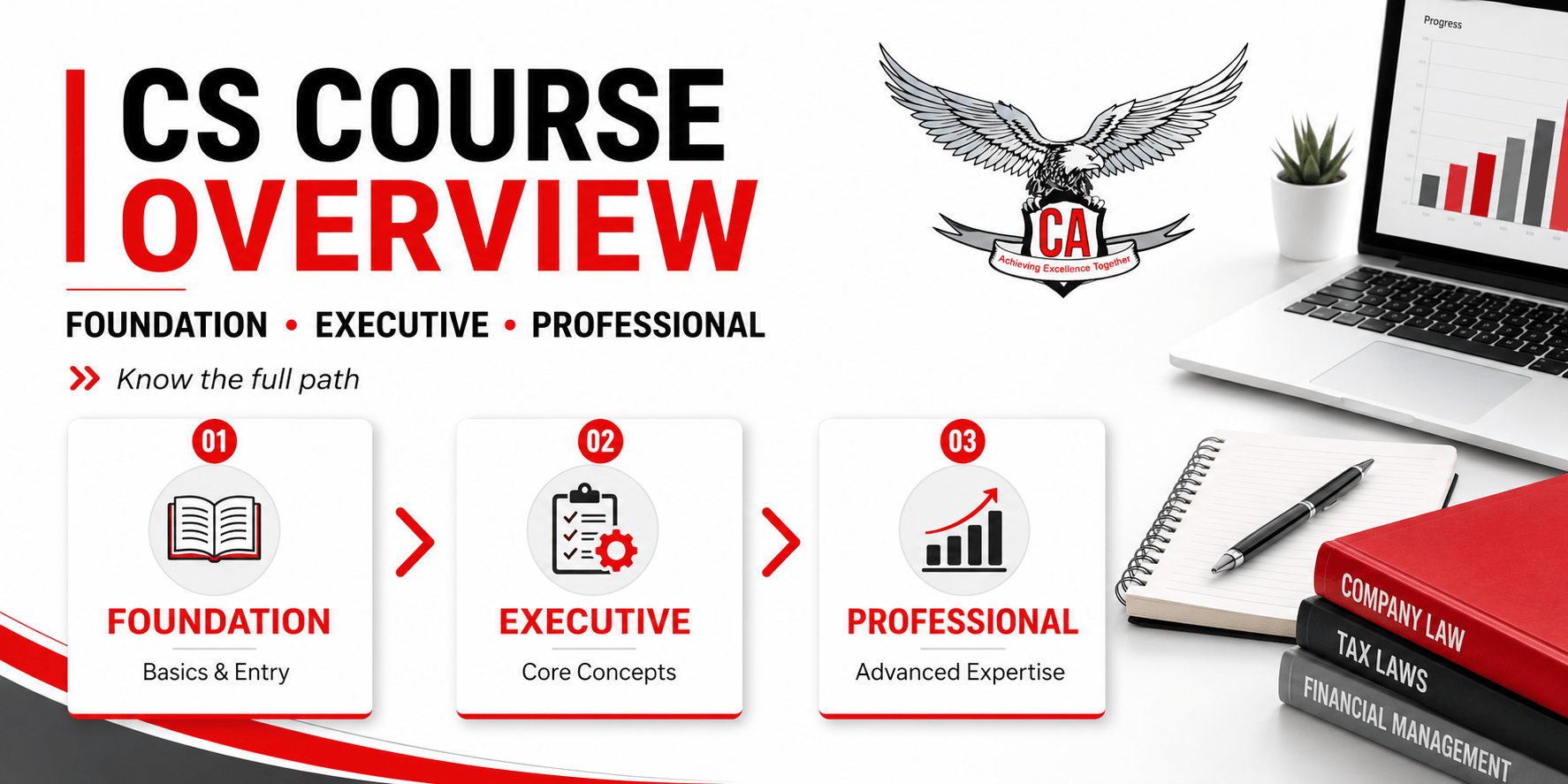
The former CS Foundation Programme is no longer the normal entry route for new students. Candidates joining after Class 12 generally begin with CSEET, while eligible graduates, postgraduates and candidates covered by ICSI’s exemption rules may enter the Executive Programme directly. The current Executive and Professional programmes each contain seven papers divided into two groups.
Course feature | Current details |
| Full form | Company Secretary |
| Conducting body | Institute of Company Secretaries of India |
| Entry stage after Class 12 | CSEET |
| Main professional stages | Executive and Professional |
| Executive papers | Seven papers in two groups |
| Professional papers | Seven papers in two groups |
| Practical training | 21 months under the current training structure |
| Main career areas | Corporate law, governance, compliance, audit and advisory |
What Is the Company Secretary Course?
The CS course prepares students to manage legal compliance, governance systems, board procedures and regulatory responsibilities within organisations. A qualified Company Secretary may prepare board documents, maintain statutory records, monitor regulatory filings, advise directors, support corporate restructuring and coordinate with shareholders, auditors and government authorities. The role is therefore not limited to administrative secretarial work. It is a professional corporate position requiring legal knowledge, ethical judgement and strong communication skills.
CS Foundation vs CSEET
CS Foundation was the previous entry-level programme for students joining after Class 12. It has been replaced by CSEET for new entrants. CSEET should be understood as an entrance examination that enables eligible students to register for the Executive Programme. Students who previously passed the valid CS Foundation examination may follow the applicable transition or Executive registration rules, while new students should prepare according to the current CSEET structure.
Current CS Course Levels and Subjects
ICSI’s restructured CSEET syllabus applies from the June 2026 session. The Executive and Professional programmes follow Syllabus 2022, with updated study materials and amendments issued for individual examination sessions.
Level | Main subjects and focus |
| CSEET | Business Communication, Fundamentals of Accounting, Economic and Business Environment, and Business Laws and Management |
| Executive Group 1 | Jurisprudence, Company Law, Setting Up of Business, Industrial and Labour Laws, Corporate Accounting and Financial Management |
| Executive Group 2 | Capital Market and Securities Laws, Economic, Commercial and Intellectual Property Laws, and Tax Laws and Practice |
| Professional Group 1 | ESG, Drafting, Pleadings and Appearances, Compliance Management, Audit and Due Diligence, plus an elective |
| Professional Group 2 | Strategic Management and Corporate Finance, Corporate Restructuring, Valuation and Insolvency, plus an elective |
CSEET: CSEET is designed to test the foundational communication, accounting, economic, legal and management knowledge required for Executive studies. Students must use the restructured syllabus and current examination instructions rather than older materials prepared for the previous remote-proctored format. Official ICSI study materials and the June 2026 question papers confirm the four-paper structure.
CS Executive Programme: The Executive Programme is the first main professional stage. It develops detailed knowledge of company law, general laws, business establishment, labour regulation, accounting, finance, capital markets, commercial law, intellectual property and taxation. Students may prepare for one group or both groups, subject to the applicable registration and examination conditions.
CS Professional Programme: The Professional Programme is the final examination stage and focuses on advanced application. Students study ESG, drafting, compliance audit, corporate finance, restructuring, valuation and insolvency while choosing electives based on their career interests. Available specialisations include areas such as forensic audit, intellectual property, artificial intelligence law, tax, arbitration, banking and insolvency.
CS Course Eligibility
Students who have passed or are appearing in Class 12 can generally register for CSEET, subject to the current ICSI conditions. Students from commerce, science and humanities backgrounds may pursue the course because a particular Class 12 stream is not normally required. Eligible graduates, postgraduates and candidates holding specified professional qualifications may qualify for direct admission to the Executive Programme. Applicants should verify their eligibility through the latest ICSI registration notice before paying any fees.
Practical Training and Membership
Passing the examinations alone does not automatically make a student a qualified Company Secretary. Under the current training structure, students must complete the applicable orientation and development programmes, including EDP and CLDP, together with 21 months of long-term practical training. Training helps students gain experience in board documentation, statutory filings, corporate drafting, compliance management, secretarial audit and regulatory communication. After completing the examinations and prescribed training, the candidate can apply for ICSI membership.
CS Course Duration and Fees
The total duration depends on the student’s entry route, examination attempts, registration dates and training schedule. A student joining after Class 12 may require approximately three to four years or longer, while an eligible graduate entering Executive directly may finish sooner. These are planning estimates rather than guaranteed completion periods. Course fees include registration, examination enrolment, training programmes and optional preparation expenses. As ICSI may revise fees, students should check the latest official fee schedule instead of relying on outdated figures.
How to Prepare for CS Exams Effectively
Effective CS preparation requires a combination of conceptual study, legal application, answer-writing practice, revision and testing. Students should begin with the latest ICSI syllabus and official study materials, then divide the course into manageable weekly targets. Supplements and amendments applicable to the examination session must also be reviewed because corporate and tax provisions can change.
Preparation stage | Recommended action |
| Syllabus review | Confirm subjects, chapters and applicable amendments |
| Concept building | Study official ICSI materials before reference books |
| Chapter practice | Attempt questions immediately after completing each topic |
| Answer writing | Practise provision, application and conclusion-based answers |
| Previous papers | Solve official question papers under timed conditions |
| Mock examinations | Attempt complete papers before the final revision |
| Performance analysis | Record repeated conceptual and presentation mistakes |
| Final revision | Review provisions, formulas, amendments and weak chapters |
Previous-year papers are useful for understanding question styles, but they should not be used merely to predict repeated questions. ICSI provides official question papers, including papers from the June 2026 session, which students can use for pattern-based practice.
Common Mistakes CS Students Should Avoid
Students should avoid using outdated books, memorising provisions without understanding their application and ignoring amendments. Other common mistakes include postponing descriptive answer practice, studying every subject with the same method, skipping full-syllabus mock tests and spending too much time on individual questions during the examination. Law subjects need interpretation and case application, while accounting, taxation, finance and valuation require repeated numerical practice. A subject-specific strategy is therefore more effective than one general study method.
Career Options After the CS Course
Qualified Company Secretaries can work in corporate employment or establish an independent practice after meeting the applicable professional requirements. Career opportunities are available across listed companies, private businesses, banks, financial institutions, consulting firms, technology companies, startups, manufacturing organisations and public-sector enterprises.
Career role | Main responsibilities |
| Company Secretary | Board support, statutory records, filings and governance |
| Compliance Officer | Regulatory monitoring, policies and compliance reporting |
| Secretarial Auditor | Examination of corporate and secretarial compliance |
| Corporate Governance Professional | Board processes, disclosures and governance frameworks |
| Legal and Compliance Advisor | Corporate law interpretation and documentation |
| Risk Manager | Regulatory risk assessment and internal controls |
| Restructuring Professional | Due diligence, transactions and insolvency support |
| ESG Compliance Professional | Sustainability governance, policies and disclosures |
Salary varies according to experience, employer size, location, industry, responsibilities and specialist knowledge. Independent practitioners do not receive a fixed salary because their earnings depend on clients, services, pricing and operating expenses.
CS vs CA vs CMA
CS is most suitable for students interested in company law, governance, compliance and board procedures. CA focuses more heavily on accounting, audit, taxation and financial reporting, while CMA emphasises cost accounting, budgeting, performance analysis and management decision-making. Students should choose according to their long-term interests rather than selecting a course only because of salary expectations or perceived difficulty.
How CA Test Series Can Support CS Preparation
CA Test Series can help CS students turn theoretical learning into examination-ready performance through chapter-wise tests, full-syllabus mock examinations, exam-pattern questions and answer evaluation. Structured testing helps students identify weak subjects, improve legal answer presentation and develop better time management. Personalised feedback can also reveal whether marks are being lost because of conceptual gaps, incomplete calculations, missing provisions or poorly organised conclusions.
Students should select test papers that match their current CSEET, Executive or Professional syllabus. Regular practice followed by honest performance analysis can make preparation more focused and reduce avoidable mistakes in the final examination.
Conclusion
This CS Course Full Overview explains that the current route includes CSEET, Executive, Professional, practical training and ICSI membership requirements. The course is suitable for students interested in corporate law, governance and compliance, but success requires consistent study, current materials, descriptive answer practice and regular mock examinations. With structured preparation and practical experience, qualified Company Secretaries can pursue careers across corporate governance, compliance, audit, legal advisory, restructuring and independent professional practice.